






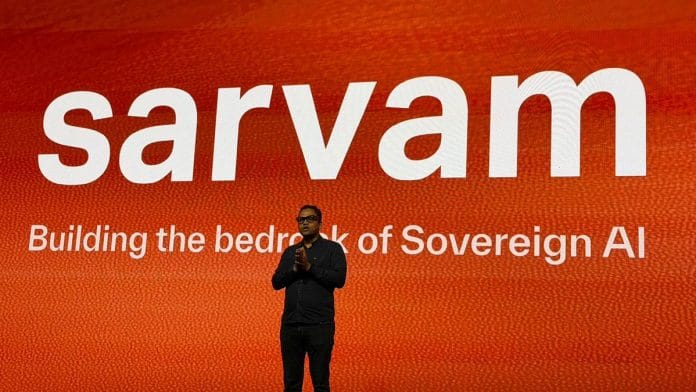

On Friday, June 12, 2026, at 5:21 pm Eastern Time, Anthropic received a letter from the US Commerce Department ordering it to block foreign nationals from Claude Fable 5 and Mythos 5 — the most capable AI models commercially available anywhere in the world. By the end of the day, the models were disabled for all customers. No warning. No transition period. A switch was flipped in Washington, and the frontier went dark for the rest of the world, India included.
Within hours, the response was predictable. Across LinkedIn, X, and television panels, a familiar argument resurfaced with fresh urgency: this is exactly why India needs sovereign AI. This is why we funded the IndiaAI Mission. This is why Sarvam matters.
They are not wrong. But the harder question is missing in action — and it has been for too long.
Let me first be clear that this piece is not arguing against ChatGPT, Claude, or Llama. These are extraordinary tools and Indian enterprises are right to use them. Productivity is productivity. Competitive advantage is competitive advantage. No serious person should ask TCS to handicap its workforce or Reliance to slow its digital operations in the name of national sentiment.
The question is what comes alongside those decisions.
Tata Group announced one of the largest ChatGPT Enterprise deployments in the world. Reliance has a $100 million joint venture with Meta built on Llama. Both companies were on stage at the AI Impact Summit. Both cited Viksit Bharat. Both know what sovereign AI means and what it requires.
So the specific question — one that has been postponed long enough — is this: what is Tata’s commitment to Sarvam? What is Reliance’s? Not a pilot. Not a case study on a website. A production deployment, a budget line, a business unit whose success depends on Sarvam working at scale.
Because Sarvam cannot survive on government procurement alone. It was never designed to. Its entire strategic logic depends on Indian private enterprise choosing — deliberately, commercially, not charitably — to build on it. Without that, sovereign AI is not a capability. It is a monument.
And monuments, when a letter arrives from Washington, offer no protection at all.
Also Read: AI bubble vs digital colonisation—Inside the Malhotra-Pai Anthropic feud
India’s building vs adoption quandary
This is not the first time India has been here.
For three decades, India has built supply and watched absorption fail. The ITIs trained welders, electricians, and machinists by the hundreds of thousands. The National Skill Development Corporation certified millions. Skilling missions announced targets, hit numbers on paper. Yet, employers were left largely unmoved. Not because the training was worthless, but because corporate India never built the hiring pipelines, role redesigns, or internal systems needed to absorb what the state was producing. The supply existed. The demand was announced. The gap between them is where the ambition quietly died.
Manufacturing told the same story. The Production Linked Incentive schemes created capacity. Sectoral missions created frameworks. But transformation inside firms — retooled factories, redesigned supply chains, and genuine integration into global value systems — remained uneven and dependent on individual corporate will rather than institutional commitment.
The pattern is visible across sectors and over time. India succeeds when adoption is built into systems and institutions — where the state mandates, the platform centralises, and the user has no choice but to participate. UPI worked because every bank had to connect. Aadhaar worked because every beneficiary had to enroll. GST worked because every business had to comply. These are genuine achievements and India is right to be proud of them.
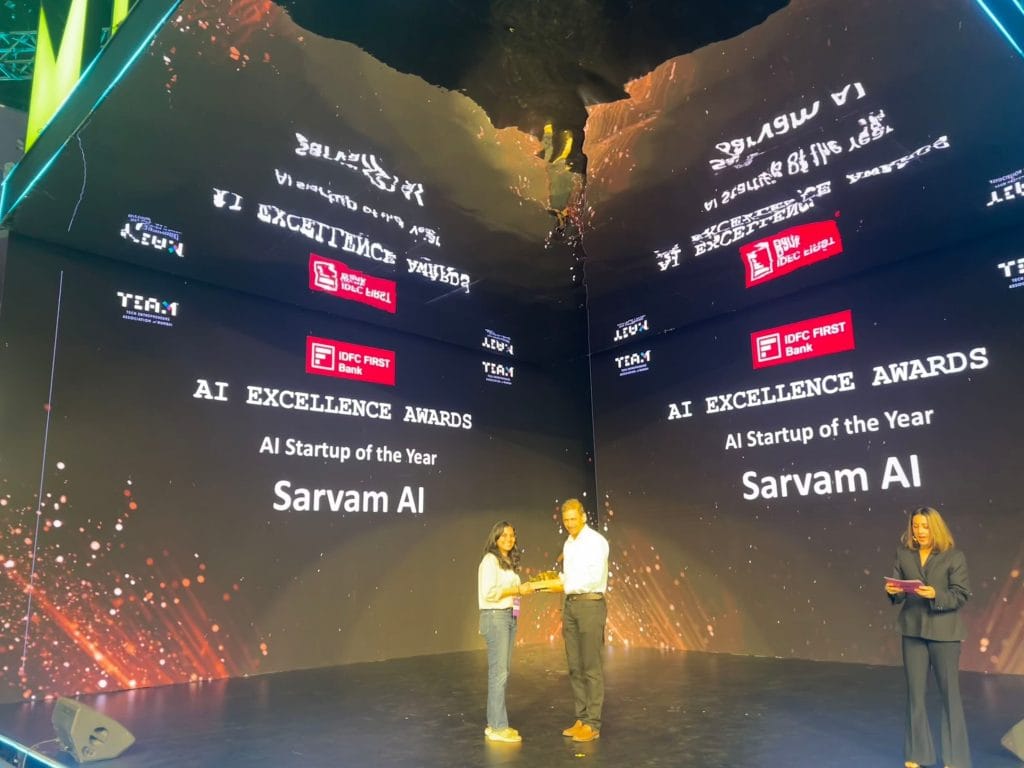
But Sarvam is not UPI. AI is not a payment rail — it does not work by connection alone. It works by use, by iteration, by the accumulated feedback of real problems run through it at scale. Nobody has to use it. And without use, there is no improvement, no trust, and no ecosystem.
It sits entirely in the market-driven category, where adoption depends on voluntary institutional behaviour, internal budget decisions, and a private sector willingness to invest in something that does not yet have the convenience or global credibility of its American competitors.
That willingness has historically been India’s weakest institutional muscle. The letter from Washington last week just made that weakness impossible to ignore.
Consider what China did when it decided sovereign AI mattered. It paired model-building with adoption. Beijing set a target of 70 per cent adoption of intelligent devices and AI agents across research, industry, and consumer markets by 2027. This was no mere aspiration but a measurable national objective backed by policy targets, regulatory frameworks, and direct state coordination between technology companies and enterprise buyers.
More than thirty Chinese manufacturers — from Lenovo and Huawei to Inspur — pushed DeepSeek-powered AI servers into private and public enterprises across the country simultaneously, creating a distribution and adoption infrastructure that no individual company could have built alone.
So rather than a model sitting on a government server waiting for voluntary adoption, there is a functional system — even if it’s state-directed and carrying its own costs — where creation and absorption move together instead of in separate steps.
India is not China. It should not be China. The state-directed model carries authoritarian costs that no democratic society should replicate. But the question the China comparison forces is an uncomfortable one: if India will not compel adoption the way China does, what is the alternative mechanism? What replaces the mandate? What creates the absorption that the market, left to itself, has historically not delivered?
The answer has to be voluntary private sector commitment, at a scale and specificity that India’s largest enterprises have not yet demonstrated. That is where Sarvam’s problem begins, and it is a structural one.
Sarvam’s impossible juggling act
Sarvam is simultaneously playing three different games, and the rules of each one contradict the others.
The first game is frontier research — building foundation models competitive with global leaders on technical benchmarks. Sarvam’s latest models have reportedly outperformed Google Gemini and OpenAI’s ChatGPT on India-specific benchmarks, a genuine technical achievement that required serious scientific investment and institutional commitment.
The second game is sovereign infrastructure — serving as the AI layer that India’s government and public institutions depend on for population-scale deployment. This is the UPI analogy: Sarvam as rails, not application. It requires reliability, security, and deep integration with government systems above all else.
The third game is commercial startup — generating revenue, demonstrating market viability, and building the private sector adoption that government funding alone cannot sustain. This requires competitive pricing, developer experience, documentation, enterprise sales, and the kind of iterative product responsiveness that only market pressure produces.
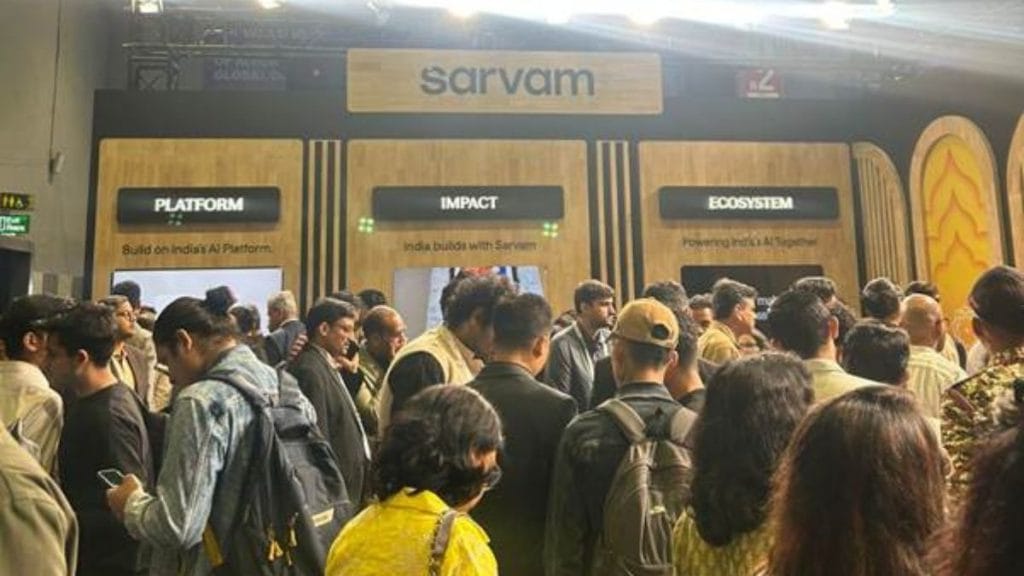
Each of these three games is winnable. But no single organisation has won all three simultaneously. OpenAI is a frontier research institution and a commercial startup — it is not sovereign infrastructure for any country. Aadhaar was sovereign infrastructure — it was never a commercial startup. The IITs are research institutions — they are not in the market.
Sarvam is being asked to be all three at once, with limited capital, in a market where its most natural enterprise customers — Tata, Reliance, Infosys, HDFC — have already placed their primary AI bets elsewhere.
That is not a criticism of Sarvam’s ambition or execution. It is a description of the institutional trap it has been placed in. And the trap was not set by Sarvam but by an ecosystem that celebrated the creation of a sovereign model without designing the conditions for its absorption.
The question India needs to ask urgently is which of these three games Sarvam is primarily playing, who is responsible for ensuring it wins that game, and what the private sector’s role is in making that possible.
Four tests for Indian enterprises
So what does private sector seriousness about sovereign AI actually look like? Not in principle but in practice, with specificity. There are four tests worth applying.
The first test is production, as opposed to pilots. Every large Indian enterprise has run AI pilots. Pilots are how organisations learn without committing. That is rational and appropriate. But Sarvam is now two years old. The sovereign LLM has been selected, funded, and delivered. The question for Tata, Reliance, Birla, Infosys, HDFC, and every other enterprise that has stood on a stage and endorsed India’s AI ambitions is simple: what are you running on Sarvam in production today? Not evaluating. Not experimenting. Running — with real users, real workflows, and real consequences if it fails.
The second test is budget. Endorsing sovereign AI costs nothing. Budgeting for it costs something. The meaningful signal is whether Indian enterprises have allocated a specific, identifiable budget line for Sarvam integration — separate from their broader AI spend, which is largely flowing to American providers. TCS is deploying ChatGPT Enterprise at scale. That is a budget decision. Reliance’s Llama joint venture with Meta is a budget decision. The question is not whether those decisions were right — they probably were, on their own terms. The question is whether an equivalent budget decision exists for Sarvam, and if not, why not.
The third test is individual ownership versus consignment to a committee. Many initiatives in large Indian enterprises die when they are assigned to a committee and sentenced to a purgatory of quarterly reviews. What really drives adoption, instead, is giving ownership to a senior executive whose career depends on succeeding. The test for each enterprise is whether there is a named individual, at a consequential level of seniority, whose job description includes making Sarvam work inside that organisation. One person, one point of accountability. An AI task force or a Centre of Excellence with twelve members and a shared inbox won’t cut it.
The fourth test is a public commitment with a timeline. India’s private sector is comfortable making public commitments on sustainability, diversity, and skilling — areas where measurement is difficult and accountability is diffuse. AI sovereignty is more concrete. It is measurable. Which means the ask is proportionally specific: by when, and at what scale, will your organisation be running production systems on India’s sovereign AI infrastructure? That question deserves a public answer from every enterprise that has publicly endorsed Viksit Bharat.
None of these tests require Indian enterprises to compromise their competitiveness or abandon tools that work. They require something more modest and more demanding at the same time: clarity about what their stated commitment to sovereignty actually means in practice, expressed in the language that boardrooms understand best. Numbers. Owners. Timelines.
India’s missing pioneers
India’s imagination is too often limited by the big few. The conversation about sovereign AI, like most conversations about national ambition, has narrowed around a familiar cast. Nilekani’s name is invoked. Ambani’s moves are tracked. Adani’s infrastructure bets are analysed. A handful of industry leaders, considerable as their virtues may be, have become proxies for a country of 1.4 billion people.
We are short of the conditions that would allow the next Nilekani to rise. We lack early customers, pioneering deployments, and institutional signals that tell an entrepreneur in Surat, an engineer in Coimbatore, or a startup founder in Hyderabad that the market is real, that the ecosystem is serious. And that building on Sarvam is a viable commercial decision rather than an act of patriotic faith.
Because that is what pioneering customers do. They do not just buy a product. They make a market legible. When a large, credible institution makes a serious, public commitment to build on a nascent platform, it sends a signal that cascades through the entire ecosystem — to investors, to developers, to mid-market enterprises, to the thousands of smaller builders who are watching to see whether the ground is solid before they step on it.
Right now, those builders are watching. And what they are seeing is a sovereign model celebrated by the state, endorsed by the famous, and adopted in production by almost nobody they can point to.
That is how passionate entrepreneurs are left hanging: not by malice or conspiracy, but by the accumulated weight of large institutions making rational individual decisions that collectively produce an irrational national outcome — a sovereign capability that nobody is pioneering, and therefore nobody is following.
Viksit Bharat will not be built by the government alone. Every serious person knows this, and almost nobody says it plainly enough. The mission, funding, and policy frameworks matter, but 2047 is not a government project delivered to citizens. It is a national project built by citizens — by entrepreneurs who see a market, by enterprises that take a risk, by institutions that choose to pioneer rather than wait.
The public sector can build Sarvam, but it cannot absorb it. That work belongs to India’s private sector in its entirety, not just the conglomerates with Davos invitations: the Patels and Reddys and Raos and Singhs and Patils and Guptas and Kumars who built this economy from the ground up and who have more at stake in its AI future than any ministerial speech has yet acknowledged.
They are waiting for a signal.
Also Read: India’s AI report card: Global media lays out pitfalls of no sovereign model, but also some pros
The moment of truth has come
Every generation in India has faced some version of the same question: do we have the will to build the systems that match our aspirations, or will we remain a country that is extraordinary at announcing and inconsistent at executing?
Sarvam is now that question made concrete. It is a test of India’s AI ambitions. A technically serious, government-selected, genuinely capable sovereign model that will succeed or fail not in a laboratory or a parliamentary committee, but in the procurement decisions, budget allocations, and production deployments of India’s largest private enterprises.
It is perfectly rational for Tata to have chosen OpenAI, or for Reliance to have tied up with Meta AI. But if the story ends there, so do the prospects of sovereign AI. The path forward is not to undo those choices, but to make an additional one. A deliberate commercial, and sustained effort to build on indigenous AI. A sovereign capability nobody uses is not sovereignty. It is a monument to intention. India has enough monuments.
What Sarvam needs — what India needs — is not another AI Impact Summit or ministerial endorsement. It needs enterprises to decide whether they are willing to invest in sovereign AI, and to do so now. That decision rests with the Chief Digital Officer of TCS, the CTO of HDFC, the technology leadership of Reliance, Birla, Infosys, Wipro.
Because the switch that was flipped in Washington last Friday can be flipped again.
The only foolproof protection against that is an Indian AI ecosystem so deeply embedded in Indian enterprise operations that no external switch can reach it.
While that ecosystem begins with Sarvam, it cannot end there. And the people who decide whether it grows beyond Sarvam are not in South Block, but in the boardrooms that have so far been loudest in their endorsement and quietest in their commitment.
The Friday letter gave them a reason to act without further delay.
Vasu Eda is the author of Get Job Ready (Penguin Random House). He is working on a forthcoming book, Innovation and the Future of India. He is on X @VasuEda. Views are personal.
(Edited by Asavari Singh)
There is a saying in Hindi: “Laton ke bhut bato se nahi mante,” which basically means that there are people who work only when kicked; they don’t listen to advice. That is the situation currently in the Indian private sector. They don’t listen to something unless there is a clear punishment for not doing it and the punishment is implemented. If it can be circumvented, they will circumvent because there is severe inertia in the system, which just takes up what is apparently the best for them and they will not look beyond their nose.
The government needs to impose certain specific conditions. Those not using the Indian platform will have to pay a penalty and a severe penalty at that. It could be graded into percentages, small percentages to large percentages. That is the only way the private sector can be made to work.
Government should use a PSU or a new private company to build products using Sarvam that enterprises can use to improve productivity and profitability and re-invigorate the economy, just like the original PSUs did in the early days. Then use great salespeople to sell.
Indian IT is just focused on labor arbitrage. Established companies won’t be able to do it.
Sarvam needs good sales people who believe in the product, not just engineers and investors. Big tech companies have thousands of salespeople.