






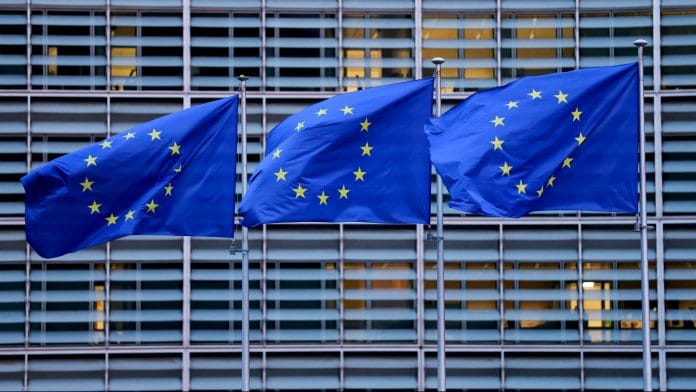



Europe is apparently waking up to its new place in the world. Disdained, insulted and bullied by its former American protector, its leaders are asking where they go from here. Is their future one of accelerating decline — a new “age of humiliation,” as my colleague Adrian Wooldridge argues? Or might recent events spur a radical and long-overdue reset?
That prompts another question: What exactly would a successful reset require?
For the next several years, the European Union has to contend with President Donald Trump. But the longer-term challenge is no less demanding. To cope not only with this administration but also its legacy — most likely a lasting shift in the global order — the EU will have to reexamine its very purpose, with profound implications for current, prospective and once-and-future members alike.
The immediate task of coping with Trump is generally cast as choosing between appeasement and retaliation. According to this framing, there’s been too much bowing down and not enough fighting back. The idea that Europe must adopt one or the other of these postures seems plausible. In this case, however, it’s mistaken.
The strategies of appeasing and confronting rest on the same misconception — namely, that the goal is to moderate Trump’s behavior. Neither is likely to do that. Appeasement fails because Trump is never satisfied and sees no agreement as binding. Retaliation also fails, because the US has escalation dominance, as it’s called. Both sides will lose if economic hostilities worsen — but Europe has more to lose than the US, and, at least in the short term, Trump cares less about US losses than the EU’s leaders care about harm to Europe. (If that second point weren’t true, the president wouldn’t have imposed the “Liberation Day” tariffs in the first place.)
So Europe can’t reliably sway Trump one way or the other. True, investors in the US have a veto of sorts, reluctant as they are to exercise it. When Trump threatened new tariffs to press his demands to acquire Greenland, and Europe’s stunned leaders said “No,” the stock market dropped, and the White House backed off — somewhat, for now. But this result doesn’t much strengthen the case for “confront to moderate.” Europe would be crazy to adopt the threat of financial breakdown as an instrument of economic retaliation. Again, escalation dominance: The risks to its own well-being are too big.
The right choice isn’t to kneel or fight back, but to disengage — quietly and courteously.
On tariffs, I commend to Europe’s leaders the classical case for unilateral free trade. There’s no need to meet US protectionism with EU protectionism. Let the US impose tariffs as it sees fit, while keeping Europe’s markets open to the US. That will minimize the damage to Europe. There’d be two other incidental benefits: It would put the blame for harm (to the US and everybody else) more squarely on Washington, where it belongs; and it would diminish Trump’s coveted role as disruptor-in-chief of global economic policy.
On security, Europe can ill afford the collapse of NATO — not least because Trump’s complaints about Europe failing to pay its way on defense are justified. US treaty commitments aren’t worth what they were, but they aren’t yet worthless, and in the short term, Europe must strive to avoid a breakdown of the alliance.
Again, this caution needn’t mean submission. For example, offer higher spending on Greenland’s security (which serves Europe’s interests as much as America’s); just say the island’s not for sale and decline to discuss that any further. Meantime, urgently scale up defense spending and production to lessen dependence on the US. Emphasize eagerness to cooperate with the US and sadness that Washington has turned so decisively against the idea. Don’t cave — but don’t provoke or antagonize. There’s no need to mock or deplore the Board of Peace, for instance; just politely decline to join it.
Getting this balance right will be difficult. Canadian Prime Minister Mark Carney’s much-praised speech at Davos illustrates the problem. He rightly emphasized that “middle powers” will need to cooperate more closely as the US recasts its role. But his rhetoric was confrontational — partly, no doubt, for domestic political reasons. Canadians are disgusted by the Trump administration and want their leaders to assert themselves, which Carney did. The US then responded to a new trade deal Carney struck with China by threatening 100% tariffs on Canada’s exports to the US. The prime minister had to explain that the new agreement was very limited, and consistent with the US-Mexico-Canada trade agreement. Bottom line: So long as the administration is willing to keep escalating — and America’s courts, Congress and financial markets are content to go along — Canada has a losing hand.
You’d think the European Union — a far bigger economy than Canada and much less dependent on trade with the US — would have better options. Yet even now, Europe tellingly sees itself as a collection of middle or lesser powers and not as a major power in its own right.
Given its population, the scale of its economy and its preoccupation with “ever closer union,” Europe’s lack of geopolitical ambition is puzzling. America’s post-1945 security guarantee goes a long way to explain it. Shielded by US power, the EU could afford to become preoccupied with internal “harmonization” — a petty bureaucrat’s dream of what “union” should mean — while ignoring the challenge of forming collective strategic goals and the hard power needed to advance them.
Could Trump’s “rupture” of the global order, as Carney correctly calls it, force a reset — and, if so, might Europe’s next age conceivably be one of renewal, not humiliation? Any such agenda would demand three radical innovations.
First, Europe would need to prioritize collective security. This is not just a matter of spending much more on defense. It also requires, within NATO, an explicit new European alliance for mutual protection. Importantly, this pact shouldn’t be confined to the European Union: The UK’s full participation, and others’ besides, is essential. Decisions on military resourcing and procurement would need to be tightly integrated. In effect, Europe’s militaries would need to be not just stronger but also, to a large extent, merged.
Second, the EU would have to correct a decades-long litany of economic policy errors. The blueprint for this has already been painstakingly set out in the Draghi Report of 2024. This documents in depressing detail the regulatory excesses that have throttled European innovation; the failure to fully integrate the internal market (despite, and in some ways because of, the obsession with “harmonization”); the mismanaged transition to cleaner energy; the lack of a single capital market; the lack of a common fiscal policy; and the lack of a genuinely European “foreign economic policy” attuned to supply-chain resilience.
Third, and most difficult, the EU requires a cultural realignment — toward, as the saying goes, “as much union as necessary, as little union as possible.” In the new world order that Trump threatens to leave behind, a union more focused on collective security is essential. But this won’t be achieved by sweeping aside the sovereignty and national identity to which citizens seem increasingly attached, in the merely performative pursuit of “ever closer union.” In short, for Europe’s sake, the Brussels mindset has to go.
So what are the chances of any such reinvention? Slim, no doubt, for all the reasons that Wooldridge explains in his article. But maybe not zero. Trump’s rupture forces change, one way or another. Neither the midterms nor the elections in 2028 will make things as they were. For Europe, slow but steady underperformance may no longer be an option: Its choices are abject failure or renewal. Without question, Europe has come to a pivotal moment.
Disclaimer: This report is auto generated from the Bloomberg news service. ThePrint holds no responsibility for its content.
Also read: PM Modi has a shot at history-making with EU’s India visit