




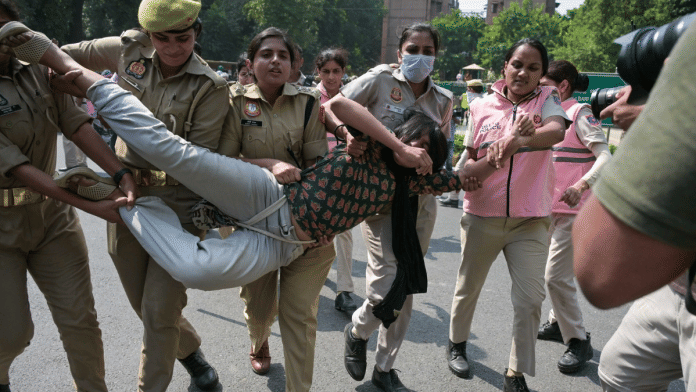

As thousands of young Indians protested on the streets of Delhi and on social media under the banner of “cockroaches”, my team and I visited Industrial Training Institutes, district employment centres and libraries in my constituency of Sivaganga, Tamil Nadu.
The visits convinced me that the protests are not an isolated outburst. They are the cascading result of overlapping failures facing Indian youth, and they show what happens when aspiration becomes as powerful an organising force in our politics as identity.
The questions we must confront
Religion, caste and language have long organised Indian politics. But ask a young citizen today and they will know about the student protests at Jantar Mantar in the national capital. This is a sign of a generation beginning to unite behind causes that cut across identity.
Examination integrity is one such cause. The NEET-UG paper leak brought the problem into sharp focus, but it was hardly an exception. In 2024, a parliamentary committee noted that five of 14 major examinations conducted by the National Testing Agency (NTA), an autonomous body under the Ministry of Education, had faced serious problems. When the Public Examinations (Prevention of Unfair Means) Act was first tabled that year, The Indian Express reported that paper leaks in 15 states over the course of five years had affected 1.4 crore applicants competing for 1.04 lakh posts, which roughly translated to 135 candidates per vacancy.
The student protests have arguably compelled the BJP-led government to initiate ‘reforms’. The Public Examinations (Prevention of Unfair Means) Bill, 2026, introduced in the Monsoon Session, focuses largely on the aftermath of a leak: heavier penalties, longer prison terms and fast-track courts. However, it did not address the discontent related to the functioning of NTA, which was established in 2017 as a self-sustained ‘premier testing organisation’. It has been criticised for having few permanent positions, relying on deputed and contractual staff, and outsourcing critical functions, factors that have impacted the future of crores of students. Additionally, fast-track courts are not the cure. Parliamentary data shows that the existing Fast Track Special Courts dealing with POCSO and sexual-offence cases have more than two lakh cases pending.
Also read: Where is Skill India money going? It’s a Rs 48,000 crore mystery
Degrees without jobs
Employment and education, two of the biggest pressure points in Indian society, are now being debated in public. According to Azim Premji University’s State of Working India Report 2026, 40 per cent of graduates aged 15 to 25 and 20 per cent of those aged 25 to 29 are unemployed. NITI Aayog has reported 8.7 crore young Indians aged 15 to 29 are not in education, employment or training (NEET).
What my team saw at government ITIs in Sivaganga helps explain why. According to reports, the number of ITIs has grown by nearly 300 per cent, driven largely by private providers, even as quality has declined. We observed that students were enrolled and the curriculum was being covered, but it was hard to tell what employable skills they had acquired. Women trainees in a Computer Operator class took notes in English but could neither explain what they had written nor follow questions asked in the language. Industry representatives at the District Industries Centre highlighted the same problem: a gap between enrolment and employability.
Who, then, is reaping the benefits of India becoming one of the world’s largest economies, if not its youth?
What we talk about instead
All this is unfolding as Parliament faces an institutional crisis. During the Monsoon Session Question Hour functioned for just 1 per cent of its scheduled time in the Lok Sabha, while a majority of bills were passed without members participating in the discussion.
When we look at the conversations that have occupied so much media and political attention, one cannot help but wonder whether we have our priorities right. How many stanzas of the national song should we sing: two or six? What colour should the national sporting jersey be, blue or orange? And, increasingly, what labels should we use for those who disagree with us and ask questions of us — “tukde-tukde gang”, “Khan Market Gang”, “Urban Naxals” or, more recently, “dimaagi naxal”?
Also read: No one should have to choose between a roof and two meals. But India’s migrants do, every day
Outcomes, not outlays
We must look beneath the headline figures. The real test of progress lies not in the size of the whole but in the quality of life within it. That means quality jobs and skills that equip young people with industry-relevant capabilities, rather than just an empty certificate. Two schemes show how far we are from this.
The first is the government’s flagship skilling scheme, the Pradhan Mantri Kaushal Vikas Yojana (PMKVY). A 2025 CAG report found design flaws, including the absence of a systematic analysis of market demand for specific job roles to guide training. The second is the Prime Minister’s Internship Scheme (PMIS). According to a parliamentary committee, across the first two pilot rounds of the scheme, 3 lakh candidates were shortlisted and companies made 1.3 lakh offers. Of these, 52,782 offers were accepted, and just 16,060 interns ultimately joined the programme. Surprisingly, Round I recorded a dropout rate of 53.6 per cent.
This calls for a shift in focus from the scale of announcements, such as the recent pledge to train 1 crore young people in AI skills in one year, to the rigour of evaluation. It means moving away from outlay-driven governance towards outcome-driven governance. We must ask: what have the government’s flagship skilling and employment schemes actually achieved, given the Rs 48,000 crore spent on them over the years?
Youth protests have tried to force the establishment to confront these realities. The first step is to acknowledge where the system has fallen short. That is not a narrative of perpetual failure, but neither should the narrative be one of perpetual triumph. India needs an honest assessment of where it stands today, with less emphasis on grand promises and greater focus on setting clear, realistic and achievable goals.
Karti P Chidambaram is a Member of Parliament for Sivaganga, and a Member of the All India Congress Committee. His X handle is @KartiPC. Views are personal.
(Edited by Prashant Dixit)
ITIs and local skill training are run directly by the state government. Instead of calling out local management, outdated courses, or the state’s own failure, this piece passes the buck upward to national schemes and central exams.
Another politician born into power walks into a couple of ITIs in Tamil Nadu, performs shock acts over youth frustration, and drops media soundbites about his party wanting a piece of government to stay relevant. His own party is sitting in power with the ruling state alliance right now.
Complaining about local failures while protecting the state government you help run…and blaming everything on Delh is a complete political farce.