






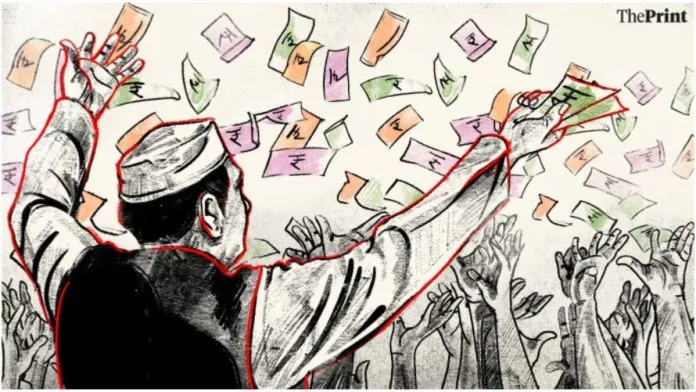


Every major Indian state is now running the same political playbook. Congress in Karnataka, BJP in Madhya Pradesh, DMK and now TVK in Tamil Nadu, and AAP in Punjab have converged on one model: cash transfers to women, free electricity, and loan waivers. PRS Legislative Research counts 12 states spending Rs 1.68 lakh crore on cash transfers to women in 2025-26. The ideologies differ but the schemes do not.
Something structural is turning governments of every stripe into machines for transferring money to voters. The paradox is that the accelerator of this politics is also India’s most admired achievement: the digital public infrastructure. While DPI did not create India’s transfer politics, it has made it cheaper, faster, targeted and more politically creditable than reform.
Over the past decade India built remarkable state capacity: a universal digital identity in Aadhaar, near-universal bank accounts under Jan Dhan, and the payments rails connecting them. The cornerstone is the Direct Benefit Transfer (DBT) architecture, which lets the state pay any citizen directly, instantly, and with far less leakage than the old machinery ever managed. The World Bank told the G20 that India reached eighty per cent financial inclusion in six years, a journey that would otherwise have taken nearly five decades. All of this is true and none of it is in dispute. What has gone undiscussed is what the same infrastructure did to the incentives of the politicians who use it.
Before this infrastructure existed, rewarding voters with money was costly and imprecise. A party first had to know who its beneficiaries were, and that knowledge lived only inside an organisation: the party worker with the ground connect who knew which households belonged to which community, and which could be swung. Transfer politics is not new, and Tamil Nadu was feeding schoolchildren decades before anyone had heard of DPI. But the old machine was blunt, leaky and slow, and it selected for parties that had spent a generation building cadre and roots.
Also read: This is how cash transfers are being discussed by global
Why cash now beats reform
DPI dissolved both problems at once. The state’s databases identify the beneficiary, the payments system reaches beneficiaries, and a scheme announced in a budget speech is running within months. The marginal cost of one more transfer has collapsed toward zero while its political return has not, because each rupee arrives in an identifiable voter’s account, traceable and creditable to the leader who sent it.
This is a politics of credit, and it is why distribution now beats reform every time. A cash transfer is designed, announced and paid within a budget year, and the beneficiary knows exactly whom to thank. A road takes five years, depends on contractors, land and clearances, serves everyone and so indebts no one, and may be opened by whoever holds office when it is done. One kind of spending earns gratitude that is immediate, targeted and certain, the other gratitude that is delayed, diffuse and easily stolen by a rival. Faced with that choice, every rational chief minister spends on transfers rather than the slow, thankless work of building things.
No surprise, then, that political competition has moved to identification itself. Once paying is trivial, the advantage passes to whoever can slice the electorate most finely. It is why a caste census, long demanded by the opposition and long resisted by the government, is suddenly something every party supports. Its merits as social justice are valid, but it will also be the most powerful instrument of identification yet, the map that tells every party precisely which group to target with precisely which scheme.
But what of development? The Reserve Bank of India has warned, in unusually direct language, that transfer spending is crowding out what states need for infrastructure. That would matter less if the remaining reforms were the centre’s to deliver, but they are not. The centre has tariffs to lower, factor markets to free and banks to fix, and its own Economic Survey now pleads with governments to get out of the way.
Also read: Cash transfers to women a new dimension in electoral politics. It yields better outcomes
The reforms only states can deliver
But the states hold far more of what remains undone, and their record is bleak. The last time an Indian state genuinely remade its economy was the early 2000s, when Narendra Modi made Gujarat an industrial state, SM Krishna turned Bengaluru into the country’s technology capital, and Chandrababu Naidu rebuilt Hyderabad around services. The reform impulse in the state capitals was fading before DBT arrived, but DBT has removed the last reason for reforms to return.
The electricity distribution companies every state owns are effectively bankrupt, kept alive by central bailouts, too frightened of voters to price power properly and starving industry of reliable supply. The cities, governed by state law, cap their own height through floor-space rules so restrictive that Mumbai and Bengaluru sprawl into traffic and unaffordable housing rather than building upward like every dense Asian city. Agricultural marketing remains caged in the state-regulated mandi, and where its grip was loosened it is being tightened again, as in Karnataka, which moved in to reinstate the penalties for selling outside the mandi that it had removed earlier, a rollback halted only by the opposition’s numbers in the upper house. Each of these is a state subject. Each would lift growth if fixed. And none of them produces a cheque with a chief minister’s name on it.
When distribution was hard, the system rewarded leaders who could build an organisation and run something, so it produced them. Now that distribution is effortless, the surest qualification is the ability to name a beneficiary class and announce a scheme. Tamil Nadu has just elected an actor who had never held office previously, on a platform built around transfers. That is not an aberration but the logical end of a market in which a record of governing counts for less than a credible promise to pay. Each new leader must outbid the last, the room for anything harder shrinks, a race to the bottom of the state exchequer.
India can no longer outrun its states
This would be easier to bear if India could keep growing as it has. For two decades it partly outran its weak states, because the growth that mattered came from sectors insulated from them, above all software exports. That cushion is thinning, as artificial intelligence erodes the labour-arbitrage model on which the boom rested. Investors already treat AI less as an opportunity for Indian IT than as pricing pressure and slower hiring. The next phase of growth will have to be built at home, in the power and the land and the cities and the farms that only the states control. India can no longer grow faster than its states are willing to reform.
The way out is not to dismantle the machine but to build capacity beside it, because India’s states are run by a remarkably thin layer of people. A newly elected American president appoints some four thousand officials, a whole stratum of fresh talent. An Indian chief minister inherits a permanent bureaucracy and appoints almost no one. There is no lateral door for an economist, an urban planner or a power engineer, and so no one inside a state government is paid to imagine reform rather than administer the next transfer. India built a machine that could finally deliver welfare without theft, and it works exactly as designed. What nobody designed was the politics it left behind. Until the states answer for that, the cheques will keep arriving. The reforms will not.
Kishen Shastry is an economist at the University of Cambridge. He tweets @kskishen. Views are personal.
(Edited by Prashant Dixit)