



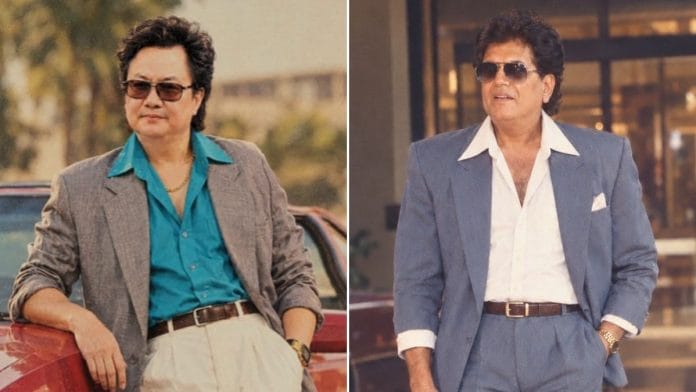

The latest internet trend is set almost 40 years in the past, with generative AI making time travel possible. Creators and teenagers on Instagram are asking AI to imagine them in a decade they never actually lived through. The results are predictably nostalgic: sepia tones, aviators, feathered hair, suspiciously younger features and enough grain to make a Doordarshan rerun jealous.
Now politicians are joining in. And it’s a strange situation of AI-generated 80s photos being posted by relics who were, in fact, physically present for the 80s.
The trend itself is simple enough. You upload a photo, ask ChatGPT or Gemini to run it through an 80s filter, and get back the predictable portrait.
This week’s Viral Spiral is politicians getting an AI-assisted trip down memory lane.
Piyush Goyal was among the first political names, posting a portrait of himself in an oversized grey suit and aviators with the caption “vibing to the 80s trend.” Kiren Rijiju followed with an AI image of himself beside a car, writing, “Why is everyone going back to the 80s vibes? I’m also forced to 80s nostalgia!”
“Forced” being the operative word, since nobody actually forced him to do anything except an algorithm and, presumably, a very persuasive social media team.
‘Obsession to woo Gen Z is funny’
The reception was fairly mixed.
Some found the photos charming, which is an interesting choice. I am absolutely judging you. Others pointed out that maybe this wasn’t the moment.
“In a country drowning in poverty, unemployment, and a severe shortage of skilled people… you still find the time and audacity for posts like this?” one user commented.
Others just found the desperation funny on its own terms.
“You and your obsession to woo Gen Z is so funny,” another user wrote.
Every Political party’s Gen-Z outreach has given us endless gags. It is like a car crash you can’t look away from, with oldies using slang they barely understand.
Assam Chief Minister Himanta Biswa Sarma joined too, stating outright, “Getting to any trend which has nostalgia attached to it. Back to the 80s eh!”
The comments provided a reality check in the form of an actual photograph of him from the actual 1980s, looking drowsy – or high – captioned, “Dude, isn’t this real you from the 80s?”
Politicians jumping on internet trends is essentially a part of their gig now. Kind of like a relatability tax paid in content instead of policy. What is upsetting is how little effort the tax requires. They could have at least tried a trend or mangled some slang to prove they were trying. Now it’s just one selfie upload, a wait of 90 seconds, and the algorithm hands you a fictional version of a decade you already lived through, no memory required.
Also read: Delhi Metro has a new reel trend. Everyone thinks influencers are losing their phones
Same old AI portraits
Not everyone participated, though.
Shashi Tharoor, never one to participate in anything the ordinary way, skipped the AI version entirely and posted an actual photograph from the 1980s, writing, “I thought I’d join the trend the old-fashioned way.”
Renuka Chaudhary went further, posting a photo of an actual magazine cover with her on it, captioned, “Everyone’s asking ChatGPT what they would’ve looked like in the ’80s. Me? I’ve got receipts. No AI needed. This is actually me in the ’80s.”
The two politicians stood out with authenticity, which might be the most understated savage move available to anyone over fifty right now.
To be fair, every one of these AI portraits looks essentially the same: sepia wash, aviators or a perm, a car or a studio backdrop, the model’s best guess at “vintage” flattening an entire decade into one interchangeable vibe with zero specificity to the actual person wearing it. It is all the same repetitive garbage.
After all, the model is generating the photos on thousands of other people’s 80s photos that came before in the training data, feeding the loop back into itself one generic portrait at a time.
It’s not just environmentally wasteful to spend so much freshwater for a sepia filter. It’s plain boring.
(Edited by Saptak Datta)