


Thumbing through the pages of the recently published Thalapathy, a sharp and breezy account of ‘The Inside Story of Vijay’s Meteoric Political Rise’ by journalists Vasudha Venugopal and Tarini Kumar, I found myself searching for possible references to an issue that has occupied the attention of a number of political commentators. In the balance sheets drawn up to assess Vijay’s first six months as Tamil Nadu’s chief minister, his reluctance to hold press conferences, grant interviews and generally engage with the media has sat squarely in the debit column.
As it turned out, the book doesn’t touch on this at all, presumably because it wanted to wrestle with weightier issues than Vijay’s silences and press strategy (or the lack of it). All the same, it seems a good moment to examine what interacting with the media means in this age of reels, tweets and controlled messaging, and whether the old rituals still matter.
When access doesn’t amount to accountability
In this age, when those who rule us can reach out directly and very effectively to their political constituencies, the print and television media are no longer the principal disseminators of information. The Reuters Institute’s Digital News Report of 2026 estimated that social media networks have already surpassed traditional channels as a source of news globally, with 54 per cent of respondents turning to them.
It is plain that some of the legacy media’s complaints about the lack of press conferences and interviews stem from growing fears of irrelevance and loss of influence. At the same time, the carping carries the weight of an argument that deserves serious consideration. It is critical in any real democracy for leaders to submit themselves to questions from an independent press, even if these questions are awkward and unwelcome.
Asking leaders to explain the basis of their decisions or policies and holding them to scrutiny in real time is an important check on power and makes politicians and governments more accountable to the public.
The broad thrust of this argument cannot be faulted, but it is important to qualify that there is no simple equation between how open a leader is to independent cross-examination and their commitment to democratic processes. It is one of the ironies of today’s political landscape that Donald Trump is the most media-accessible US president in recent history. In contrast, Joe Biden fared poorly. He was criticised for being a news-media evader and for barely holding any solo news conferences in 2023. The Washington Post, far from inimical to him, went as far as running an editorial that May titled ‘Biden no longer does press conferences. This is not acceptable’.
Trump’s interactions with the press, more spectacle than substance or scrutiny, show that accessibility does not necessarily mean accountability. His combative style, his tendency to enter into adversarial exchanges and his habit of singling out and berating reporters may be in keeping with his inherent belligerence, but it is also a reflection of the legacy media’s diminished role.
Also Read: Tamil Nadu’s AI book scam is a massive failure of oversight
Modi, Manmohan & managed media
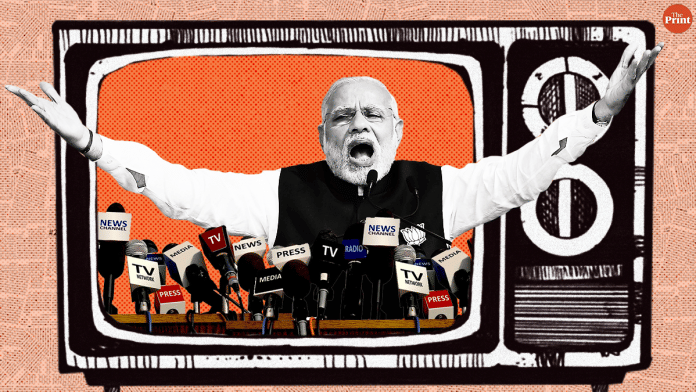
Having said this, the open press conference with tough questions and unscripted exchanges remains the gold standard for democratic accountability. We have traditionally fared very poorly on this count in India, and much worse now with the advent of social media. Prime Minister Narendra Modi has held no full-fledged press conferences. By way of possible explanation, he once said that “today’s media is not the same”, which seemed like an oblique way of suggesting that it has become partisan and polarised and has lost all pretence of neutrality.
Indian politicians have realised that while open press conferences could invite hostile cross-examination, the curated interview is a far safer format. Prime Minister Modi gave as many as 80 interviews to legacy media outfits before the 2024 general election, but it is possible that at least some of them were scripted or conducted with pre-approved questions.
Politicians are also aware that the moment shapes the interview. Pre-election exchanges naturally focus on such things as strategy, tactics and who is ahead, affording the space for the interviewee to control the narrative. Former Prime Minister Manmohan Singh addressed a small number of open press conferences, but much of his interaction with the media took place on foreign trips and aboard Air India One. The first is a space where the purpose of the visit influences the exchange. The second, what the Americans call a gaggle, is made up of reporters selected for the trip who are likely to be constrained from asking hard questions by the hospitality as well as the loosely organised and informal setting.
Social media access has also led politicians to hand out interviews as if they are rare favours, another mechanism to discourage awkward questions. Sonia Gandhi’s sit-down interview with The Guardian ahead of the launch of her memoir Belonging was among the very few she has done over the last 30 years.
Perhaps unsurprisingly, it was something of a softball. By her own admission, politics forms the “background” or “framework” for this personal memoir (which, incidentally, is remarkably tender and moving, especially when recollecting her relationship with her husband Rajiv Gandhi).
But we will probably never know the answers to the awkward questions that were never asked. What exactly was her relationship with Ottavio Quattrocchi, the central figure in the Bofors scandal? Why did she choose to remain the power centre when Manmohan Singh ran the government? And could it really be true that her only disagreement with Narasimha Rao (“an erudite statesman”) was over the pace of the inquiry into her husband’s assassination?
We need a culture where our leaders are open to sharp, rigorous and relentless questioning. Social media has undermined this by providing them with access to curated, supportive audiences (the echo chamber) and has encouraged a culture of selective access (the managed media).
Read Vasudha Venugopal and Tarini Kumar’s account of Vijay’s meteoric rise and his use of digital platforms at staggeringly low costs to directly reach people, bypass the legacy media and control the narrative. No one has done this more successfully in India in recent times. Sure, this has upset a number of journalists whose access Vijay does not need. But I doubt he is even listening.
Mukund Padmanabhan is a Professor of Philosophy at Krea University and was the former Editor of The Hindu and The Hindu BusinessLine. He is the author of The Great Flap of 1942, a narrative history of India and World War II. Views are personal.
(Edited by Asavari Singh)