






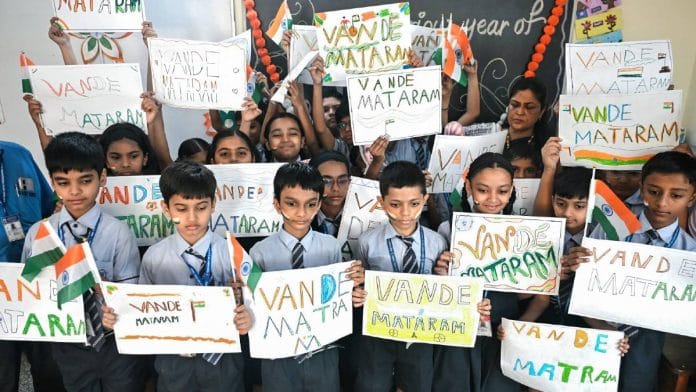


Parliament is about to do by legislation what the Constituent Assembly, in 1949, deliberately declined to do. The Prevention of Insults to National Honour (Amendment) Bill, 2026, listed for introduction, consideration and passage in the Monsoon Session, will extend the penal protection currently enjoyed by the National Anthem, the National Flag and the Constitution to Vande Mataram — all six stanzas of it. Wilful insult or disruption of the song will attract the same punishment prescribed under Section 3 of the 1971 Act: imprisonment up to three years, or fine, or both, with an enhanced minimum sentence of one year on a second or subsequent conviction.
On the surface, this looks like a technical amendment, formalising the status of a song already central to India’s national imagination. In substance, it closes a gap that was never accidental, and in doing so, revives a question India’s founders had already answered.
Go back to October 1937. The Congress Working Committee, meeting in Calcutta, took up the “problem” of Vande Mataram directly. Dr Rajendra Prasad moved the resolution; Sardar Patel seconded it; Gandhi was present as special invitee. The Committee’s conclusion was unanimous — not grudging, not a concession extracted under pressure, but a considered judgment: the first two stanzas of Bankim Chandra Chattopadhyay’s poem captured the song’s spirit of resistance and belonging, while the later stanzas — invoking Durga “wielder of the ten weapons,” Lakshmi and Saraswati by name — were, in their own words, “in no sense objectionable” to omit from national gatherings, precisely because forcing devotional verse on citizens of every faith was never going to unify a plural republic. This was not the fringe view of a placatory Congress. Rabindranath Tagore, no political supplicant to anyone, endorsed keeping only the first two stanzas. The consensus ran the length of the freedom movement, from the moderate to the revolutionary.
That settlement carried into the Constitution itself. On 24 January 1950, President Rajendra Prasad announced Jana Gana Mana as the National Anthem, with Vande Mataram to be “honoured equally” — but this equal honour was extended to the song as the country had come to know it in public life: the two stanzas that had rung out in freedom marches and jail cells, sung by Hindus and Muslims together as a battle cry against empire. The Constituent Assembly did not adopt six stanzas. Article 51A, when Parliament inserted Fundamental Duties in 1976, names the Flag and the Anthem as objects of civic reverence. It is silent on the National Song. That silence was not an oversight. It was a choice, made by people who had just finished building a secular republic out of a subcontinent still bleeding from Partition, and who understood — in a way that seems to require re-learning every generation — that a state cannot compel its citizens to sing to gods that are not universally theirs.
Respect and compulsion are different
The Supreme Court revisited this exact terrain in Bijoe Emmanuel v. State of Kerala (1986). Three Jehovah’s Witness children in Kerala stood respectfully and silently through the National Anthem each morning, but did not sing it, as their faith forbade it. They caused no disruption. They were expelled anyway.
The Supreme Court held the expulsion unconstitutional, with Justice O. Chinnappa Reddy writing what deserves to be carved into the record: proper respect is shown to the Anthem by standing when it is sung; it is not right to say that disrespect is shown by not joining the singing; standing respectfully while remaining silent violates no law. The Court invoked Justice Robert Jackson’s words in West Virginia State Board of Education v. Barnette — that no official can prescribe orthodoxy in matters of opinion or force citizens to confess their faith by word or act.
Here is the difficulty the 2026 Bill walks into. If the Supreme Court has held that citizens cannot be compelled even to sing the National Anthem, which already enjoys constitutional recognition and statutory protection, it becomes very hard to argue that citizens can be compelled to participate in singing the National Song, which enjoys neither. Codifying penalties for “disrespect” to Vande Mataram does not, by itself, override Bijoe Emmanuel; courts have consistently read a requirement of deliberate, intentional disruption into Section 3 of the 1971 Act, and silent non-participation has been held, in more than one High Court, not to constitute an offence. But codification changes the atmosphere in which the question gets litigated, school-enforced, and policed at the ground level, long before any court gets the chance to draw that distinction.
There is another irony. No one has ever surveyed how many of the 788 members who will vote on this Bill can recite all six stanzas from memory, let alone explain what they mean. The first two stanzas may be familiar to many, as they were sung in school, and at Independence Day functions across the country. Their imagery of rivers and orchards and moonlit nights are accessible to any Indian regardless of faith.
The remaining four are a different matter entirely. Composed in dense, Sanskritised Bengali, invoking Durga, Lakshmi and Saraswati by specific epithet, they were removed from public life in 1937 precisely because so few Indians outside Bengal could engage with them meaningfully — not merely pronounce the words, but grasp the theology embedded in them. A legislator, or a citizen, can be compelled to stand for a verse. Nobody can be compelled to understand one, and it is worth asking how many in the House voting for this Bill could translate, unaided, the very stanzas they are about to protect with imprisonment. Legislating criminal liability around a text that most legislators themselves could neither fully recite nor construe is not reverence. It is performance standing in for understanding.
Nobody sensible questions whether Vande Mataram deserves respect. It ignited a freedom movement; people went to the gallows chanting it. But respect and compulsion are not the same instrument, and the 1937 settlement was not weakness — it was the collected wisdom of people who had actually won India’s freedom, deciding what unity required. A republic built on equal citizenship does not need everyone to pray in the same words. It needs, as the Constitution’s framers understood better than we currently do, the right to disagree — even silently, even respectfully — protected as the beginning of freedom, not the end of loyalty.
The author is a retired IAS officer of the 1984 batch, Punjab cadre, who superannuated as Special Chief Secretary, Government of Punjab. Views are personal.
(Edited by Prashant Dixit)
Vande Mataram is the a strongly culturally-rooted expression of Bharatiya nationalism. Just because it was mutilated to appease the remnants (or should I say fifth columnists) from among those who – before the song – mutilated Bharata does not make it fair to call it ‘settled’. It was, in a very mechanical sense, ‘settled’, but in every other sense, it was an indolent wound on a civilisation that has had its authentic cultural expression suppressed and stigmatised for centuries.
Those who hated Bharata Mata and Vande Mataram got their land of the pure. Even if one were to concede this right in the absence of this act of secession (I would not – your beliefs cannot dictate my expression – but let’s provisionally accept the argument), now, having realised their dream of dismembering Bharata Mata and satiating their fetish of ravishing her, they are left with no right to stake any claims to the expressions of Bharatiya nationalism simply on account of the fact that they refused to leave for the country they loved, lived, and died to create.
Everyone who belongs to this nation should know and respect its symbols. If your beliefs forbid you from being loyal to your country, you are most welcome to join your ummah (community of the faithful) in the deserts you came from.
Hello,
Look, let’s stop dressing up history in fancy academic jargon. In 1937, a tiny group of top Congress leaders sat in a room in Kolkata and decided to chop up *Vande Mataram*. They didn’t ask the public, they didn’t hold a vote, and they sure didn’t care about the millions of ordinary people who faced British lathis singing the whole song.
They did it for one simple reason..plain, old-fashioned political appeasement. Jinnah and the Muslim League threw a fit, calling the song “anti-Islamic,” and Congress folded. They slapped a lofty label of “pluralism” on it, but it was a total surrender. They edited away our sacred civilizational heritage just to placate a political faction.
And what did that grand compromise actually achieve? Absolutely nothing. Did it stop the hostility? No. Did it build communal harmony? Not for a second. Jinnah took the concession, doubled down, and demanded Pakistan three years later anyway.
For eighty years, Hindu sensibilities were told to sit down, shut up, and accept this one-sided compromise. But even after mutilating the song, the disrespect toward *Vande Mataram* never stopped. The goalposts just kept moving.
Now, when a long-overdue effort is made to restore the original stanzas and put a legal deterrent in place against insulting it, the same armchair commentators start hyperventilating about “coercion” and “the right to offend.”
Nobody is forcing anyone to worship anything. It’s called basic civic respect for the battle cry of our freedom movement. If the law can protect a flag and a piece of paper, it can protect *Vande Mataram*. Eight decades of one-sided appeasement didn’t earn respect… it just built an entitlement to disrespect. Time to get over it.