






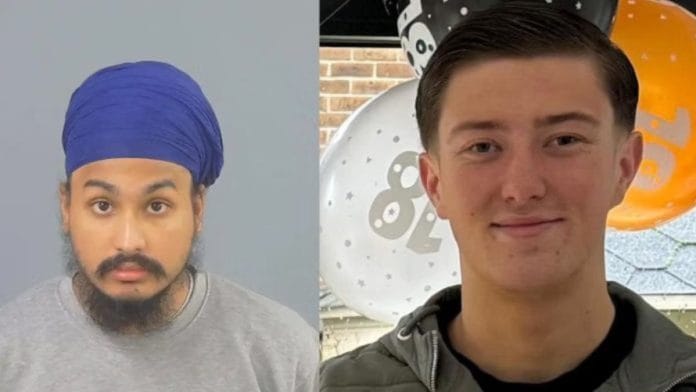


Henry Nowak, an 18-year-old student, was stabbed to death on 3 December 2025 in Southampton, England, by a British Sikh man Vickrum Digwa. Months later, as investigations progressed, official decisions emerged, and more details became public, Southampton witnessed riots and violence that reportedly left 11 police officers injured.
A young life filled with hopes, plans, and possibilities ended in a crime, a tragic loss to society. His father, Mark Nowak, spoke about the grief the family would carry “every single day for the rest of their lives” and appealed that they did not want his death to be used to create further division, hatred, or tension.
Yet somehow, despite that appeal, the child of a Polish immigrant has now become the face of “white lives matter”.
What happened was tragic and horrific. Part of the public sentiment also seems to come from the chilling footage circulating online where Nowak was reportedly saying that he had been stabbed, but a police officer appeared to respond, “I don’t think you have, mate.”
The white victimhood narrative
I can understand why such footage creates anger and frustration. Watching someone in distress not being taken seriously.
But the question remains—how did this turn into violent responses and a much larger political storm?
For part of that answer, one can simply look at the response from UK MP Nigel Farage. In the past, when Metropolitan Police officer Wayne Couzens kidnapped, raped, and murdered Sarah Everard, Farage explicitly appealed for calm and argued against using that tragedy to launch broader attacks against men or institutions.
But now, the language appears very different. Instead of appeals for peace, we hear phrases like “cold outrage.”
It is also interesting because this is the same politician who, in the past, spoke about preferring Indian immigrants over Eastern European migration, perhaps shaped partly by his Brexit politics. Yet suddenly, a British citizen from a Polish immigrant background easily becomes absorbed into a broader white identity narrative.
And that made me wonder what exactly changed. It feels that different responses to tragedies can not be shaped by what happened, but by who was involved and what political story can be built around it.
The cynical exploitation of tragedy has become so normal that it barely registers anymore.
Because the larger idea seems to be building a narrative around white victimhood—that the majority population is somehow facing systematic double standards from institutions, often described through phrases like “two-tier policing”.
Whether statistics or broader data support such claims often becomes secondary. One incident, once attached to a larger political narrative, can become enough on its own.
I have also noticed something else during these conversations. There are some people from Indian backgrounds—Sikh, Hindu, and others—who often agree with reform party or even far-right positions because they genuinely believe that Muslim immigration or Islam itself is the central problem.
Some of them strongly identify as British and, ironically, do not want newer immigrants from South Asia arriving either. There is even a term sometimes used for them—“freshies.” The assumption often seems to be: we are different, this is not about us, this is not about our brown skin.
Which is why it is interesting to see how quickly such distinctions can disappear. Tommy Robinson stood outside a police station and quickly connected Nowak’s murder with Pakistani Muslims and grooming gang narratives. The tragedy itself almost became secondary.
Also read: Why Sridhar Vembu’s ‘return home’ appeal to Indians in the US is significant
Family vs the world
What struck me is how quickly a personal tragedy became part of a much larger political story about betrayal of white people by institutions and the state. And in such politics, I sometimes wonder whether the difference between Muslim, Indian, Sikh, immigrant, or simply brown matters as much as people think it does.
The other debate emerging from this tragedy is around banning the kirpan in public spaces. While Britain has traditionally allowed religious symbols and accommodations in public life, the Henry Nowak case has once again raised questions around religious exemptions for ceremonial Sikh blades.
To be fair, that itself is a much larger debate—one involving religion, security, accommodation, minority rights, and where societies choose to draw boundaries—which probably deserves an article of its own.
Furthermore, something that I am not seeing discussed enough is the incident itself and the behaviour surrounding it. Allegations around family members attempting to hide what happened, going to extreme lengths to protect their son, introducing claims of racism into the narrative, or even attempts to hide evidence raise uncomfortable questions beyond politics alone.
It also made me think about something more personal. Growing up as a South Asian, there are certain values many of us are taught from childhood—to stand by blood through everything, to protect family no matter what, that, in the end, it is always us versus the world.
But sometimes I wonder whether this mentality also makes us lose sight of something bigger. When loyalty towards family becomes everything, we forget we are also part of a larger society and a shared humanity.
And this is the more uncomfortable question here: if someone from your own family committed such a crime, what would you do in that moment?
Would you choose family loyalty, or would you choose what is right?
Amana Begam Ansari is a columnist, writer, and TV news panellist. She runs a weekly YouTube show called ‘India This Week by Amana and Khalid’. She tweets @Amana_Ansari. Views are personal.
(Edited by Saptak Datta)
Actually it is UK government which is twisting narrative to make it appear as immigrants versus local. In reality the protest by white men are against police who have perfected ” Two tire ” response system. One system for Muslims immigrants and second for the rest.. ……
Khalistan is have mastered the art of playing the victim card. It’s quite normal for them to claim religious persecution in India to obtain citizenship of a Western nation.
They have consistently betrayed India through their acts and misdeeds. The Western nations, naive as they were, fell for their propaganda. But of late, all of them are realising how dangerous these Khalistani hooligans are. Canada and Australia have already started cracking down on these criminals. Hope UK and other nations too follow in their footsteps.
The fact is that the convict lied at the murder scene- His family may have tried to amplify the racism narrative, but they did not start it.