






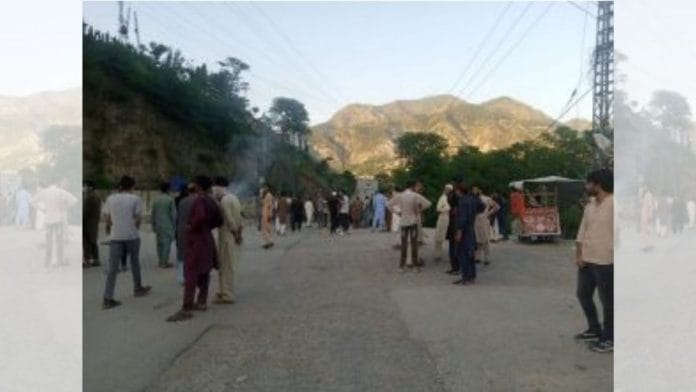

Draw a single line down the map, and you can watch two governments run two entirely different stories at the same time. On one side, a state is trying to win people over with land parcels, farmer registries, unique identification numbers. On the other hand, a state is losing people over a ballot box; twelve legislative seats, thousands of miles from the voters they’re meant to represent. Both are called Kashmir. Neither looks anything like the other.
PoJK: A Crisis of Representation, Not Just Economics
The unrest in Pakistan-occupied Jammu & Kashmir (PoJK) is often described by state media as a reaction to inflation and utility prices, even though it is largely driven by the Joint Awami Action Committee (JAAC). That framing itself is incomplete. It has multiple layers, and through each of them the Pakistani state has failed simultaneously. The JAAC’s core demands, formalised through the October 2025 Muzaffarabad Accord, its Charter of Demand, and a subsequent electoral reform charter, went well beyond subsidies. When Islamabad missed its own implementation deadlines, the committee escalated towards direct confrontation with the state.
At the centre of that confrontation sit twelve legislative seats. The PoJK Legislative Assembly has 53 members. Of these members, 33 seats are directly elected within PoJK. Eight seats are reserved for women, technocrats and overseas Kashmiris. Twelve seats belong to refugees from Jammu and Kashmir who now live in cities such as Karachi, Lahore, Rawalpindi and Sialkot.
Because eight additional seats are filled through nomination, the ruling party begins with a built-in bloc before a single vote is cast in PoJK. At this level, the ruling party needs only a small share of the refugee seats to form a PoJK government.
In the 2021 cycle, some of these refugee constituencies were decided by as few as 1,500 to 6,000 votes, spread thinly across Pakistan rather than concentrated in PoJK; a structure the JAAC argues makes the seats trivially easy to steer from Rawalpindi. On June 7, 2026, protests were triggered by the JAAC’s opposition to this arrangement, though a pre-emptive move also played a role. Two days before the violence broke out, the Government had banned JAAC under the Anti Terrorism act.
This is not a fringe grievance. Reserved seats come from PoJK’s 1974 Interim Constitution. They were intended to represent people who lost their homes after Partition. JAAC says that reserved seats no longer serve that purpose. Instead, they argue that reserved seats are now mainly used to influence government formation in Muzaffarabad.
When the dispute went to court, the PoJK Supreme Court ruled that reserved seats are constitutionally protected. The PoJK Supreme Court said that reserved seats could not be altered by action or street pressure, and that any constitutional change must go through the Assembly, not through protest. The ruling by the PoJK Supreme Court was clear and logical. However, it did not calm the anger. The anger remains because the real grievance is that non‑resident votes still shape governance. The problem of non‑resident votes is still intact.
The human cost has been severe. Earlier rounds of protest in October 2025 over the same issue resulted in at least 15 deaths and roughly 200 injuries. Independent tallies from the Human Rights Council of PoJK have documented more than 80 fatalities since late July alone, alongside reports of digital censorship targeting domestic and international outlets covering the unrest. What began as a dispute over electoral arithmetic has widened into a broader argument about who is permitted to govern PoJK, and from where.
J&K: Institutionalisation Through Administrative Machinery
On the Indian side, the defining feature of the current phase is structurally significant: the routine, almost bureaucratic work of building administrative state capacity. Jammu and Kashmir, according to sources, is working on digitising and updating almost 70 lakh land parcels. This is part of a modernisation effort under the Digital India Land Records Modernisation Programme. 13 lakh discrepancies have already been fixed after people checked the information and raised multiple issues. In three months, from March to May 2026, over 25 lakh Unique Land Parcel Identification Numbers were created. The exercise has extended across thousands of villages. Alongside the digitisation of land records, the government has also been rolling out projects such as the Farmer Registry and the Digital Crop Survey, both of which form part of the broader AgriStack framework.
None of this is dramatic in the way a protest or a crackdown is dramatic, which is precisely why it rarely makes headlines. And even if it does, it’s always negated as a state-run narrative- facts and figures- but what serves as a stark reminder is that whether people call it narrative-based figures or not, Jammu and Kashmir has come a long way.
Also, land records, revenue documentation and credit-linked digital identity are the substrate on which everyday governance like welfare access, institutional credit, land dispute resolution actually runs. Officials have linked the exercise to a reduction in land disputes, noting that a significant share of such disputes originate in discrepancies within the older, paper-based record system. The administrative narrative here is one of formalisation: a territory whose special constitutional status was reorganised in 2019 being absorbed, module by module, into standard national governance frameworks.
Also Read: Why the world still covers Kashmir like it’s pre-2016
Reading the Divergence
Three angles are worth holding in tension rather than collapsing into a single verdict.
First, the nature of the grievance differs fundamentally. PoJK’s crisis is about representation- who gets to vote, and from where layered onto economic distress. J&K’s current phase is comparatively depoliticised, concerned with administrative accuracy rather than electoral architecture, in part because its more contentious constitutional questions were resolved unilaterally in 2019, not through ongoing negotiation. There are conversations going on about how much power the regional leadership holds vis-à-vis central frameworks. But we must also acknowledge that cross-sectoral stakeholder collaboration has helped this region quite a lot.
Second, visibility is not evidence of severity, nor is invisibility evidence of calm. PoJK’s crisis is visible because it involves confrontational strikes, fatalities, and a banned organisation. J&K’s administrative build-out is invisible because it is procedural, but procedural governance carries its own long-term stakes: whether digitised records are accurate, whether they reduce or simply relocate disputes, and whether formalisation is experienced locally as service delivery or as depoliticisation by other means.
Third, both stories complicate the flattened Kashmir conflict template that still shapes much coverage of the region and South Asian geopolitics. PoJK is not a passive, quiet counterpart to a restive Kashmir. It is currently the more volatile half of the equation, driven by a domestic legitimacy crisis with limited connection to India at all.
J&K’s present, meanwhile, is not defined by street confrontation but by land parcels, mutation backlogs and ULPIN counts; an administrative governance story whose long-term outcomes, in terms of dispute resolution and public trust, are still unfolding and worth tracking on their own terms.
What this comparison ultimately offers is not a verdict on which side is better governed, but a case study in how governance legitimacy is built or eroded through very different mechanisms: one through the ballot and who is allowed near it, the other through the ledger and who is finally counted in it.
Tehmeena Rizvi, PhD, specialises in Women, Peace and Security studies in South Asia with a particular focus on Afghan Migration and the Kashmir region.
Views are personal.
(Edited by Maryam Hassan)