




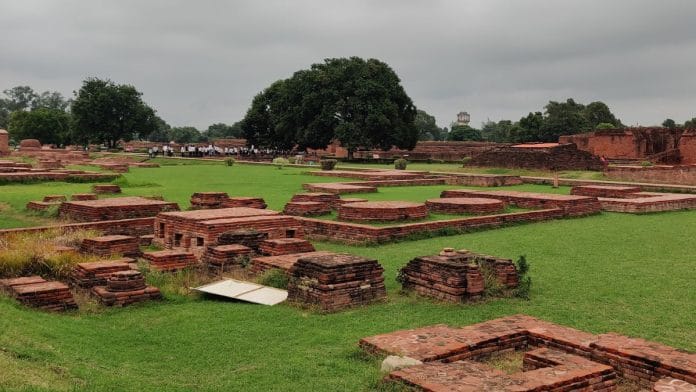

We have an enduring image of an idyllic ancient India with gurukuls that impart knowledge to all seekers. The very word ‘gurukul’ conjures a forest hermitage where a boy of any background studies obediently at the feet of a well-bearded guru. You find this image in textbooks, calendars, diaries, comic books, epics and TV shows. It is imprinted in Indian public memory.
The image evokes a sense of a perfect learning culture in the past, from which we supposedly declined because of invasions and colonialism. The fact is that there is little evidence of how widespread or effective gurukuls were at spreading knowledge.
“Traditional” learning has often been thrown about as a solution to India’s education problems. Unfortunately, whether at Nalanda or the madrasas of Awadh, the education of the average Indian was rarely a priority for India’s rulers.
Ritual versus vocational
When the early Sanskrit epics and law books (dharmashastras) talk about education, they are very clear that they’re talking about elite circles — princes, sages, Brahmins. They never claim to be concerned with the average Indian’s education: that’s our projection.
In fact, the dharmashastras are uncompromising on cultivators (Shudras) being kept away from sacred knowledge. For example, the Gautama Dharmasutra demands that a Shudra who listens to the Veda have his ears filled with molten tin. One who recites it should have his tongue cut out. One who retains it should be cut in two (XII.4). This isn’t to say that Indians couldn’t get any education if they weren’t part of the elite. Vocational education happened on the job and was transmitted within families and castes, not in public schools. But this didn’t provide many opportunities for mobility.
So whose education did rulers actually fund? Early states needed ritual services, so that’s what they invested in. The 8th-century king Karunandadakkan, for example, endowed 95 seats for a school (śālai) by Vedic lineage: 45 to the Paviliya branch, 36 to the Taittirīya, and 14 to the Talavakāra. Nalanda, the great Buddhist mega-monastery that drew scholars from Tibet, China and Java, conducted an oral admission test demanding command of Buddhist and Vedic scripture.
The graduates of these schools were in demand across Eastern Asia. But from the 11th century, as I have argued in an earlier column, Indian states grew more complex, and rulers wanted not just priests but also accountants. Nalanda began to lose its funding around the same time that Brahmin and Kayastha families, wielding bureaucratic skills, spread as a revenue-collecting, record-keeping cadre across the subcontinent. From this point on, the trained bureaucrat would receive increasing state support.
Also read: Nalanda had a scholar at the gate to screen students. Only three out of 10 were admitted
Shudras teaching Persian and the Agamas
Over the next centuries, bureaucratic knowledge proved to be more porous than Vedic knowledge. Across the subcontinent, landowning castes, despite many technically being Shudras, taught accounting and other useful subjects. Chandar Bhan Brahman, a Hindu from Lahore who worked as Shah Jahan’s secretary, claimed to have been taught by one “Jatmal Shudra” and “Gopi Chand Shudra”. (Rajeev Kinra, Writing Self, Writing Empire.)
In the South, Shudra scholars were taking a slightly different approach to enter scholarly networks. The 17th-century Shaiva monasteries (ādhīnams) of Dharmapuram, Tiruvavaduthurai and Tiruppanantal were headed by Vellalas, a high-ranking cultivator caste considered by some to be sat-shudras, “pure shudras”. Historian Iva Koppedrayer argues that Vellalas attained these positions by expounding the Shaiva Agamas, which were less protective of their sanctity than the Vedas. These Vellala-run adhinams were patronised by “new money” rulers — the Setupatis of Ramnad, the Tondaimans of Pudukkottai — and they controlled valuable land grants around Thanjavur and Tiruchirapalli. As with Jatmal and Gopi Chand, Tamil Vellalas leveraged their usefulness to rulers to enter education systems once reserved for upper castes.
The most prestigious precolonial schools — the Indo-Persian madrasas — do not figure in our imagination of ‘traditional’ Indian education. Today, Bollywood and TV media largely portray madrasas as centres of extremist brainwashing, but 18th-century madrasas such as Lucknow’s Farangi Mahal taught logic, philosophy, mathematics and Euclid’s geometry alongside Quranic study. The Farangi Mahal was endowed with 700 seats and attracted scholars from Iran and beyond. Like Nalanda, an elite madrasa education opened up a scholar to salaried positions across Asia, from Istanbul through Isfahan to Malacca. Not all madrasas could boast such connections, though. The Farangi Mahal offered state-sponsored training for a small administrative and juridical elite, not a world-class education for all Awadhis.
Also read: How Buddhists lost out to Brahmins in Nalanda. Even before the Turks came
How the British invented the Brahmin schoolmaster
At the advent of British domination of the subcontinent, state-sponsored Indian education was an elite affair. But non-elite schools, funded by local people, had also carved out a space for themselves.
In her book Beyond Macaulay, historian Parimala Rao discusses several surveys conducted by colonial officials in the 1800s. In Bengal, William Adam found 1,255 of 1,463 Hindu teachers to be non-Brahmin, with whole tracts of south Bihar showing not one Brahmin teacher. However, schools in general were poor and lacked resources. A schoolmaster in the North-Western Provinces earned less than a man who cut grass, a Sanskrit pundit less than a farm labourer. As they had throughout history, children stayed away from schools not because Brahmins could keep them out, but because their labour was needed at home. According to Rao, a Madras official in 1823 recorded parents saying the boys were better employed minding bullocks than going to school.
While scribal or clerical education was available for those who could pay the teacher, Vedic learning was still restricted to Brahmins. Rao quotes a 19th-century survey of Sanskrit schools in Malabar, which found the classes in Veda and theology filled almost entirely by Brahmin boys — 471 of them, with three Brahmin girls. The astrology classes in the same schools admitted Vaishya, Shudra and other-caste pupils, including a few girls.
These indigenous schools were absorbed into the colonial state’s education system, even as madrasas were decimated by changing syllabi and reactionary religious reforms. By 1882, almost 70,000 of the 85,000 British-run government primary schools had originally been Indian schools. However, Rao shows, British officials pressed repeatedly for Brahmin teachers. One wanted teaching positions reserved for Brahmins for the “security of the government”. A British judge in Ahmedabad said that it would be “inappropriate” for a Brahmin student to bow to a Shudra teacher. As noted earlier, this was appropriate in many cases. But the British were forming their opinions of Indian society from ancient sacred texts, not from the chequered reality.
The Governor of Bombay Presidency, Mountstuart Elphinstone, opened dozens of new schools staffed by Brahmins. By the century’s end, most Indian schoolmasters were Brahmin. To an extent, the image of the Brahmin presiding over village schools across an ancient, educated Bharat was a product of the colonial classroom. At the same time, it must be said, colonial-era urban institutions enabled many formerly uneducated families to enter government services and gain upward mobility (including my own).
The crumbling government schools in recent viral clips are the heirs of a long apathy among India’s ruling elites — funded late, staffed cheaply, asked to run on almost nothing. Today’s students want state-funded education to offer economic mobility to millions. But the answer can’t come from ‘traditional’ state-funded Indian schools, which only ever cared about training the court’s specialists. The answers to our education system’s ills won’t be found in our past: we’ll have to do the hard work of imagining a better future.
Anirudh Kanisetti is a public historian. He is the author of ‘Lords of Earth and Sea: A History of the Chola Empire’, and the award-winning ‘Lords of the Deccan’. He hosts the Echoes of India and Yuddha podcasts. He tweets @AKanisetti and is on Instagram @anirbuddha. Views are personal.
This article is a part of the ‘Thinking Medieval‘ series that takes a deep dive into India’s medieval culture, politics, and history.
(Edited by Prashant Dixit))
Knowledge-based society is a 20th century concept. Almost no country anywhere had “education for everyone” before that, so what is the point of this article? English historians have noted that literacy rates were in excess of 25% in India before their rule, much better than what was in UK. I think this author has a restricted/myopic view when he does his research