





It is fashionable and politically expedient for the current so-called Dravidian ruling dispensations in Tamil Nadu to exclusively focus on Sangam literature of the distant past. In this, they are aided by leftwing foreign scholars who love to pick and choose some writings from that period and ascribe to them a faux secular character. I for one have never understood this.
There has never been and there never will be any art form in any part of this country that is not imbued with the sacred. My favorite writer from antiquity, Tiruvalluvar, opens his Kural with a reference to “Bhagavan”. It is true that his appeals to humans to be ethical do not invoke the specter of horrible penalties in realms after death in order to nudge humans toward good behavior. But that does not make him “secular” whatever that much-maligned word may mean. Valluvar’s writings can be seen as the epitome of the sacred.
I must make a confession. In my not-so-humble opinion, I have not been a great fan of other Sangam writings in the cloying way that many patronizing west-based scholars have been. In my view, the acme, the zenith, the vertiginous heights of Tamil writing arose around 400CE and afterwards, and these were sacred outpourings without an exception. The very names of the compilations make that certain. Thevaram, Divya Prabandam, Tirumurai, Tiruvachakam, Tiruppavai, Tiruppugazh, say it all. “Tiru” means sacred. And that is why the names of so many towns and villages start with “Tiru”. Our ancients thought that we inhabited a sacred geography.
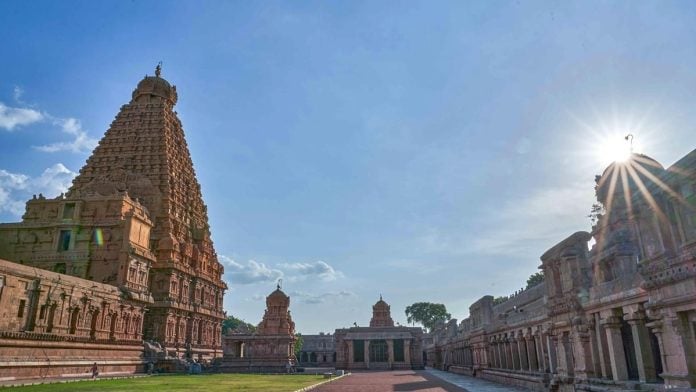
Recently I was at one of my favourite temples: the Patteeswarar Temple at Perur near Coimbatore. This is an ancient Chola temple with subsequent Hoysala, Vijayanagara and Nayaka embellishments. The Hoysala connection is not so intriguing if we understand that current state boundaries do not represent foundational reality. Coimbatore is at the crossroads of Kannada and Tamil cultures and has a healthy dose of Malayalam and Telugu cultures added to it. The brilliant Englishmen Sullivan and Stanes added some seasonings within the last two hundred years. In the venerable Coimbatore Club, you can run into tea-planters from The Nilgiris who use words like “enunciate” and “vertiginous” quite casually.
Coming back to the Perur temple—one notices that right outside the inner sanctuary of Shiva, there are carved reliefs of Tirugnanasambandar, Thirunavukkarasar, Sundarar and Manikkavachagar. These glorious figures of our literature stand there for all of us to note that they were close to Shiva and that Shiva loved them. They have left behind some of the finest literary compositions that humans on this planet have produced.
In every temple or shrine, we have a custom of giving a “local” name to the Divinity which we believe strides the whole cosmos. Shiva is called “Patteeshwarar”. Parvati is called “Pachhainayaki” or “Maragadavalli”. Pachhai (emerald) and Maragada (emerald or green jade) make it clear that She is associated with verdant greenery. Being at the eastern end of the Palghat Gap, Coimbatore and adjacent districts are green. Coconut and even occasional banana and areca groves are common. Coimbatore has the good fortune of benefiting from both the Southwest and the Northeast monsoons although El Niño has played somewhat truant this year. Pachhainayaki’s statue is not very tall. She looks supremely comfortable and She leaves you with the feeling that She will bless Her devotees quite bountifully. One has to admire our ancestors who left behind for us an exquisite shrine for an emerald goddess who keeps our land green.
In the Perur temple is a wonderful Mandapam housing a shrine dedicated to Nataraja (again Shiva, but just called differently) and Sivakami (Parvati again with another name). This Mandapam is clearly of more recent Vijayanagara and Nayaka construction just based on the architectural style and the sculptural details. What can one say of a place where a four-or-five-hundred year-old structure is considered “recent”?
Also read: Napoleon lost his country trying to root out sanctions evasion. It’s a lesson for US senators
The disappearing Oduvars
On a memorable visit, we were lucky. The temple Oduvar was around. Oduvars are specialised reciters or singers in Tamil temples who recite compositions of our great poets. At my request, the Oduvar recited one of Sundaramurthy Nayanar’s padigams. The result was beyond enchanting. In the presence of the dancing Nataraja bronze and of the effervescent Sivakami, we were listening to something that Sundarar who had visited Perur had written more than ten centuries ago. The padigam included references to Arur and Perur, thus once again emphasizing that Shiva who is everywhere makes himself available at specific places in order for us to celebrate Him there.
The Oduvar explained to me that when Sundarar went to Chidambaram, he beheld not the Nataraja statue there, but the one in Perur. It confirmed to me that while for others Chidambaram may be the center of the universe, for us Coimbatoreans, that place belongs to Perur. After all, are Siruvani, Bhavani and Amaravati not the three best rivers in the world? The Kaveri is great not on her own but because our three rivers join the Kaveri.
Now Oduvars are a declining breed. Their salaries are so low that fresh recruits are scarce and, in any event, it is not fashionable to listen to Tamil poetry dating from fifteen centuries ago. But I think the disappearance of Oduvars will result in a loss of something precious. I am skeptical that our governments will do much. We must look for new methods. The enormous popularity on Youtube of Pa Satgurunathan’s recitals of Tamil padigams gives me hope. I think a popular movement to raise funds to encourage and support the Oduvar tradition is something that all of us should contribute to and help sustain.
Even as I was convinced of the weakness of our present state’s support for our traditions, I read an article that our Chief Minister Joseph Vijay, who from his name appears to be a Christian, was present at a grand function held at the Madurai Meenakshi temple. That gives me cause for optimism. Perhaps our Chief Minister will imitate his Chola, Hoysala, Vijayanagara, Nayaka and even British predecessors and take action to ensure that a century from now our descendants can still visit our great temples and listen to Oduvars.
Jaithirth ‘Jerry’ Rao is a retired entrepreneur who lives in Lonavala. He has published three books: ‘Notes from an Indian Conservative’, ‘The Indian Conservative’, and ‘Economist Gandhi’. Views are personal.
Sir
You should have given a photo of the Perur temple to the folks at Print. Why are they using a representative image??
Perur is not a remote village where their reporter cannot go!