






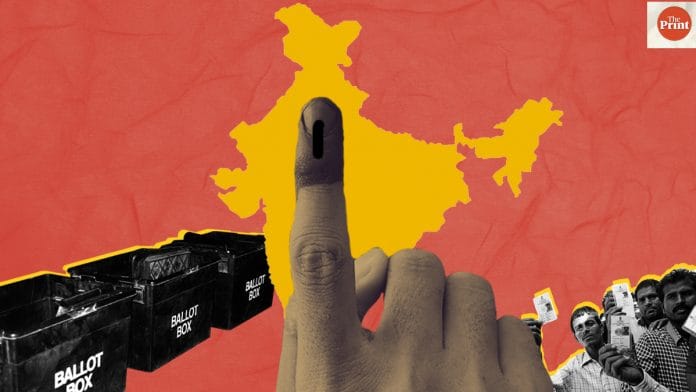


The results of the elections to four state assemblies — Assam, West Bengal, Keralam, and Tamil Nadu — and the UT of Puducherry have not thrown up many surprises. But they do clearly point toward a shifting political landscape.
There are three significant outcomes: the expansion of the BJP beyond its traditional geography, especially in West Bengal and Keralam; the disruption of regional party systems such as the DMK and AIADMK, both deeply entrenched in Dravidian ideology; and the continued decline of Congress, though it has not been as decimated as the Communists.
The repeat performance of the BJP in Assam and the hung assembly in Tamil Nadu were more or less predictable. The 108-seat win by Joseph Vijay’s Tamilaga Vettri Kazhagam (TVK) is a game-changer but raises serious questions about government formation and stability.
Together, the results suggest that if the BJP plays its cards right, the fallout could give it a larger advantage in 2029.
Also Read: Opposition doesn’t know how to beat BJP. What it can learn from Hungarian Magyar’s playbook
Broken bastions
Tamil Nadu is facing a Delhi moment — a hung assembly where no single party has the majority to form a government.
In 2013, the BJP emerged as the single-largest party with 31 seats in the 70-member Delhi assembly but refused to form a government, resulting in an AAP-Congress government that lasted just 49 days. In the 2015 election, the AAP bagged 67 seats and ruled Delhi for 10 years, wiping out the Congress completely from the political scene.
If Vijay’s TVK-led coalition fails to prove its majority and forces a re-election, it could sweep the polls and wipe out all other parties in Tamil Nadu. It is this fear that appears to have driven the Congress to rush to TVK’s support, and the AIADMK may still follow suit.
The AIADMK appears to be facing an imminent split, with reports suggesting that around 30 of its 47 MLAs favour supporting TVK, even if party general secretary Edappadi K Palaniswami (EPS) refuses to join the coalition.
What might all this bode for Tamil Nadu in the long run?
At some stage in the future, perhaps, the two Dravidian parties may even merge and form a single party in order to survive if the TVK rule extends beyond a year or two.
While the DMK and the AIADMK have several years of experience in governance, both TVK and Congress lack comparable experience in managing the complexities of Tamil Nadu politics and do not have the same organisational depth in the state either.
Besides, the poll promises made by the TVK appear to be very unrealistic, to say the least: Rs 4,000 every month for unemployed youth with graduate degrees, six free LPG cylinders per year for every family, creating fifty lakh jobs, and a crop loan waiver for farmers are only some of the schemes that will create a big hole in the state’s budget.
Currently, Tamil Nadu has a robust automobile industry and has emerged as the fastest-growing state economy, registering 11.19 per cent real growth in 2024-25. It also leads every state in four-year average real manufacturing growth from 2021-22 to 2024-25 at 9.38 per cent, while its overall GSDP grew by 8.63 per cent. It would be a sad story if populist, unproductive schemes drive an industrially diversified state to penury.
Meanwhile, the West Bengal results have elevated the BJP to a much greater status of “giant killer”.
Corruption at all levels and mismanagement of public administration, coupled with the sheer arrogance of the state apparatus and total apathy toward the woes of women and poor segments, were highlighted by the BJP. The outgoing chief minister misread the charges against her government as baseless allegations and paid a heavy price. Besides, her refusal to accept defeat, followed by the Governor dissolving the assembly, has further lowered her stature.
Also Read: Next epic election will be UP 2027. Akhilesh Yadav is hardly ready for Yogi Adityanath
What the verdict means for national politics
The recent election results point to three larger socio-political changes in the offing.
First, the dismantling of the colonial narrative of the north-south and Aryan-Dravidian divide has begun with the political defeat of parties deeply rooted in Dravidian moorings. Joseph Vijay’s TVK may not have ‘Dravidian’ in its name, but it will probably do very little to change the narrative. The Congress is too weak to indulge in any ideological political course correction. If the BJP is able to build a grassroots party and a new narrative, it has a better chance of establishing itself as a nationalist alternative to regional outfits.
The second is the re-emergence of the silver screen factor in Tamil Nadu politics, which had disappeared after the Jayalalithaa-Karunanidhi era ended about a decade ago. All parties in Tamil Nadu will have an uphill task facing this challenge.
The third and equally significant aspect is that in the centenary year of its formation, the Communist movement has no government in any state, rejected for the irrelevance of its ideology and governance model. Like the proverbial Last Samurai, the Left Democratic Front (LDF) in Keralam was the last bastion of Communism. Unlike the Chinese and Russian Communists, who are nationalists in principle and practice, the Indian Communists abhorred nationalism and despised Hinduism.
While the Congress has emerged as the new messiah of the minorities, especially Muslim voters, as the figures for Assam and Keralam suggest, the effect of religious polarisation could unfold a new political trajectory in future elections, benefitting the BJP. While this trend may lead to the return of a two-party coalition to some extent, the Congress will have to seriously consider a change in the apex leadership if it wants to be considered a serious party rather than an ‘also-ran’ party.
For the BJP, the next three and a half years will be election years. It has to show exemplary performance in the states under its control, retain the states that will go to polls next year, win new geographies, and also aim for a stronger majority in 2029.
Seshadri Chari is the former editor of ‘Organiser’. He tweets @seshadrichari. Views are personal.
(Edited by Asavari Singh)