



Little Syria, the neighbourhood was called, before new immigrants swarmed its streets, armed with six-figure paycheques from advertising or academia and hungry for sun-drenched brownstones to refit with oversized parlour windows and hardwood floors. Apple, Michele Varian, Page Sargisson, Patmos: the names suggest an erasure carried out with totalitarian determination. 522 Atlantic Avenue still stands, though, beside the neighbourhood’s oldest mosque, Al-Farooq. Five kilometres from the World Trade Centre, and fifteen minutes by subway, a room in the four-storey building housed a solitary desk, one phone and a fax machine: the global central office of the organisation that would later begin calling itself al-Qaeda.
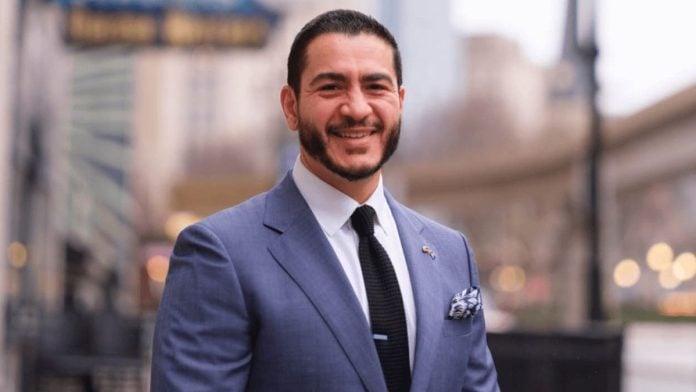
For weeks, as Senator-elect Abdulrahman Mohamed El-Sayed fought his history-making campaign, the child of Egyptian immigrants came under relentless attack for alleged links to al-Qaeda and the Muslim Brotherhood. The allegation—though disingenuous—isn’t baseless. Federal prosecutors listed 13 documents signed by El-Sayed’s mother, Fatten Elkomy, and multiple phone calls she made on behalf of the Islamic American Relief Agency, an organisation that the US would later designate as a financial and logistical conduit operating for terrorist entities, including al-Qaeda.
El-Sayed’s opponents chose not to mention that his mother—a qualified nurse who worked for IARA as an administrator from 1999 to 2004—was never named by prosecutors as a suspect, let alone charged with terrorism.
The debate is worth having, though—not because of the El-Sayed family’s alleged terror connections, but because of long-unanswered questions about the relationship between the 9/11 perpetrators and the Central Intelligence Agency (CIA). Like dozens of other jihadist fundraising networks, IARA was the child of a poisonous romance that blossomed at the dawn of the Afghan jihad. There has never been an accounting of how these networks were set up, who let them operate unhindered and who should answer for the carnage still unfolding.
America’s al-Qaeda
“All of our blood, all of our sweat, our whole life pours now into the usurious banks of the Jews,” said Abdullah Azzam, the Palestinian ideologue at the centre of the Arab jihadist mobilisation for Afghanistan. Large numbers of volunteers came to hear his convention speech in Seattle in 1988, where he pitched Afghanistan as a stepping stone to a wider global struggle.
Pakistan’s embassy, Azzam said, issued visas with ease, except to applicants from countries adjoining Israel.
“Try once, twice, three times,” he counselled his audience, “And if you don’t succeed, take a plane without the visa. We have some people who can receive you at the airport and will try to get you in one way or another.”
Two full years before the Soviet Union invaded Afghanistan in 1979, key figures in the jihadist movement—among them Azzam, the Egyptian Muslim Brotherhood leaders Tais al-Jumayli, Saud al-Funaysan and a young Saudi named Osama Bin Laden—began visiting America to attend conventions of an Islamist group, the Muslim Arab Youth Association. The memoirs of Bin Laden’s wife make clear that he first met Azzam in Indiana.
Living in Islamabad from 1982—and banned from travel to Algeria, Libya, Egypt, Syria and Iraq—Azzam faced no evident difficulty securing American visas, investigative work by the scholar Thomas Hegghammer has shown. He visited the US every year until 1988, months before his assassination in Peshawar. The former American diplomat Michael Springmann has alleged that the CIA station in Saudi Arabia pressured him to issue visas to jihadists—leading eventually to his dismissal from the service.
Led by the Egyptian Muslim Brotherhood cadre Mustafa Shalabi, the al-Farooq mosque began funnelling volunteers to Azzam in Peshawar.
“We had over 32 branches in the US spanning the country—Phoenix, Boston, Chicago, Tucson, Minnesota and in the capital, Washington DC,” wrote the jihadist Abdullah Anas. The most important, though, was the New York office, Anas recorded. Al-Jihad magazine, Azzam’s mouthpiece, found its largest audience in America.
Azzam himself announced that a branch of his Maktab al-Khidmat, the office routing Arabs to the jihad through Peshawar, was active in New York. He invited supporters to send cheques to the Al-Farooq mosque and the Maktab, saying he now held a bank account in the city. The centre was officially called Al-Kifah and run for the benefit of refugees; its real purpose, though, was known to anyone who read Al-Jihad or listened to Azzam’s widely circulated speeches.
American allies in the Middle East, like Egypt, began cracking down on the Afghan Arab networks from 1987, as concerns rose over their capacity for violence—but New York remained a safe harbour for the global jihad.
Also read: From Zohran Mamdani to Abdul El-Sayed—US voters are challenging Trump’s identity politics
A poisonous romance
Ever since the Second World War, American and British intelligence services had seen Islamists as reliable partners against communism. Gerhard von Mende, the Nazi bureaucrat who had recruited collaborators in Soviet Central Asia, was put to work in this new enterprise, journalist Ian Johnson has shown. Lacking reliable sources behind the Iron Curtain, the CIA and MI6 airdropped several of these former Nazis to conduct intelligence operations. The spies were betrayed, however, by Kim Philby, MI6’s head of operations against the Soviet Union—arguably the highest-ranking double agent in history.
American efforts to cultivate the Muslim Brotherhood, though, continued apace. In 1948, Sayyid Qutb—whose book, Milestones, is counted among the founding texts of modern jihadism—was awarded a fellowship to study in the US. Later, the Egyptian Islamist Said Ramadan emerged as a key figure in efforts to recruit Islam as a weapon against communism.
Late in 1953, Ramadan met President Dwight Eisenhower as part of a delegation of anti-communist Islamic clerics. The next year, he was granted asylum in Germany, escaping a crackdown on the Brotherhood by Egypt’s secular government.
The French journalist Caroline Fourest has noted that Ramadan emerged at the vanguard of Islamist causes worldwide. In Pakistan, Prime Minister Liaquat Ali Khan wrote the preface to one of his books and gave him a slot on national radio. Ramadan became a close friend of the Indian Islamist ideologue Abul A’la Mawdudi, among the principal theorists of the idea of the Islamic State.
Leading a mosque set up in Munich as a hub for the Brotherhood’s European operations, the scholar Gilles Kepel records, Ramadan emerged as a conduit linking rich Middle Eastern donors with Islamist causes.
Also read: The new American Left faces an old challenge – Turning ideals into reality
The path to 9/11
Documentation of the American intelligence relationship with jihadists in the build-up to 9/11 is thin, but it’s clear the CIA was aware of several key figures around the IARA case. A September 1998 memorandum shows the CIA was aware of Ziyad Khaleel, a key member of IARA later accused of supplying Bin Laden with equipment, including a satellite phone used to organise the bombings of American diplomatic missions in East Africa.
The same document also shows the CIA was aware of the operations of Elias el-Hage, who ran the Brooklyn centre for several years—before going on to participate in the East Africa bombings. Yet, no real effort seems to have been made to shut down their activities in America.
The same disturbing pattern preceded the 1993 bombing of the World Trade Centre—the event that led to the closure of the Brooklyn centre, from which many of the terrorists involved were drawn. Egyptian cleric Sheikh Abdel Rahman, who inspired the bombers, had been issued three American visas despite having been jailed in Egypt for supporting terrorism, investigators found.
After the bombing, new front organisations soon sprang up—often with the same cast of characters. El-Hage, who moved with Bin Laden to Sudan, played a key role in setting up IARA’s parent organisation, the Islamic African Relief Agency. Funds raised by IARA made their way across the region, including to Peshawar—likely used to fund al-Qaeda operations in Tajikistan, Chechnya and Kashmir, where declassified CIA records show the agency knew the group was operating by 1997.
Fatten Elkomy may well have got her IARA job because of her family’s Muslim Brotherhood sympathies: El-Sayed’s half-sister, the scholar Eman Abdelhadi, is on record saying her mother was an activist in the 1970s. Egypt’s Brotherhood, though, has several competing tendencies, the largest made up of middle-class supporters who believe the religious right’s interests are best served by participation in establishment politics.
El-Sayed’s father-in-law, the Karnataka-born doctor Tayeb Jukaku, has long been a prominent donor to another American charity associated with the Muslim Brotherhood, the Islamic Society of North America. ISNA was accused of helping fund Hamas in 2007—an accusation some legal experts have since characterised as a political smear.
From what we know, there’s no evidence that Elkomy is guilty of anything other than political choices we might not like. To turn the debate on this issue does a disservice to the victims of terrorism in the US and the rest of the world. America’s intelligence services and their political bosses must be made to explain how al-Qaeda’s Brooklyn office ran for so long under their benign gaze.
Praveen Swami is a Contributing Editor at ThePrint. His X handle is @praveenswami. Views are personal.
(Edited by Saptak Datta)