




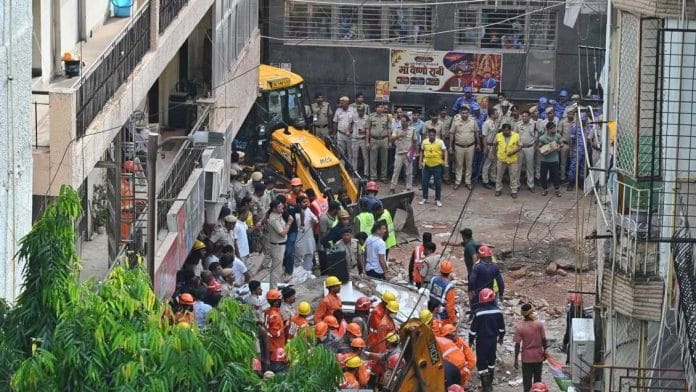

The Satya Niketan collapse feels painfully familiar to me for two reasons.
I come from Devli, an urban village in South Delhi, where narrow lanes, incremental construction, overloaded infrastructure, and the difficulty of emergency access are everyday realities.
I also graduated from Aryabhatta College, just a short distance from Satya Niketan. Friends and batchmates lived in these lanes. I have climbed those staircases and sat inside those tiny rented rooms.
Students often joked about the size of their rooms, the wires hanging overhead, the lack of ventilation, and the bathrooms squeezed into impossible corners. We treated these things as inconveniences because that is what young people learn to do when they cannot afford alternatives. You adjust and share. You tell your parents the room is fine.
That memory looks different after seven people were killed when a five-storey PG building in Satya Niketan collapsed on September 6. Preliminary investigations are examining unauthorised basement work and alterations to an ageing structure; the building had reportedly been sanctioned originally for far fewer floors.
The tragedy forces an uncomfortable question: when affordable student housing exists largely in spaces everyone knows are unsafe, how voluntary is the risk that students are supposedly taking?
The room is only the end of a much longer failure
It is easy to begin with a greedy landlord. There are certainly landlords who subdivide houses beyond reason, build additional floors, misuse basements, ignore fire norms, and extract extraordinary rents from desperate students. They must be held accountable.
But stopping there lets Delhi off too easily.
Delhi University reportedly has more than 2.5 lakh students but only around 9,000 hostel beds. The overwhelming majority must therefore find accommodation elsewhere.
And this is not merely a Delhi University problem. For decades, Delhi has accumulated universities, colleges, coaching institutes, hospitals, offices and employment without developing anything resembling an adequate affordable rental-housing ecosystem around them.
The market naturally filled the vacuum. That is how ordinary residential neighbourhoods became enormous informal student cities: Mukherjee Nagar, GTB Nagar, Vijay Nagar, Kamla Nagar, Satya Niketan, Ber Sarai, Katwaria Sarai, Jia Sarai, Munirka and Laxmi Nagar, among others.
Some are planned neighbourhoods. Some are urban villages. Some contain unauthorised or heavily modified construction. Their histories and legal statuses differ, and we should resist collapsing them into one category.
What connects them is inadequate institutional housing.
A two-room house becomes a PG. A basement becomes a library or classroom. Another floor appears. Balconies are enclosed. Electricity loads multiply. Hundreds or thousands of students arrive, while roads, drainage, parking, fire access, sewerage, and open space remain substantially what they were.
This is not just informality but a parallel student-housing system that Delhi depends upon but has never seriously planned for.
The geography of aspiration has become a geography of risk
The people living in these rooms are often 18, 19 or 20 years old. Many have arrived from small towns and villages carrying an extraordinary amount of family aspiration. Their parents are paying college fees, coaching fees, deposits, food, metro fares and rent. An additional ₹5,000 or ₹10,000 a month can decide where their child lives.
We should therefore be careful with the comfortable middle-class question — why would anyone live in such a building? — when safer rooms cost more, hostel beds are scarce, long commutes are exhausting, and many families are already stretching their finances simply to keep a child studying in Delhi.
Affordability is itself a safety issue.
No government can provide a hostel room to every student or aspirant. Nor should private rental housing disappear. But if the city structurally relies upon private PGs to house its student population, regulating that ecosystem is no longer optional.
Also Read: Collapsed building in Satya Niketan housed 75-bed PG; ‘ground floor was under repair’
We have seen the warning before
In Mukherjee Nagar in 2023, students trapped by a coaching-centre fire escaped through windows, using ropes and wires; police said 61 students and some staff sustained injuries.
In July 2024, 26-year-old UPSC aspirant Nilesh Rai died after coming into contact with an electrified gate on a waterlogged street near Patel Nagar.
Days later, three aspirants drowned in Old Rajinder Nagar after water entered the basement of Rau’s IAS Study Circle, where a library was operating even though the basement had been cleared for storage.
And in 2026, the problem has hardly disappeared. A fire at a B&B in Hauz Rani killed 22 people, while a nearby building collapse killed six, prompting yet another crackdown on unauthorised structures.
Now, there is Satya Niketan. But an eerily familiar sequence follows throughout these events: tragedy, outrage, inspections, sealing, suspensions, committees, and then the city’s attention moves elsewhere.
Urban villages expose Delhi’s larger contradiction
Satya Niketan also belongs to a larger story about how Delhi has urbanised.
Places such as Ber Sarai, Katwaria Sarai, Jia Sarai and Munirka became extraordinarily valuable because they supplied something other areas did not provide adequately: relatively inexpensive rooms close to universities, institutions and employment.
This is why I am uncomfortable to simply describe urban villages as the problem.
Yes, unsafe construction exists. So do landlord profiteering, unauthorised additions and political patronage. Villagers cannot be exempted from responsibility merely because their settlements are old.
But the state cannot spend decades benefiting from a neighbourhood’s informality and discover only after a tragedy that informality was entirely the neighbourhood’s fault.
Delhi’s urban villages were surrounded by the expanding city, but were never fully integrated into its planning, infrastructure and regulatory systems.
Their fields disappeared into institutions, colonies and roads. Their population multiplied. Rental markets exploded. Yet the original settlement frequently remained trapped within lanes and infrastructure designed for an entirely different scale of life.
Delhi effectively removed much of the rural economy surrounding these settlements without completing their urban transition.
Then it called the resulting landscape unplanned.
This problem goes far beyond villages
The same dysfunction appears in different forms across Delhi.
Unauthorised colonies emerged because formal development failed to keep pace with demand. Older apartment buildings undergo repeated renovations and structural alterations. Basements acquire spaces for which they were never designed.
Farmhouses, colonies and commercial establishments exist through complicated histories of enforcement, regularisation and political accommodation.
In places such as Sangam Vihar, adjacent to my village Devli, people themselves have had to negotiate deficits in basic urban infrastructure.
At the other end of the economic spectrum lies Sainik Farms, a reminder that informality in Delhi is hardly synonymous with poverty.
Burari’s changing agricultural landscape, urban villages, unauthorised colonies and ageing planned housing may look like separate planning problems. But they are connected by a deeper institutional habit: Delhi frequently allows urban reality to develop first and attempts to regulate it afterwards.
By then, livelihoods, rents, investments and political constituencies have formed around the violation. Enforcement becomes socially disruptive and politically expensive. So exceptions are made, until something collapses.
From exclusion to absorption without integration
This is where the student-housing crisis meets Delhi’s larger problem of fragmentation.
Delhi is not one coherently governed urban fabric. It is an archipelago of planned colonies, urban villages, unauthorised colonies, resettlement colonies, JJ clusters, old settlements and newly commercialised neighbourhoods, often operating under different regulatory histories and receiving radically different levels of infrastructure.
Two neighbourhoods can sit across a road from each other and experience the state very differently. That is a form of administrative ghettoisation.
The danger now is that Delhi moves from decades of neglect to redevelopment and commercialisation directly, without solving the intervening question of integration.
The people actually living there enter the planning conversation somewhere near the end.
But student housing should be treated as integrated infrastructure, and we need to change the premise.
A university does not only consist of classrooms, faculty, and a campus gate. If tens of thousands of young people migrate to study there, where they sleep is part of the educational infrastructure too.
Delhi needs a transparent registry of PGs and student accommodations, periodic structural and fire-safety audits proportionate to building age and occupancy, enforceable standards for basements and exits, and public information that allows an 18-year-old renter to know whether the building being offered to them is safe.
Universities cannot wash their hands of what happens outside their gates either.
Delhi should seriously examine whether suitable public land, including land already available with public institutions or government agencies, can support affordable student accommodation rather than leaving the entire burden to an improvised rental market.
When village or former Gram Sabha land is considered for student housing, its ownership and legal status must first be clarified, and affected communities should be consulted. The need for affordable housing cannot become a justification for ignoring existing claims to village land.
Further, the answer cannot simply be demolition. Abruptly sealing thousands of affordable rooms without alternatives merely pushes poorer students farther away or into another unregulated market.
Regulation without affordable supply can reproduce the very danger it seeks to remove.
The question Satya Niketan leaves us with
When I think about Satya Niketan, I keep returning not to policy documents but to those rooms I visited as a student.
Mattresses, tables, clothes hanging wherever space allowed. Two or three young people trying to construct a temporary home in a city they had come to because education promised them a different future.
There is something deeply wrong when the price of that aspiration includes quietly accepting risks that wealthier people would never be asked to accept.
The students who died did not design Delhi’s housing policy. They did not create the shortage of university hostels. They did not write building regulations, approve additional floors, inspect basements, maintain drains or decide which violations would be tolerated.
They simply needed somewhere they could afford to live. That is why Satya Niketan cannot be allowed to become another entry in Delhi’s archive of preventable tragedies.
The question is no longer whether Delhi has unsafe student housing. We know that it does. The question is why the city continues to recognise the crisis building by building, body by body, instead of accepting that student housing itself is an urban-planning responsibility.
And perhaps the most uncomfortable question is the simplest: Why does regulation in Delhi so often arrive only after the ambulance?
Puneet Singh Singhal is the Co-founder of Billion Strong and the founder of Green Disability and Dilli Dehat Project
Rajwardhan Singh is a public policy analyst, writes on urban planning on his Substack, and also hosts a podcast called “Indicast”.
Edited by Maryam Hassan