




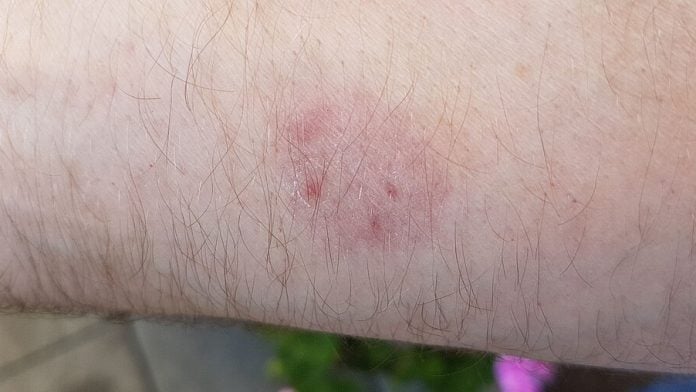

A circular, itchy, or scaly rash often makes people think of ringworm. India’s heat and humidity favour fungal growth, but not every ring-shaped rash is fungal. The wrong cream, particularly a steroid combination, can delay recovery and worsen the condition.
Ringworm is a superficial infection caused by dermatophytes, fungi that feed on keratin in the skin, hair, and nails. Medically, it is called tinea.
What does genuine ringworm look like?
Classical ringworm, or tinea corporis, often begins as a small, itchy patch that gradually expands. It typically forms a circular or oval lesion with a slightly raised, scaly outer border and a relatively clearer centre. The active edge may look red or inflamed as the infection spreads around the periphery.
Appearances can be deceptive, particularly on Indian skin. In darker skin tones, fungal lesions may look brown, grey, violaceous, or darker than the surrounding skin. They may not become ring-shaped, especially in those who oil their body or apply an anti-itch cream containing steroids from a chemist OTC.
It can affect different sites: peeling and cracks between the toes; itchy inner thighs; scalp scaling, broken hair and hair loss; or thickened, discoloured nails, especially in people with poor immunity such as uncontrolled diabetics.
When a rash looks like ringworm but isn’t
Several common skin conditions can closely resemble fungal infections. Nummular eczema produces round, itchy, dry patches. Unlike ringworm, however, scaling here covers the entire lesion rather than concentrating at its advancing edge.
Psoriasis can cause well-defined, scaly plaques, sometimes with a circular appearance. Lesions on the elbows, knees, scalp, or nails may provide useful clues.
Contact dermatitis after exposure to cosmetics, detergents, fragrances, or jewellery can cause redness, itching, swelling, or blisters. Pityriasis rosea may begin with a larger oval patch followed by smaller lesions on the trunk. Insect bites and other inflammatory conditions can also resemble infection.
These conditions need different treatments. An antifungal cream will not cure eczema, just as a steroid cream will not eliminate a fungal infection.
Also read: Mumbai’s sea is not Times Square. Don’t put billboards on it
The steroid cream trap
A major challenge in India is the unsupervised use of combination creams containing antifungals, steroids, and sometimes antibiotics.
Steroids temporarily suppress redness and itching, making a rash appear better. However, they can suppress the local immune response and allow fungus to spread. The infection may become extensive, less recognisable, and harder to treat.
This altered presentation is called tinea incognito. Instead of a typical ring, the patient may develop poorly defined patches, widespread inflammation or follicular bumps. Repeated use of potent topical steroids can also cause skin thinning, stretch marks, and visible blood vessels, particularly on the groin and face.
So, never use a steroid-containing combination cream on an undiagnosed rash without medical advice.
Why fungal infections keep returning
Ringworm can spread easily within a household. I sometimes tell patients that an untreated infection can turn someone into a family Wi-Fi transmitter: one person develops ringworm, another starts itching weeks later, and soon several family members are affected.
Shared towels, bed sheets, clothing, footwear, and grooming equipment, as well as close skin-to-skin contact, can facilitate transmission. Sometimes, infection returns not because medication is ineffective, but because the source of reinfection has not been addressed.
If several family members are affected, treating one person may not be enough. Wash and thoroughly dry towels and clothes, change bed sheets regularly, avoid sharing grooming items, and keep bathrooms clean and dry.
Decluttering, ventilation, separate towels, and regular laundry also help. Anyone with a suspicious rash should be examined rather than sharing medication. Sometimes the problem is not resistance but repeated reinfection.
Also read: Why is Sabrina Carpenter silent on Nagpur’s plywood inflation? Desi Instagram wants to know
How can a dermatologist confirm the diagnosis?
Clinical examination is helpful, but visual assessment alone is not always enough. If the diagnosis is uncertain, recurrent, or unresponsive to treatment, a simple test can make a difference.
A dermatologist may scrape scale from the active edge of the lesion and examine it under a microscope using potassium hydroxide (KOH). The presence of fungal hyphae supports the diagnosis, although results must be interpreted alongside the clinical examination.
Culture may be advised for persistent, extensive, or resistant infections. Dermoscopy offers further clues, while scalp and nail disease may require specific samples and oral antifungal treatment.
Reports of difficult-to-treat dermatophytes make accurate diagnosis and prescribing essential.
When should you seek medical attention?
You should see a dermatologist if a rash spreads, returns, affects several family members or fails to improve. Seek prompt care for pain, swelling, pus, fever, rapidly spreading redness, or scalp hair loss. Extra caution is needed with diabetes or weakened immunity.
Keep skin folds and feet, especially between the toes, dry. Change out of sweaty clothes, wear breathable fabrics, and do not share towels, clothing, footwear, or grooming tools. Take precautions when someone at home has a confirmed infection.
Ultimately, a rash is a symptom, not a diagnosis. A circular patch does not automatically mean ringworm, and itching does not always indicate infection. The smartest next step is an accurate diagnosis, not rushing to the pharmacy for a steroid cream.
Dr Deepali Bhardwaj is a Consultant Dermatologist, Max Hospital, Saket. She is also an anti-allergy specialist, laser surgeon and internationally trained aesthetician. She tweets @dermatdoc. Views are personal.
(Edited by Prasanna Bachchhav)