




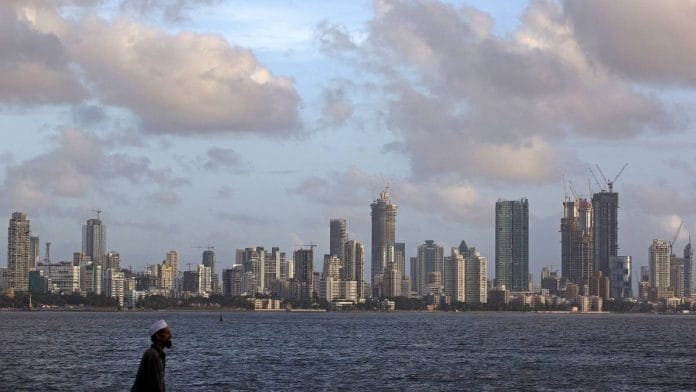

Bombay has always been described in terms of ambition, work and money. But where do people go when they want to do none of those things?
To the sea.
You can sit at Juhu for hours on a Sunday and achieve absolutely nothing. Walk along Worli Sea Face before work. Talk to somebody. Watch the water. Sit quietly.
That kind of space matters in a city with very little of it. Homes are small, land is expensive, and everywhere you look, there is a building being demolished, redeveloped or built. Delhi has parks and gardens spread across the city. Bombay has far fewer places where you can get away from buildings, traffic and construction without paying to be somewhere.
Which is why the Maharashtra Maritime Board’s plan to put floating advertisements off Juhu and Worli bothers me.
The sea is not just another feature of Bombay’s landscape. It is central to how the city sees itself, and how the rest of the country imagines it.
Project Cinema City has written about how Bombay’s lack of breathing room pushed filmmakers repeatedly towards the seafront, until places like Marine Drive and Juhu became shorthand for the city on screen. Historian Gyan Prakash has written that, before he ever came to Bombay, Marine Drive, Chowpatty and Juhu Beach already existed in his mind through Hindi films.
The coastline, then, is not merely somewhere people go. It is part of the city’s identity.
And unlike most things in this city, access to that experience is not determined entirely by money. Someone living in a sea-facing apartment and someone who took the local train to Juhu can still sit in front of the same water.
That is a rare kind of equality in a city where so much is divided by income and access.
But even that access stops at the waterline. For most Mumbaikars, the sea is something to sit beside and look at, not something they can safely use.
Pollution remains a serious problem. The BMC’s own environmental monitoring has found sewage contamination around marine outfalls, while water-quality testing at Juhu has recorded high levels of faecal contamination.
There is a lot the city could still do to make the water cleaner, safer and more usable. Yet one of the ideas now being considered for the coastline is to place illuminated advertising structures in the sea.
That is a strange order of priorities.
The city has not made the sea more accessible or usable for the people who live beside it. But it has found a way to make money from the fact that they already gather there.
There is also a difference between a hoarding on a building and one sitting out in the water. A building has owners who can choose to rent out its façade. The water off Juhu and Worli is part of a view shared by everyone along that stretch of coast. The state can regulate what happens there, but that does not make the view a piece of commercial real estate waiting to be leased.
The advertisements raise environmental questions too. Experts have warned about light pollution and possible effects on marine life. The sea is already dealing with sewage, garbage and the effects of construction along the coast. Adding illuminated commercial structures to the water does nothing to improve its condition or its value as a public space.
The government says the advertisements can raise revenue for maritime and transport projects.
But the coastline does not need a commercial purpose to justify its existence.
Juhu does not need to earn more money to justify the thousands of families who spend their evenings there. Worli Sea Face does not need another commercial purpose to justify the people who walk and sit there every day.
Mumbai should have much bigger ambitions for its sea than finding new ways to advertise on it.
(Edited By Raunaq Lekhi)