



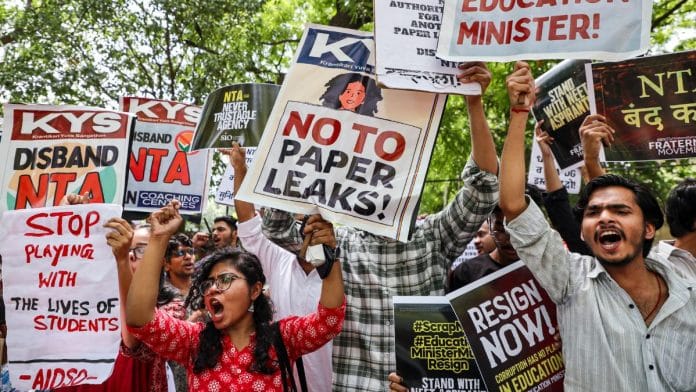

Every time a major paper leak occurs in India, we witness the same ritual. Opposition parties demand resignations. Television studios conduct trials before investigations begin. Hashtags trend. Students protest. Governments defend themselves. And within a few weeks, the debate shifts elsewhere until the next scandal erupts.
The problem with this approach is that resignations may satisfy public anger, but they do not solve systemic failures. If the objective is genuinely to protect students, then India must move beyond outrage and ask a harder question: what actually works?
To answer that question, it is useful to begin not with NEET or the National Testing Agency (NTA), but with Uttar Pradesh.
Also Read: In India’s NEET and CBSE exam crisis, the only adults in the room have been children
UP’s old cheating ‘debate’
Older Indians will remember a time when Uttar Pradesh was almost synonymous with examination malpractice. Mass copying was not an exception; in many places it had become an industry. Entire local ecosystems evolved around helping students pass examinations through unfair means. Students from nearby states such as Punjab and Haryana used to pay cheating mafias of UP and get their 10th and 12th certificates. Images of people climbing school walls to pass chits became international news. Parents, local politicians, school administrators, invigilators, and organised cheating networks often formed a chain in which everyone benefited except the honest student.
It was against this backdrop that former Chief Minister Kalyan Singh introduced one of the toughest anti-cheating measures in the country. In 1992, the Uttar Pradesh government promulgated the Uttar Pradesh Public Examinations (Prevention of Unfair Means) Ordinance, popularly known as the Anti-Cheating Act. The message was blunt: cheating was not a harmless shortcut; it was a crime against merit. The law made cheating and aiding cheating punishable offences and significantly increased the risks associated with examination malpractice.
What happened next is politically revealing even today.
When Mulayam Singh Yadav came to power in 1993, the Anti-Cheating Act was repealed. It sent a clear signal—that the state was no longer serious about tackling cheating. The political debate itself is instructive. In most countries, governments compete over who can improve educational standards. In Uttar Pradesh during the 1990s, one of the most visible educational debates was whether anti-cheating laws should exist at all.
That debate never fully disappeared.
Years later, during his tenure as Chief Minister, Akhilesh Yadav made remarks from a public stage suggesting that some amount of cheating was common and asking who had not done so in examinations. It was clear evidence of a deeper political attitude toward academic dishonesty. If leaders treat cheating as a minor social reality, institutions tend to adapt accordingly. If leaders treat cheating as corruption, institutions respond very differently.
This is why the experience of Uttar Pradesh after 2017 is relevant.
Yogi’s anti-cheating playbook
When Yogi Adityanath became Chief Minister, his government approached cheating not as an unavoidable social habit but as a governance challenge. Instead of merely increasing punishments, the administration attempted to identify the specific mechanisms through which cheating mafias operated. The Yogi government identified four clear methods used by cheating mafias to service the students who paid them.
The first method was impersonation, commonly known as the solver method. A weak candidate would pay money, while a brighter student would sit for the examination in his place. The solutions included stronger identity verification, photographs, Aadhaar-linked checks, biometric mechanisms, and tighter scrutiny. Together, they dramatically increased the difficulty of impersonation.
The second method was mass cheating at examination centres. Here, the challenge was institutional collusion. If the centre management, invigilators, and local operators worked together, entire examination halls could be compromised. The Yogi government responded by tightening centre-selection norms, introducing CCTV monitoring, enforcing infrastructure requirements, and expanding surveillance. Suddenly, cheating centres became much harder to operate.
The third method involved answer-sheet manipulation. Allegations ranged from page replacement to post-examination tampering. In response, coded answer sheets, page numbering, barcodes, and stricter custody procedures were introduced by the Yogi government. Every page became traceable. The scope for manipulation narrowed drastically.
The fourth method was question-paper leaks. To counter this, the government prepared three sets of papers from the start and tracked their movement through GPS.
Overall, the result was striking. In several examinations, large numbers of students simply stopped appearing. One thing became clear: when cheating becomes difficult, the behaviour of the system changes.
Yet even after these reforms, paper leaks have persisted. And this is where the national debate often becomes intellectually lazy.
The paper leak challenge
Many people speak as though paper leaks are simply the result of bad intentions. The reality is more complicated. A question paper exists digitally before it is printed. It exists physically during printing. It exists during packaging, transportation, storage, and distribution. At every stage, human access creates vulnerability. The uncomfortable truth is that any examination system dependent upon millions of printed papers moving across thousands of kilometres will always face leakage risks.
One could argue that previous governments often swept such incidents under the carpet and allowed compromised examinations to continue, which is why many leaks never became major national controversies. The criticism of the current government is different: it has chosen to cancel examinations whenever credible evidence of a leak emerges. While that may increase public attention and inconvenience students, it does not absolve the government of its responsibility to conduct examinations that are secure, fair, and robust in the first place.
This is particularly true for high-stakes examinations such as NEET.
More than twenty lakh students compete through a single examination. One paper. One day. One result. A medical seat can transform a family’s future. The incentives are enormous. Criminal networks understand this. The value of a leak rises in direct proportion to the stakes involved.
This is also why comparisons with UPSC and JEE are important. UPSC involves three stages—Prelims, Mains, and interview. Success requires performance across multiple filters. JEE similarly involves JEE Main and JEE Advanced. The value of compromising one stage is limited because another stage still remains. NEET concentrates extraordinary stakes into a single examination. That structural reality increases the incentive for organised fraud.
Also Read: Next epic election will be UP 2027. Akhilesh Yadav is hardly ready for Yogi Adityanath
Build leak-proof exams
If we are serious about solutions, the first answer is obvious: computer-based testing.
The world solved this problem decades ago. GRE, GMAT, TOEFL, and numerous professional examinations abroad have operated successfully through digital systems.
India has already demonstrated the capability to conduct large-scale computer-based testing. JEE Main became fully computer-based in 2019 under the Modi government. This was a paradigm shift in how India conducts large-scale competitive examinations and involved much more than administrative reforms. Testing centres had to be discovered, certified, and expanded. Private players had to invest in infrastructure. Security protocols and SOPs had to be written, tested, and refined.
Over time, the NTA built the capability to conduct JEE at a national scale for nearly 14-15 lakh candidates. In doing so, it created a proven template for the future of Indian testing.
The NTA itself was established in 2017 to professionalise large-scale examinations and separate testing from the day-to-day functioning of individual ministries and boards. Like every institution, it has faced challenges. But the answer to those challenges cannot be abandoning modernisation. The answer is accelerating it.
Moving NEET to a computer-based format will not be easy. While the infrastructure and expertise exist, exam-specific adaptations will have to be made. Additional centres will need to be created, as NEET aspirants are far more than JEE aspirants. Capacity will need to expand. Rural accessibility concerns must be addressed. But these are implementation challenges, not conceptual barriers. There will be debate over normalisation of scores and ranks based on the toughness of the paper in different shifts.
The second solution is encrypted centre-level printing. Instead of transporting printed papers across India, encrypted files can be transmitted securely and decrypted shortly before the examination begins. This dramatically reduces exposure points.
The third solution is randomised question banks and multiple paper variants. The less valuable a single paper becomes, the less attractive it is to leak.
Finally, India needs a cultural shift.
Any politician like Akhilesh Yadav who laughs at and normalises cheating in school should not be surprised when corruption appears elsewhere.
The real divide in this debate is not between ruling parties and opposition parties. It is between two philosophies. One says cheating is inevitable, so learn to live with it. The other says cheating is a problem, so build systems that make it difficult.
One philosophy asks for excuses. The other asks for solutions.
Resignations may dominate headlines, but solutions determine whether the next generation trusts the system. And the solutions lie in meticulous usage of technology and process re-engineering.
Shantanu Gupta is the author of ‘The Monk Who Became Chief Minister’, a biography of UP Chief Minister Yogi Adityanath. He tweets @shantanug_. Views are personal.
(Edited by Asavari Singh)
The state his fav is governing had 3 paper leaks in 2024 for important exams and similar incidents in 2021. Resignation along with showing accountability exists,shows consequences also do because most of these paper leaks are a result of someone being very confident that the system will.protect them
So no resignation is necessary.
This time paper setter leaked the questions. What about this possibility elimination?
Sir,why can’t BJP government at centre can learn from bjps UP government? Should Union Education minister not take responsibility to not learn? If the same mistake is repeated, some one must be held accountable.