



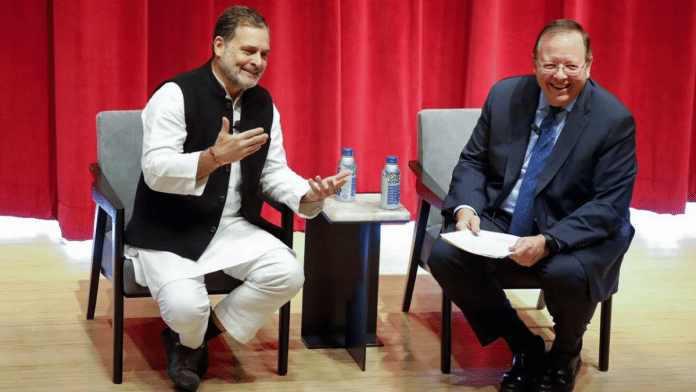
Rahul Gandhi’s comments in Chicago on India-Israel relations have generated vocal criticism from the Left. But context matters, and it’s not usually visible in short social media clips. Gandhi was not outlining his stance on the Israel-Palestine question or on Israel’s war in Gaza. He was responding to a specific question about whether Prime Minister Narendra Modi was too close to Israel, and if this was hampering India’s relations with other countries.
Gandhi gave a measured reply, saying that India and Israel have longstanding ties but India is larger than Israel and “our foreign policy should be based on what’s good for us and not based on what’s good for someone else.” This statement speaks directly to debates in the US over the influence of pro-Israel lobbies like AIPAC. In an April 2026 Washington Post-ABC-Ipsos poll, 52 per cent of Americans said that Israel had “too much” influence on the US decision to go to war with Iran.
In the Indian context, Gandhi’s statement was a thinly veiled criticism of Modi’s kowtowing to Israel, including his poorly timed visit to Tel Aviv and Jerusalem in February, only two days before the US-Israeli strikes on Iran. Israeli human rights lawyer Eitay Mack wrote at the time that Modi “acted and spoke like the leader of a minor state visiting a global power, desperate to curry favour.”
Gandhi went on to condemn both the 7 October 2023 attack by Hamas and Israel’s brutal military campaign in Gaza, without using the word ‘genocide’. But a brief, pointed answer to a specific question does not represent the sum and substance of a leader or his party’s position.
Also read:Congress terms Israel’s actions in Gaza as ‘genocide’, seeks ‘immediate ceasefire’
Congress’s position on Israel and Palestine
Consider the Congress party’s statements since the war began in 2023. Sonia Gandhi has repeatedly criticised Israel’s conduct, most recently writing that “in the two-and-a-half years since the dastardly, horrific, and absolutely unacceptable attack by Hamas on Israel, it has become clear that the retaliation of the Israeli armed forces and political leadership has been characterised by wanton cruelty and barbarity”. She also said that some Israeli leaders have displayed “clear genocidal intent”. Her statements were amplified and reposted by Congress president Mallikarjun Kharge and Rahul Gandhi.
Priyanka Gandhi Vadra has on several occasions used the word genocide to describe Israel’s actions in Gaza. Jairam Ramesh, the party’s communications head, has described Israeli actions in Gaza as an “ongoing genocide”.
The Congress party has, therefore, condemned both the Hamas attack that killed 1,219 people, most of them Israeli civilians, and the Gaza war in which more than 74,000 Palestinians, including nearly 22,000 children, have been killed, according to UNICEF. Rahul Gandhi’s statement was a continuation of that position, even if he did not use the word “genocide”.
This is rather different from the Modi government’s stance. Modi was quick to condemn the Hamas attack as terrorism, but his much weaker condemnation on 17 November 2023 mentioned “the deaths of civilians in the conflict between Israel and Hamas”, assigned responsibility to no one. Apparently, civilians just died.
Contrast this with the UPA government’s 12 June 2006 Ministry of External Affairs statement condemning “the killing of innocent civilians, including women and children, in Gaza by the Israeli Defence Forces in an unprovoked attack”. India did eventually vote for the non-binding New York Declaration on the two-State solution between Israel and Palestine in the UN General Assembly in September 2025. But the Modi government has never said that in its own words. But the two-State solution is a longstanding Indian position, and there is nothing unique about the government agreeing to it.
Also read: Israel war on Gaza has gone beyond ‘right to self-defence’ to ‘responsibility to protect’
Realism and idealism in Congress foreign policy
Some of the criticism of Rahul Gandhi draws on false binaries. JNU Professor Emerita Zoya Hasan described his interview as “a distinctly ‘realist’ and ‘nationalist’ position on foreign policy”, which, in her view, departed from Congress party traditions. But this is an oversimplification: the Congress party has always blended realism and nationalism with idealism in its conduct of foreign policy.
According to political scientist Nicolas Blarel, even while standing with Arab nationalism and the non-aligned movement, Jawaharlal Nehru “shared ideological affinities and socialist leanings with some eminent Jewish leaders like Chaim Weizmann and David Ben-Gurion”. His government recognised the state of Israel on 17 September 1950. And during the 1962 war with China, India sought Israeli military supplies, as it did again in 1965 and 1971.
Under Indira Gandhi, India tilted towards idealism, recognising the Palestine Liberation Organisation (PLO) in 1974 as the sole legitimate representative of the Palestinian people. It also co-sponsored the UN General Assembly Resolution 3379 in November 1975, which equated Zionism with racism. But here too realism played a role; the oil shock of 1973 had deepened India’s dependence on Gulf oil.
Rajiv Gandhi showed willingness to establish relations with Israel. He met Shimon Peres at the UN in 1985, the first public meeting of Indian and Israeli prime ministers. Yet, Rajiv Gandhi also strongly criticised Israel’s crushing of the Intifada in July 1988 and recognised the State of Palestine in November 1988. PV Narasimha Rao established full diplomatic relations with Israel in January 1992, once the Madrid conference had opened direct Arab-Israeli talks.
Gaza raises the moral stakes, which is why so many Congress leaders have called it genocide. Several Israeli genocide scholars have also described Israeli actions as genocide. Last week, the International Court of Justice found Myanmar responsible for committing genocide for the first time. The same court is hearing South Africa’s case against Israel. ‘Never again’ has to mean something.
Condemning genocide has not meant severing ties elsewhere either: Brazil, Indonesia, Mexico and South Africa all use the word, yet only Turkey has halted trade with Israel.
A state has to look out for its interests, and those interests can require difficult compromises. But passing instant judgment on part of an answer while ignoring both Congress’s history and the current recalibrations on Israel-Palestine around the world adds heat, not light to this debate.
Amitabh Dubey is a Congress member. He tweets @dubeyamitabh. Views are personal.
(Edited by Prashant Dixit)