






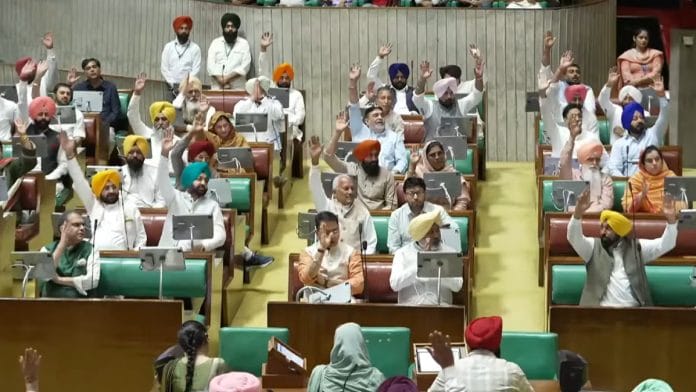


One of the most familiar rituals in Indian households was asking a parent to sign a school diary or consent form, which was often delivered without even skimming the pages. We are similarly casual with employment contracts and insurance policies. It is perhaps this larger social habit that explains the unsettling revelation last week: Punjab MLAs had passed the state’s new anti-sacrilege law without fully reading it.
On 29 June, Sikh legislators across parties appeared before Sri Akal Takht Sahib over the Jaagat Jot Sri Guru Granth Sahib Satkar (Amendment) Act, 2026. The Shiromani Gurdwara Parbandhak Committee and the Takht had objected to both the lack of consultation and parts of the law itself. These issues are significant and deserve careful public debate. But what was most concerning was that several lawmakers acknowledged they had not gone through the text of the Bill before supporting it.
The episode followed the usual pattern of wrangling between the government and the Opposition. But the legislators’ admissions raised a deeper constitutional question—one that was largely lost amid the political exchanges.
The duty behind the vote
What does representative democracy expect of a legislator?
Legislatures are not created merely to record numerical majorities. They exist to deliberate. Every Bill introduced before an Assembly is expected to be examined, questioned and debated before it becomes law. Members may vote according to party discipline, but this cannot replace personal understanding.
Reading proposed legislation is not an additional responsibility or a mark of exceptional diligence, but the minimum constitutional threshold for exercising legislative authority.
In this case, the MLAs’ admission becomes even more significant when viewed in the context from which the legislation emerged.
What happened in the Akal Takht hearing
Punjab has spent nearly a decade seeking justice in the sacrilege cases that transformed the state’s politics. The 2015 Guru Granth Sahib desecration at Bargari and related incidents, followed by police firing on protesters at Behbal Kalan and Kotkapura, profoundly damaged public trust in political institutions.
The Shiromani Akali Dal-BJP government defended its actions, the Congress sought power promising justice and institutional reform, and the Aam Aadmi Party similarly assured Punjabis that those responsible would finally be brought to justice.
Around ten years later, however, the political conversation shifted. Instead of convictions in the original cases, attention became centred on a new law meant to strengthen punishment for sacrilege.
The Punjab Assembly unanimously passed the Jaagat Jot Sri Guru Granth Sahib Satkar (Amendment) Bill, 2026, on 13 April, introducing harsher punishment for acts of sacrilege. However, questions were raised about whether adequate consultation had taken place before introducing legislation concerning matters of profound religious significance.
In a conversation with me, Giani Kuldeep Singh Gargaj, the acting Jathedar of the Akal Takht, said: “Eh pehla kanun hai jis vich ohna ton hi nahi puchheya ja reha jina de sambandhit eh kanun hai” (This is perhaps the first law being framed without consulting the very people and institutions it directly concerns).
He argued that one of the most unusual aspects of the proposed law was that it could extend legal responsibility beyond the accused to those entrusted with the care and custody of Sri Guru Granth Sahib Ji. If an incident of sacrilege occurred, they too could face proceedings for alleged negligence. This, he said, was one of the principal reasons why wider consultation with the concerned Sikh institutions was necessary.
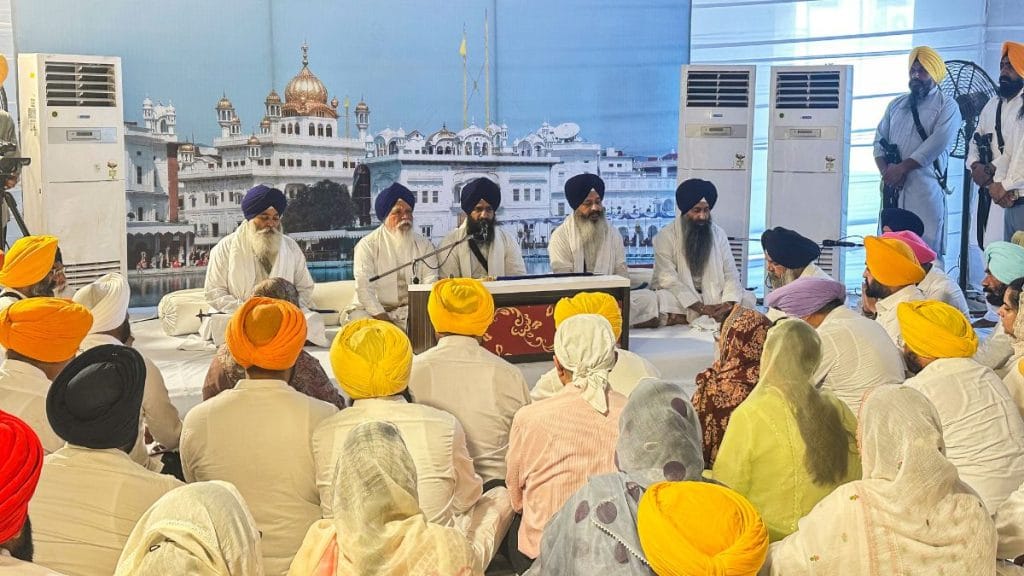
This led the Akal Takht—the highest temporal seat of the Sikhs—to summon Punjab’s Sikh MLAs and ministers for a hearing to explain the circumstances under which the Bill had been passed. It was during those proceedings that the legislators acknowledged that they had not read the Bill before supporting it.
When Jathedar Giani Kuldeep Singh Gargaj questioned AAP MLAs Jagroop Singh Gill and Kulwant Singh on the contents of the proposed legislation, both admitted they had not read the Bill and had merely signed it. They added that they had not been given enough time to study the legislation before it was placed before them.
The hearing exposed another troubling detail. When AAP MLA Manjeet Singh was asked to explain “custodian”, a term central to the proposed legislation, he gave an incorrect definition. The episode suggested that the concern was not merely about procedural haste but about legislators being expected to support a law whose key legal concepts they themselves were unable to explain.
Beyond the sacrilege debate
Taken together, these exchanges shifted the debate beyond the politics of the sacrilege law to a more fundamental question about the legislative process itself.
When elected representatives openly acknowledge they did not read a Bill because they were not given adequate time, it is a clue that the problem is also institutional — a legislative process in which scrutiny risks becoming a formality rather than the central purpose of a legislature.
However, time constraints cannot justify supporting legislation without first understanding its contents. In a parliamentary democracy, legislative responsibility begins with the responsibility to read.
Besides, arguments about not having enough time to read and understand documents are less convincing today than they might have been five years ago. We live in an age where complex documents can be summarised, translated and explained within minutes by AI tools such as ChatGPT and Gemini. It’s quite possible to decode lengthy legal texts into plain language and even compare different versions of a Bill with a few basic prompts.
Ironically, many political leaders showcase their use of artificial intelligence on social media as evidence of being technologically progressive. If AI can be used to create speeches, captions, campaign material and videos, it is difficult to understand why it cannot be used for the far more important task of helping legislators understand the very laws they are expected to enact. Technology cannot replace judgement, but it can certainly remove the excuse of not having enough time to understand a Bill.
Also Read: Punjab’s anti-sacrilege law doesn’t guarantee justice. What more needs to be done
The real question before democracy
The admission of the Punjab MLAs should not be treated as just evidence of the failings of some leaders or one state government.
It should make us ask whether our legislatures are gradually surrendering the very function for which they were established.
A modern parliamentary democracy depends on informed deliberation. Legislators are expected to bring judgement to the legislative process, not just their presence. If proposed laws are no longer being personally examined by those entrusted with passing them, legislative debate risks becoming a procedural exercise rather than a meaningful constitutional safeguard.
Every political party that occupies legislative benches should honestly ask whether all its members consistently read every Bill before voting. Strong party structures and collective decision-making are integral to parliamentary politics, but they cannot become substitutes for independent legislative responsibility. If unquestioning approval gradually replaces informed scrutiny across party lines, the problem ceases to be political and becomes institutional.
The admissions before Sri Akal Takht Sahib also invite reflection beyond politics itself.
Legislators are part of the society that elects them. They, too, come from a culture in which reading has increasingly become secondary to approval, and where speed is often valued over reflection and careful examination.
If society has normalised signing without reading in everyday life, it should not surprise us that similar habits eventually appear within public institutions. Except, when a legislator supports legislation without understanding its contents, the consequences extend far beyond the individual
Laws determine rights, obligations, institutions, and public policy. They affect millions of citizens who rely upon their elected representatives to exercise informed judgement on their behalf.
That is why this episode deserves to be remembered not simply as a controversy surrounding one proposed law, but as a reminder of the standards upon which representative democracy ultimately depends.
Political controversies are temporary. Governments change, legislation is amended and public attention inevitably shifts elsewhere. Institutional culture, however, changes much more slowly. It is shaped by the everyday assumptions that societies gradually stop questioning. One such assumption is that understanding can be delegated while responsibility can still be claimed.
Democracy does not permit that distinction. The authority to legislate carries with it a corresponding obligation to understand what is being legislated. Without that obligation, legislative approval risks becoming little more than a ceremonial signature beneath decisions made elsewhere.
The proceedings before Sri Akal Takht Sahib held up an uncomfortable mirror, not only to elected representatives but also to society itself. The habit of signing without reading may appear harmless when it begins with a ‘papa sign kar do’ for a school diary, or a bank form, or a routine document. It becomes far more consequential when the signature belongs to someone entrusted with making the law.
Institutions are rarely weakened by dramatic crises alone. More often, they are diminished by ordinary habits that gradually become accepted as normal. Signing without reading is one such habit. When it enters the legislative process, it ceases to be a private failing and becomes a democratic one.
Damanjeet Kaur is a Punjab-based writer. Views are personal.
(Edited by Asavari Singh)