






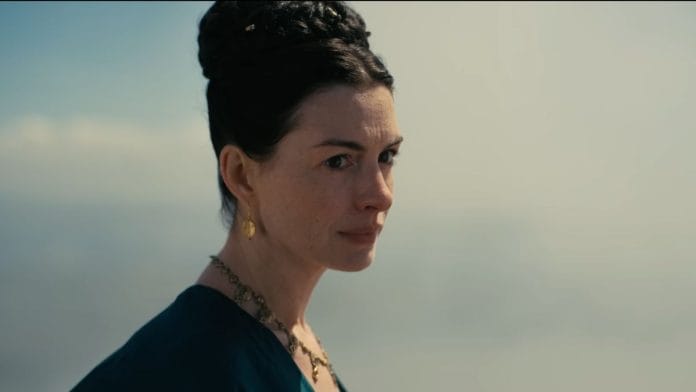

Filmmaker Christopher Nolan has long faced criticism for how he writes women. His female characters, as per critics, are often simply assisting the male protagonist’s story, as if their presence is nothing more than a box being checked. The Odyssey may finally put that criticism to rest.
The film still centres on Odysseus (Matt Damon) and his long road home after the Trojan War. But, the women around him are no longer just furniture. From Anne Hathaway’s Penelope to Samantha Morton’s Circe, and Zendaya’s Athena, they aren’t footnotes in The Odyssey. They are the ones doing the heavy lifting in the plot, especially Penelope.
History remembers her as the loyal wife who waited, but Nolan portrays how waiting was never a passive act.
She’s politically sharp, quietly manipulative — given the way she handles Antinous’ advances — and holds the entire kingdom together through sheer intelligence rather than any grand spectacle of power. Her battle has no swords, but it’s every bit as gripping as Odysseus’ misadventures at sea.
In a conversation with Telemachus (played by Tom Holland), she delivers the film’s sharpest line, which definitely is my personal favourite: “The throne wasn’t empty for 20 years, I have been sitting on it.”
It lands as the result of years of pent-up frustration, after being endlessly pressured to remarry just so the kingdom could have a proper ruler.
Even the female characters with less screen time leave a dent. Take Charlize Theron’s Calypso, the nymph who keeps Odysseus stranded on her island. She barely registered as a footnote in Homer’s original text, but Nolan manages to give her character, and some depth. Calypso could have been just a passing role, but Nolan shows that she is lonely, conflicted, and trapped by her own immortality. She is cursed to watch everyone she loves eventually leave or die.
In the almost three-hour-long film, the one scene that sends chills down your spine is also headlined by a woman. Circe is the witch who turns men into pigs, but mythology has always painted her with more nuance. Nolan adapts that reading, letting Morton play Circe not as a villain but as a woman who grew up in a world built on male violence and entitlement.
Her scenes begin as spine-chilling, and by the time she and Odysseus finally face each other, their encounter turns into one of the film’s most thought-provoking exchanges.
Also read: Furore over Lupita Nyong’o’s Helen in Nolan’s Odyssey is about beauty standards, not Homer
A recurring pattern
In the past, Nolan’s female leads ‘allegedly’ lacked this depth and command on the plot.
One of the most cited examples is Inception (2010). Mal Cobb, played by Marion Cotillard, is one of the film’s most memorable characters, yet she primarily functions as a manifestation of Dom Cobb’s guilt. Her motivations, desires, and identity are largely filtered through his memories. She is central to the story, but only as an extension of the male protagonist’s emotional conflict.
A similar argument is made about The Prestige (2006). Sarah, Olivia, and Julia are pivotal to the rivalry between the two magicians, but their lives and choices are ultimately secondary to the men’s obsession. They are often caught in the crossfire of male ambition rather than being allowed independent narratives.
The sharpest criticism Nolan faced was for Tenet (2020). Kat, played by Elizabeth Debicki, has moments of agency, especially in the climax, but much of her role revolves around escaping her abusive husband and motivating the unnamed protagonist’s mission. Even in Oppenheimer (2023), which rewrote box office records, Jean Tatlock and Kitty Oppenheimer deliver powerful performances. I mean, Emily Blunt earned her first-ever Oscar nomination for Kitty. However, some critics argued that both women were largely defined by their relationship with J Robert Oppenheimer, with their inner lives receiving little exploration.
So, this recurring pattern has forced many critics in the past to describe Nolan’s women as orbiting the male lead rather than existing as protagonists in their own right.
Looks like it took Nolan to adapt one of the oldest stories ever told to finally shake off one of the oldest criticisms of his own filmography. Who knew the director obsessed with time simply needed to travel back 3,000 years to learn how to write women.
Views are personal.
(Edited by Aamaan Alam Khan)