






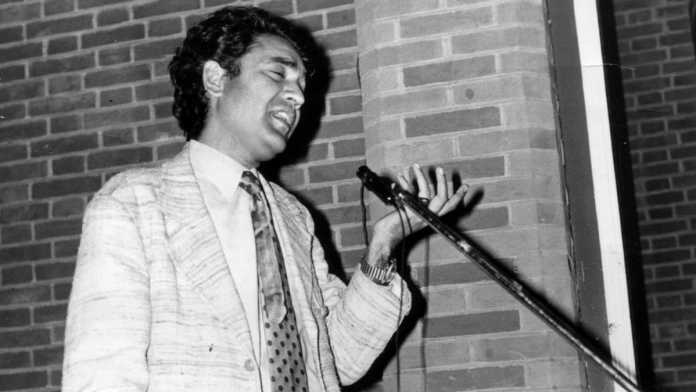


Shiv Kumar Batalvi drank himself to an early grave at 36 and never once had to worry about going viral. Yet, five decades later, millennials found him through Bollywood and Gen Z found him through reels. Together they made Batalvi cool again. His work remains relevant because heartbreak doesn’t die.
It’s rare for these two generations to agree on anything on social media, but Batalvi seems to be an exception. Because both generations, at their core, are yearners. And no one wrote longing better than Batalvi.
He is the original sad boy, and arguably more quotable than poets twice as famous. Everything he wrote circles back to one thread: Longing or birha. He wrote on love that was lost or unfulfilled so vividly that it refuses to fade.
One of his most popular works is the poem, Ikk Kudi Jihda Naam Mohabbat. It is about a girl named Love who has simply gone missing. The imagery Batalvi’s words create is so evocative that composer Amit Trivedi couldn’t hold back from pulling it into Udta Punjab. In the Alia Bhatt-starrer, the poem, dressed as a song, plays almost unchanged.
Diljit Dosanjh, who sang Ikk Kudi along with Bhatt for Udta Punjab, introduced Batalvi’s imagery to listeners who had never encountered him. The singer managed to capture the ache in Batalvi’s voice.
One of his most used poems in Bollywood is Ki Puchhde Ho Haal Fakiran Da. This poem, about the state of wandering, indifferent to worldly gains, has been recited, sung and sampled across decades of Punjabi folk music.
Artistes like Rabbi Shergill and Jasleen Royal have both drawn on Batalvi’s fakir imagery in their own compositions, using it as shorthand for a kind of detached, world-weary devotion that still resonates with listeners chasing meaning outside conventional ambition.
While its most famous versions are independent folk tracks sung by artistes like Mahendra Kapoor and Ghulam Ali, a variation of the line—Tu puchh naiyo haal fakira da—is the opening verse of the song Fakira in the 2019 film, Student Of The Year 2.
The lines also found its way to the Shah Rukh Khan starrer Dunki. They are played in the background when Vicky Kaushal, who plays Sukhi, finds out that his love interest Jassi has died of suicide.
But one of my favourite Batalvi poems which has been given a musical touch is Ajj Din Chadheya from Saif Ali Khan and Deepika Padukone-starrer Love Aaj Kal (2009). Batalvi is said to have written it when experiencing a heartbreak. He compared the day itself to his lover’s presence, describing sunlight as intoxicating and faintly dangerous, “like the bite of a poisonous snake.”
It was Punjabi singer Hans Raj Hans who first poured the poem into music in a 2002 album, Ghama Di Raat, dedicated to Batalvi. But it reached its widest audience through Love Aaj Kal.
Lyricist Irshad Kamil folded Batalvi’s own opening line straight into the Bollywood song, unable, apparently, to improve on the original phrase.
Also read: Dalit poet Lal Singh Dil was true ‘faqir’ who understood Punjab economy better than govt
Beyond the playlist
Music isn’t the only thing that keeps the poet, who died in 1973, alive. Social media, particularly Instagram, has basically become Batalvi’s afterlife.
There are social media pages dedicated entirely to Batalvi’s poetry, some with following in lakhs.
They post his verses as captioned reels and carousel slides, turning his work into a shareable format usually used for breakup memes and motivational quotes.
For a generation that discovers literature through their social media feed rather than a bookshelf, this has done more to keep him current than any curriculum could.
Some people go beyond just posting his poetry, they also narrate his stories, keeping him alive through conversations. They also break down individual poems line by line for listeners—who Batalvi wrote for, what he was longing for, what he had lost.
Batalvi wrote before Instagram, before breakup playlists became a thing, and before there was a word for the ache of loving someone who was already gone. His words translate almost too easily into a generation fluent in feeling everything out loud.
That’s how, Batalvi, who spent his life drowning in unrequited love and cheap whisky, became the unofficial ambassador of heartbreak today.
Views are personal.
(Edited by Theres Sudeep)