






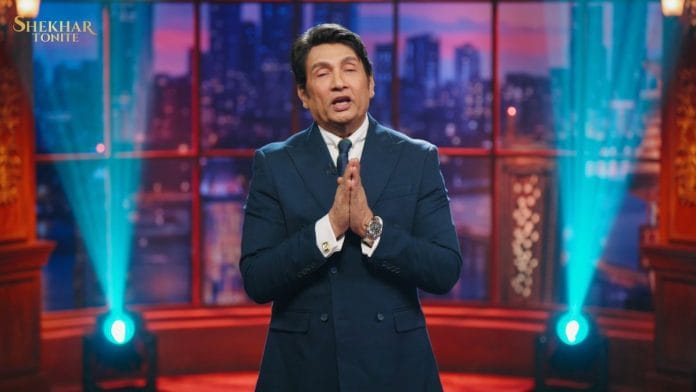


India has never really managed to build a proper late-night talk show culture. Every few years, someone tries to revive the format, but most end up becoming celebrity interviews or carefully packaged conversations, instead of sharp political satire. The only host who truly came close was Shekhar Suman, with his Movers and Shakers (1997). Now, after returning with Shekhar Tonite in May, he claims to be doing political comedy again. But the first episode itself suggests that the show is less interested in satire and more in easy political punchlines, especially considering its first guest — Union Minister Nitin Gadkari.
The show started with jokes about the West Bengal Assembly election. “We don’t know whether achhe din will come or not, but for some politicians, their bad days have already begun,” Shekhar said, referring to the state’s former CM Mamata Banerjee. He then moved on to more jokes about her, saying that all of Mamata’s banners have now been replaced by that of the Adhikaris, laughing harder than the audience itself.
He then went further, joking that the BJP spent only “10 taka” on Jhalmuri to win elections in Bengal, while it took “10,000” in Bihar. And he didn’t stop there. He said that in the election, not only Ram, but Babar also won, referring to Muslim politicians who were elected.
A set pattern
In the first episode, when Shekhar cracked jokes around internet freedom, he sounded more like a social media comment section. “If we upload this, the ministry will delete it” was one of his punchlines. With his jokes, he refrained from being too critical of the government.
In international late-night shows, they use political satire to critically examine what the government is doing, before presenting it in jokes. They don’t step back while joking about leaders like US President Donald Trump, nor do they rely only on loopholes. That is where Shekhar Tonite falls short.
One thing Shekhar does in almost every episode is perform a set of political jokes, laugh at them himself, appreciate himself for doing what “no one else is doing”, and look obsessed with jokes that were written by a team. But everything political stops the moment the guest arrives.
That may be the biggest problem with the show. Like most celebrity interview shows, it never tries to get the guest’s political stand. It doesn’t have to become a debate, but the interviews also don’t offer anything new to the audience. We already know about Nitin Gadkari’s work, Ali Fazal’s films, Manoj Bajpayee’s acting, Amruta Fadnavis and Gippy Grewal’s singing. What’s next? We’ve already seen them talk about these things on The Kapil Sharma Show. The question should be: what more can this show offer after a 15-minute political monologue by Shekhar? Even a short conversation on a contemporary issue could have placed the show in a different league.
Also read: How Bollywood shrunk Ravi Kishan to fit the gamcha and paan stereotype
The only option
Shekhar clearly mentions that the show is not meant to make people laugh, but to wake them up. If we watch the show with that perspective, then it works better. From jokes about people not buying gold, saying athletes have decided not to win gold by taking the situation too seriously, to a joke about the Maharashtra Chief Minister riding a bike while his security follows him in cars and bikes, “saving fuel” only on paper — it seems the meme industry is the primary source of his content.
Then what’s the need for a late-night show? From NEET to petrol prices to gold prices, everything is already on social media.
In the third episode, he went all out with the “Cockroach Janta Party”, claiming everyone is a cockroach, and then explaining what had happened to the party so far, followed by jokes on “Meloni” and “melody.” But haven’t we all already cracked these jokes with friends or while doomscrolling on social media?
India needs a political satirist, not a translator of social media with better wordplay and good English.
At the same time, it would be unfair to be too hard on Shekhar. Whatever one thinks of his jokes, he is at least attempting political satire at a time when most so-called comedians avoid political humour altogether. That itself makes him the only mainstream option we have right now. That is perhaps the biggest reason why the show is being appreciated.
Views are personal.
(Edited by Aamaan Alam Khan)
Agree.
But you may have to exempt some top politicians lest you want to be raided by ED.
Sadly, our politicians are too thin skinned and can’t take a joke or criticism.