






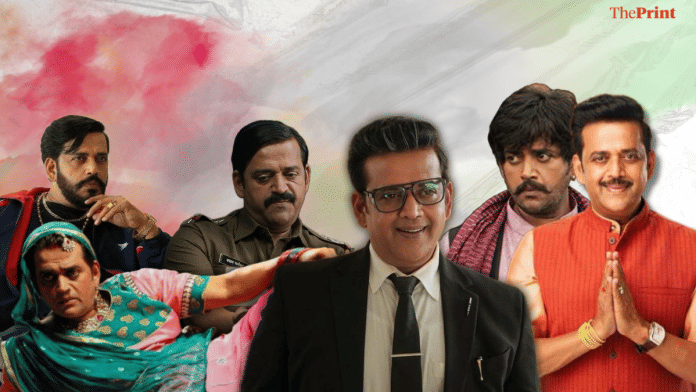


It is a well-known fact that Ravi Kishan is a talented actor. Yet, the image he is most likely to evoke is that of a paan-chewing, gamcha-wearing North Indian with an accent that borrows from real life but belongs to no one in particular. It has become so routine that even imagining Ravi Kishan in a suit, speaking English—or even everyday Hindi—elicits a chuckle. Rarely does an actor become so typecast that no writer or producer can see any other role for them. That’s what Ravi Kishan is going through, and he needs to be saved.
Pick almost any Bollywood film he has done in the last decade, and the elements are depressingly familiar. A gamcha around his neck. Paan in his cheek. A thick UP-Bihar accent announces itself through every syllable. And a role that puts him on the wrong side of the law, or in charge of it, which, in his case, amounts to the same thing. He is the corrupt police officer, the local neta (politician) who takes bribes and throws his weight around, or the villain who must be defeated. Sometimes he is all three at once.
Take Laapataa Ladies (2023), the Kiran Rao film that earned an Oscar nomination and wide critical praise. Ravi Kishan plays a police officer, and, of course, he is chewing paan and speaking in a forced accent with “humara, humara” injected into nearly every line, as if the stereotype itself were a character. The film needed a grounded, rooted cop, and that is fair enough. But other characters in the film were not made to perform their regional identity in every line of dialogue. Only Ravi Kishan was.
In Ranjit Tiwari’s 2017 film Lucknow Central, starring Farhan Akhtar, he was once again proclaiming “humara, humara” and warning police officers that he would transfer them to the traffic police if they did not listen to him. He played a similar corrupt, selfish politician in the critically acclaimed series Khakee (2022). Then came Psycho Saiyaan (2026), where he plays Hunter Chauhan — an obsessive, toxic man who targets a woman and forces her into a relationship where denying him is equal to death. Once again starring alongside his favourite co-actor—the gamcha.
Even more tellingly, the South Indian film industry, which has no stake in the UP-Bihar stereotype, defaulted to the same template, with minor variations here and there. In the Telugu film Race Gurram (2014), he played Siva Reddy, a ruthless, power-hungry politician—and while the setting was South India, the attitude handed to him was the same one Bollywood had already made familiar.
Also Read: Imtiaz Ali films were always about travel. Main Vaapas Aaunga takes a slightly different route
A role to play
Clearly, Bollywood seems to have a double standard, and it’s hard to ignore it now. Salman Khan in the Dabangg series and Ajay Devgn in the Singham franchise are also playing police officers, but no one handed them regional stereotypes. They got swagger, style, and hero lighting. It feels as if Bollywood believes realism only applies to actors like Ravi Kishan. The unspoken rule seems to be that larger-than-life portrayals are reserved for superstars, while actors from the Hindi heartland must look the part on screen—accent, gamcha, and all.
The irony is that Ravi Kishan has already proved, on his home turf, that he is a versatile actor. His first Bhojpuri film, Saiyan Hamar in 2003, was a typical romantic action drama, but here he was speaking the language of his home, not Hindi, with a forced accent. Dressed like a person next door from a humble background, he did not chew paan, instead he treated the woman he loved with respect and did what is expected of any other romantic hero. It revived the modern Bhojpuri film industry and became its first silver jubilee hit. Three years later, in Banke Bihari MLA, he played a strong-willed man who takes on corrupt local politics and the local mafia. That was twenty years ago. But Bollywood has still not caught up since.
Bollywood has had its moments of lucidity. Anurag Kashyap cast him as a politician in Mukkabaaz (2017), but here he was not stereotyped. He loved his chair, but not in the way most films have shown him, and even the accent felt more rooted and less like a film prop. Then came the iconic Netflix comedy series Maamla Legal Hai, where he plays VD Tyagi, a witty advocate who is both educated and street-smart. He is well-dressed, speaks English, knows how to handle his competition, and uses his wit to one-up the law in the courtroom. The character is layered—he may help others, but he has underlying intentions favourable to himself. It was a timely reminder, if one was needed, that Ravi Kishan indeed had more range than Bollywood often gives him credit for.
When he showed off his English on The Kapil Sharma Show, it came as a surprise to many. It should not have. On the show, Kishan spoke about missing out on Gangs of Wasseypur (2012) because Kashyap was reportedly told he could be “unprofessional” on the set. However, his Batla House (2019) co-star John Abraham, who was on the show with him, described Kishan as one of the most professional actors he had ever worked with. Kashyap eventually cast him in Mukkabaaz and showed what he can do.
Bollywood has enough evidence by now that the actor they have stereotyped with the typical UP-Bihar flavour can be imagined differently. Perhaps it is time that happened more often.
Views are personal.
(Edited by Insha Jalil Waziri)