








For the Imtiaz Ali school of filmmaking, travel isn’t merely a backdrop for the unfolding story that is bound to tug at your heartstrings. Travel, or the journey, is more often than not an essential breathing character of the film. From his directorial debut Socha Na Tha (2005) to the latest Main Vaapas Aaunga, for Ali, geography is the essential mirror to the soul. It is almost as if it is physical motion that triggers an internal transformation for his characters. And while many Indian films are now being made in exotic locales, they often use travel as a brief detour, a pretty pit-stop at best. Ali, on the other hand, uses travel as a means to drive (pun intended) the story forward.
In Main Vaapas Aaunga, the metaphor of travel is very different from his body of work so far. It is a journey of horror, not thrill and adventure. It’s one of choicelessness, not will. It is the shutting down of youthful innocence, not the unlocking of the self. In many ways, this journey — which is independent India’s own tryst with blood and gore at the time of its birth — is an antithesis of Ali’s ‘window seat’ filmography. It is a reckoning. For India, this train journey was the rite of passage from the poetry of the heady, non-violent freedom movement to the messy business of governance. For Keenu too, it is adulting and shedding of a romantic illusion.
Ali’s weaving of travel as the protagonist into his stories began with lighthearted, accidental journeys. In Socha Na Tha, a spontaneous getaway to Goa allows two people to escape family pressures and give them the space, both physical and within their heads, to discover, rather, get back in touch with their true feelings.
An evolving journey
The director’s love story with the journey evolves with time, and in Jab We Met (2007), a missed train from Mumbai to Delhi forces a depressed Shahid Kapoor and a bubbly Kareena Kapoor into an impromptu road trip across Ratlam, through the heartland of Punjab, to Shimla, and back to Punjab. In Jab We Met, travel, perhaps for the first time in an Imtiaz Ali film, is a metaphor for self-discovery. And it is this self-discovery that lets his characters free: in love, in their head, and in life.
As Ali’s filmography matured, the nature of travel began to turn darker, plumbing uncomfortable depths of the psyche of both his characters and the audience. In the acclaimed Rockstar (2011), Ranbir Kapoor’s character Janardhan Jakhar’s agonising metamorphosis from the innocent aspiring musician to the tortured artist “Jordan” is quite visibly unfolding in the realm of geography. In the pursuit of Nargis Fkhri’s Heer, Kapoor travels from Delhi’s Pitampura, through the Kashmir Valley, all the way to Prague, and back to Delhi. And on this journey, at every step, Kapoor’s character is being chiseled, reshaped, recast into a newer form. In fact, Janardhan’s sojourn with Heer through Kashmir proves to be his birth as a musician. When he starts off on this journey, all that an innocent Kapoor wants is to become a big musician. “Toote hue dil se hi sangeet nikalta hai (Music only comes out of a broken heart)” is what his mentor tells him.
Jordan’s pursuit of Heer essentially begins out of a selfish desire to be a better musician. By the end of the journey, Kapoor becomes the raging music star he always wanted to become. But when on the verge of losing Heer, all that Jordan can think of is: “Mujhe nahi banna hai bada. Bas mera dil nahi tutna chahiye (I don’t want to be big, my heart should not break, that’s all)”. He tried to find his heart in music, but that pursuit took him on a journey of love, only for him to realise that’s what it was about all along. The music was only a means to get on that journey.
In Highway (2014), for the abducted Veera played by Alia Bhatt, a truck journey along the highways of North India unexpectedly becomes the sanctuary she was always seeking. The shifting landscape, which moves from suffocating urban spaces to the vast expanse of the Himalayas, is a symbol of her liberation from a lifelong domestic prison.
In Tamasha (2015) the pristine, faraway beauty of Corsica allows Ranbir Kapoor’s Ved to strip his stifling Delhi corporate-man persona, and get back in touch with who he really is, the enigmatic storyteller. Ved is a complete unknown in Corsica. There is no facade to put on, no expectation to live up to. Once again in an Ali directorial, travel is the protagonist. Cut back to Delhi, and Ved, much to the disappointment of Deepika Padukone’s Tara, is not the same guy she met on the sunkissed island. The film thereafter can effectively be summed up as Ved’s journey to get back in touch with himself in Delhi, in the confines of everyday living, in the carefree manner that a laid-back Corsica allowed him to.
Also read: Main Vaapas Aaunga is a masterclass in how memory works. Don’t look at it as a hit or flop
A one-film trick?
Ali’s other projects, including Love Aaj Kal (2009) and the Shah Rukh Khan-starrer Jab Harry Met Sejal (2017), also borrow, and build on, the same template of travel and discovery.
Like his movies, where he often shows how a part of you is unexplored, not mined, till you meet a particular person, for Ali, travel is also placed on the same pedestal.
“My films are my travel diaries,” Ali had famously said in a 2017 interview.
In the same interview, he noted that “travelling in itself makes you discover newer things about yourself, and this kind of a self-reminder and awakening is very important for filmmaking.”
Imtiaz Ali’s movies take us on a journey. They take his protagonists — usually male — on one too. And it is essentially this journey that gives the film its soul. You tag along, cry with him, root for him, and finally rejoice with him. The journey, as his filmography shows, is one of self-discovery, of forming an idea of one-self, one of coming of age. Usually, and logically so, that is the final destination.
Main Vaapas Aaunga spins this journey on its head. The journey does not lead to love, or discovery, or the coming of age that one normally associates with an Ali film. This time, the journey takes the protagonist away from his idea of himself, his people and his ground. Away from life as he knew it itself. He becomes a nowhere man.
Journalist Rahul Pandita’s debut novel Our Friends in Good Houses talks about the state of “ungrund”, which is German philosopher Jakob Bohme’s explanation for the perpetual void in one’s state of being that is an empty “nothing” yearning to become something whole-er.
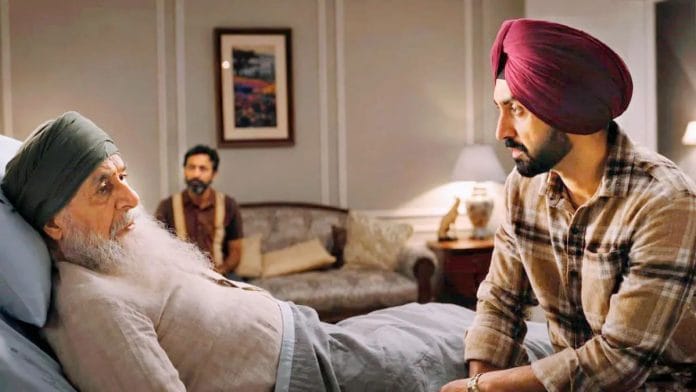
In Main Vaapas Aaunga, a young Keenu, played by Vedang Raina, tries twice to “return” home after the horrific partition of India and Pakistan. Each time, he tries to make it the quintessential Imtiaz Ali journey, one that takes you home, to love, to yourself. And each time, that does not happen.
That should have never worked in the Imtiaz Ali universe. Instead, it works like a charm. And so, when a dementia-stricken Keenu, now played by Naseeruddin Shah, is finally reunited, albeit virtually, with home, and love, and himself — thanks to the efforts of his grandson — we surprisingly feel the same depths of the heart that a Jordan or Ved’s own “successful” journeys made us feel. Ali’s trademark journey never happened this time. In fact, the journey that did happen was far from what he usually takes his protagonists and audiences on. But somehow, it worked. With Ali, travel always works.
It remains to be seen whether what we saw in Main Vaapas Aaunga was only a one-film trick, or will it be a regular theme in Ali’s future works.
But why even dissect this. “You don’t analyse such sunlit perfection, you just bask in its warmth and splendour,” wrote Stephen Fry about humourist PG Wodehouse’s writing. Maybe the same is true of Ali.
Views are personal.
(Edited by Aamaan Alam Khan)