




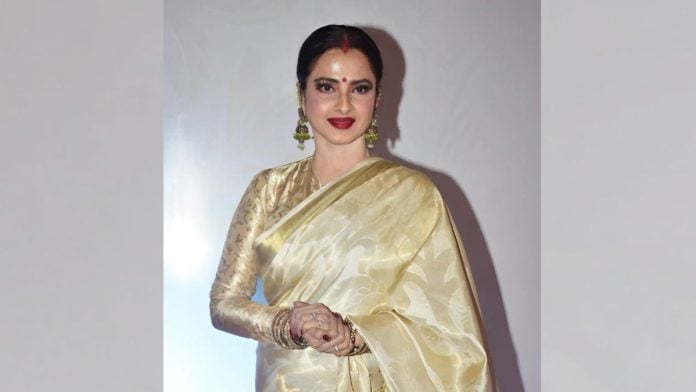

When Rekha walks into a room in a Kanjeevaram saree, gajra in her hair, gold at her neck and enough kajal around her eyes to make a Mughal miniature jealous, the verdict is unanimous: Gorgeous, diva, queen. Nobody conducts a forensic examination of her jawline, skin, waistline or hairline. Nobody helpfully informs her that she looks good for her age. Rekha turns 71 today, and the beauty police have misplaced her file.
Imagine the same scene with almost any other Bollywood female actor who has crossed 40 or had a baby. Within minutes, the internet would be debating her face, body, clothes, her alleged cosmetic interventions and whether she should consider ‘hiding her flaws’. It is an enviable privilege in an industry that treats a woman’s birthday or pregnancy as the beginning of a countdown.
Aishwarya Rai Bachchan, once practically declared a natural resource by the international beauty industry, has had her changing appearance scrutinised mercilessly, particularly after motherhood. Katrina Kaif cannot so much as appear in a photograph without inviting commentary on her body of late. Many of Rekha’s contemporaries like Jaya Bachchan are also routinely dissected for their looks, clothes and demeanour. Bollywood is full of women who have been worshipped for being beautiful and then publicly reprimanded for having the temerity to grow older.
Rekha, on the other hand, gets a standing ovation for just turning up.
Sure, she looks spectacular, in a saree or otherwise. She has cultivated an entire mythology around herself, and has never seemed particularly interested in helping the public solve it. Questions about her marriage, her love life, the sindoor she wears regularly have intrigued the audience for decades. She has answered the questions candidly and sometimes, ignored them, preferably while looking magnificent.
While stars now regularly share their workouts, breakfast bowls, and skincare routines with the enthusiasm of governments issuing public notices, Rekha’s reticence feels aristocratic. She does not need to explain herself every Tuesday. She can disappear, reappear in silk and gold, and then suddenly do a couture photoshoot and just leave the country to do what it does best: gossip.
Rekha’s desirability has also survived the changing roles that Hindi cinema traditionally uses to retire its heroines. In Khiladiyon Ka Khiladi, she played Madam Maya, a crime boss romantically involved with Akshay Kumar’s character. She was 41; Akshay was 28. Even in the 90s, she romanced a much younger man without first seeking permission from the aunties of the nation.
Rekha would later play a mother in Koi Mil Gaya and then a grandmother in Krrish. In Bollywood’s usual calculations, this should have been the point at which the glamour was packed away with the chiffon sarees. Yet the grandmother on screen and the diva at the awards ceremony coexisted happily.
Also read: No one does gossip like Karan Johar. He knows how to spill the tea on Koffee with Karan
Bollywood’s cruelty
Of course, she, like every other female actor, did not escape the cruelty of the film industry. Early in her career, she was criticised for her complexion, weight, appearance and Hindi diction. The transformation from the young actor dismissed as an unlikely star to the woman who inhabited Umrao Jaan, Silsila and Khoon Bhari Maang required reinvention and a proper understanding of the movie business.
Her signature look: the Kanjeevaram, the flowers, the heavy jewellery, the red lips — every element is recognisable, and none appears to be an apology for age. When she occasionally turns up in Western outfits, she can look just as arresting. Her reinvention was never an obligation to become somebody else.
But don’t ignore the double standard tucked inside all this admiration. Rekha’s mystique protects her; her rarity means there are fewer photographs for the internet to pick apart, and her carefully composed appearances leave little room for the everyday indignities of celebrity surveillance. The same culture that applauds her agelessness is vicious about another woman’s changing face. We celebrate Rekha’s refusal to fade, then tell other women to accept their age gracefully — which often means becoming less visible.
Bollywood has spent decades teaching women that beauty is a loan whose interest compounds with age. Rekha has somehow turned hers into inherited wealth. She walks into a room, and the room stares in awe. No footnotes.
The beauty police can keep their measuring tape. Rekha has always had other plans.