




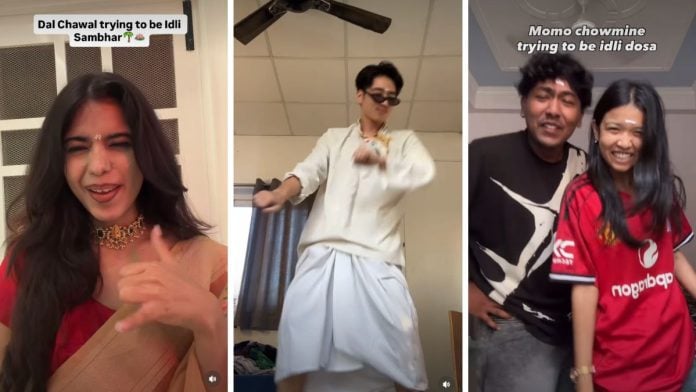

An eight-year-old Tamil love song has found a new lease of life on Instagram, thanks to a new viral trend.
Content creators are drawing a white mark on their forehead, sometimes with sunscreen, toothpaste or even Fevicol, with captions like: “Litti chokha trying to be idli dosa”, “momo chowmein trying to be idli dosa”. There is even a Tibetan “tsampa guys trying to be idli dosa”. The background song remains the same — ‘Othaiyadi Pathayila’, from the 2018 Tamil film Kanaa, and it has been used in more than 1.1 million reels to date.
The reels are unserious, but the creators are not mocking just South Indians. In the food versions, they caricature their own regions too. The joke runs on these regional absolutisms.
But even on the meme’s own terms, is that really all it takes? A sari, flowers, jewellery, a white line, and a particular hairstyle, and suddenly someone has become “South Indian”? Litti chokha stands for all of Bihar apparently, idli dosa for the entirety of southern India, and culture is reduced to a costume kit.
This seems to be bothering other people too. A Reddit user called the trend “infuriating”, asking how a white mark between the eyebrows was enough to “turn someone into ‘idli dosa’”, and suggesting many creators probably could not name five South Indian states. In two days, dozens of users had commented, almost all agreeing with her.
Where the difference lies
Interestingly, there is no single “South Indian” forehead marking. In Kerala alone, chandanam, bhasmam, and kumkum are not interchangeable. They are not even the same colour.
Which is not to say one needs to know a textile’s entire history before wearing it. Quite the opposite. Borrow more. Celebrate each other’s festivals. Wear each other’s clothes. Eat each other’s food. That is one of the best things about India.
But there is a difference between engaging with a culture and borrowing only its visuals. And that begs the question: at what point does cultural exchange become cultural moodboarding?
The former usually involves some curiosity about the culture itself. You eat a dish and learn its name. You attend a wedding and understand something about the clothes or rituals. You come across Onam online and find out what it celebrates, what a pookalam (floral arrangement) is or why sadya (the festival meal) is served. A Punjabi woman can wear a kasavu saree (Kerala’s popular cream and gold sari) without needing to become an expert on Kerala. She just has to treat the clothes as more than material for ‘South Indian’ cosplay.
The Instagram trend skips that engagement and goes straight to the photo-op.
“South India” has long been subject to exactly this kind of flattening. The Hindi-speaking mainstream has repeatedly collapsed Tamil, Malayali, Telugu, Kannada and other identities into one generic “South Indian”: one accent, idli-dosa-sambar, oiled or tightly braided hair, jasmine flowers, and religious markers pulled from completely different traditions.
Also read: Where did Bollywood’s everyday women go? Bring back the messy queens
Admiring the right way
The same oiled hair tied with jasmine that now photographs beautifully as a “South Indian aesthetic” once helped make the provincial “Madrasi” woman immediately legible in Hindi popular culture. The backlash to Param Sundari last year was partly about this old shorthand returning again: jasmine flowers and an oiled braid making a woman recognisably Malayali.
That “South Indian aesthetic” was already having a moment around Onam this year. Vogue India celebrated Kerala’s white-and-gold palette too, but the aesthetic was still attached to the culture it came from. The pookalam and sadya appeared as parts of Onam rather than decorative props for the look. It distinguished between garments such as the sari and mundu instead of folding everything into one generic costume. The clothes, flowers, and food were still being admired for how they looked, but they had names and context.
The reel trend doesn’t need this context. Its joke works when a handful of signs can instantly produce the generic “South Indian”.
The stereotype got a glow-up. It is still a stereotype.
Views are personal.
(Edited by Aamaan Alam Khan)