






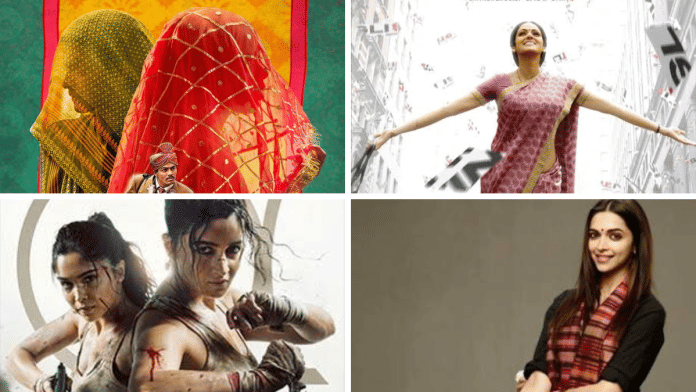

Bollywood has found two easy ways to write women: make them desirable or make them formidable. The first gives us women designed to be watched as eye candy. The second allows women to be admired as warriors—survivors of something so brutal that their toughness becomes their whole character.
While promoting her latest film Gandhari, Tapsee Pannu talked about both. First, she said that filmmakers keep blaming the audience when women are objectified on screen. “Janta maang rahi hai (The people are asking for it),” they claim, as if that ends the discussion.
Pannu’s comments come amid the backlash over Buchi Babu Sana’s Peddi and Yash’s Toxic. Peddi got Janhvi Kapoor into an “objectification” row so heated that Sana had to apologise and re-edit scenes. The audience targeted the camera work, and the emphasis on the actor’s body rather than the character itself, reflecting a male gaze narrative need.
On the other hand, in Geetu Mohandas’ Toxic, female characters were criticised as largely existing through glamour, sensuality, and their orbit around the male lead, Yash.
This portrayal isn’t limited to two films. Similar complaints have followed big pan-India films for years. Box office hits like the Pushpa series, KGF, and Animal (2023) have shown women reduced to songs, lingering shots, or merely the hero’s motivation. The problem is not that a woman cannot be glamorous and/or sexual. It is when that is all the film knows what to do with her.
Meet the damsel not in distress
The only other way Bollywood seems to know how to show the female is with a focus on the “strong woman”.
“The idea of a strong woman has started looking almost like an abuse right now,” Pannu said in an India Today interview. She pointed out how the label is narrowed down to intense and serious roles. “You cannot be strong and funny. You cannot be strong and soft,” she says.
Pannu’s own films double as the case study. Pink (2016), Thappad (2020), Assi (2026), and now Gandhari (2026), where she plays a mother turned avenger after her child is trafficked. Alia Bhatt’s Jigra (2024) runs on the same fuel, where she plays a sister hellbent on saving her brother. Similarly, in Alpha (2026), Bhatt plays a super-soldier in isolation since birth.
Then there are films where women’s entire performances are built around grinding through an institution that has wronged her. Take Yami Gautam in Article 370 (2024) or Rani Mukerji in Mrs Chatterjee vs Norway (2023).
Now these are often good, important films. And I agree that a gun, a grievance, and monologues on empowerment do make impressive characters. However, it doesn’t necessarily make them relatable every time. So when this becomes the dominant definition of female agency, something is lost.
And this is where I sense the loss of the middle ground that used to exist.
Also Read: Kriti Sanon deserves better roles. She is more than just a hot, messy, emotionally bruised woman
The everyday woman
Think of Deepika Padukone’s Piku (2015). She is not trying to change the world. She has a job, a difficult father, a sex life that her father keeps telling the world about, a temper, and a stubborn sense of how her life should be lived. She is sometimes impatient and selfish. She cares for her father and yet resents having to care for him. Unmarried past the age her relatives approve of, and devoted to an impossible father, the film lets her mess be the entire plot.
Similarly, Kareena Kapoor Khan’s Geet, in Jab We Met (2007), talked too much, ran off with a stranger on a train, then even got hesitant and threatened him with karate, made one terrible decision after another, and healed entirely on her own schedule. Yet, the film never turned her into a lesson. She is not a role model. Heck, she’s not even particularly sensible. But she is unforgettable.
Her individuality does not come from defeating a villain or performing a dance number. It comes from having a personality so specific that the character could not belong to anybody else.
Then there is Shashi Godbole, played by the unforgettable Sridevi, in English Vinglish (2012).
A middle-aged homemaker who makes laddoos, doesn’t know English, and is routinely humiliated by her own family for it. She hardly sounds like the material for today’s conventional Bollywood heroine. Yet, that was precisely the point.
Shashi’s humiliation was quiet, but so was her transformation. She did not need to become glamorous or aggressive to reclaim her worth. She simply needed to realise that her life had value beyond her husband’s and children’s approval. No courtroom monologue has stayed with me the way Shashi’s 3 minutes of stuttering, imperfect English wedding toast did.
Many other characters like Rani from Queen (2013), Ayesha from Dil Dhadakne Do (2015), Sulu from Tumhari Sulu (2017), Bitti in Bareilly ki Barfi (2017), or even Aisha in Wake Up Sid (2009), whose petty everyday irritations make them feel like people who existed before the camera arrived.
The few “ordinary” women who do show up now aren’t even given a film to themselves. They’re parked next to a male lead as proof of his arc. In Kabir Singh (2019), Kiara Advani’s Preeti is central to the hero’s emotional world, merely to absorb his toxicity. But the film gives us little sense of a life that exists independently of him. Her silence and softness become part of his story.
Animal does something similar with Rashmika Mandanna’s Geetanjali. She holds the family together while the story revolves around Ranbir Kapoor’s violence and rage that often lands on her.
Also Read: The Indian village vanished from Bollywood plots. Now they are back on OTT
See the women, not their plot
There are a few theatrical releases where the middle ground actually survived. Laapataa Ladies (2023) built its entire plot around two ordinary brides swapped by accident on a train: Phool, who wants nothing more than to return to her husband and in-laws, and Jaya, who uses the mix-up to slip out of a marriage she never wanted and get back to her studies. Neither is punished nor glorified for what she wants; the film lets both wants sit there, equally valid.
Other than this, OTT releases have preserved the ordinariness. Mrs. (2023) puts Sanya Malhotra in the daily grind of a marriage that was never built around her. But her strength shows up entirely in that mundaneness, in the small, repetitive acts of endurance a large section of Indian women would actually recognise as their own life.
More recently, Babita Singh Reporting (2026) gave us Nimisha Sajayan, a woman who is, by the film’s own design, unimpressive. An easily talked-over, quick-to-apologise assistant sub-inspector with a dismissive husband and in-laws. She ends up investigating a friend’s murder almost by accident and finds her voice along the way, without ever being turned into a superhero cop for it.
So the middle ground is not boring; it is where most women actually live. Bollywood may have lost it not because the audience stopped wanting such women, but because filmmakers stopped believing an ordinary woman can carry a story.
But women like Shashi and Piku are relevant in a way no amount of rage or glamour can be. That connection is lost every time an Animal or a Peddi occupies the theatres.
Views are personal.
(Edited by Insha Jalil Waziri)