




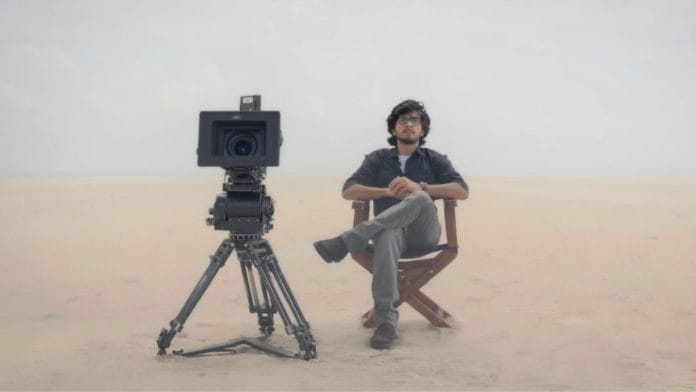

Indian cinema has rarely addressed the art and challenges of filmmaking in the way Mollywood Times, directed by Abhinav Sunder Nayak, does. While the plot revolves around a director’s childhood dream of making the scariest horror film, Mollywood Times gradually exposes the darker truths of the industry, where corporate interests often overpower artistic vision.
Vineeth, played by Naslen K Gafoor, dreams of achieving commercial success without compromising his artistic vision. That conflict becomes the heart of the story.
It reflects the reality of today’s film industry, where many directors who began their careers making grounded, auteur-driven films eventually shift toward commercial entertainers.
Good directors can fail
Vineeth fails several times. His first short film turns out to be the biggest lie of his life. He believes he has made the scariest film ever after his grandfather enters into a coma while watching it. As the truth unfolds, the film reminds us that even good directors can make bad films and that not every film becomes a cult classic.
Why can’t we accept that directors like Anurag Kashyap or Imtiaz Ali can make a bad film? When Imtiaz Ali’s Main Vaapas Aaunga was failing at the box office, the entire PR machinery behind the “cult director” narrative became active. Reels were flooded with one message: “Watch the film now, before it becomes a cult classic.” Can’t we just accept that if a film has to work, it will work on its own?
The same thing happened with Bandar. The film failed at the box office, much like most of Kashyap’s work. Even when he made Almost Pyaar with DJ Mohabbat (2023) and Nishaanchi (2025), he rarely spoke about them later, instead returning to Gangs of Wasseypur. While Kashyap has often questioned the lack of screens for his films, this is exactly the kind of reality Mollywood Times quietly discloses.
When films become corporate projects
The film suggests that major production houses sometimes invest in films for reasons beyond box-office success, hinting at financial structures where profits and losses serve purposes other than storytelling. The marketing of Prabhas’ Ramayana was weak, and the film itself failed to connect with audiences. Yet we cannot argue that Prabhas is not a good actor; he has proved himself through Baahubali and his other works in the South. Rather than providing answers, Mollywood Times leaves viewers wondering why such projects continue to receive massive investments.
That imbalance is visible across the industry. Even when a big-budget film receives mixed reactions, stars keep signing projects while major studios continue financing expensive films. How do these studios absorb repeated losses? How do they continue operating at such a scale? Mollywood Times makes these uncomfortable questions an integral part of its commentary on the Indian film industry.
It argues that filmmakers focused on creating meaningful cinema often lack the marketing machinery needed to compete with studio-backed spectacles. A recent example is the box-office clash between Baby Do Die Do, produced by Huma Qureshi and Saqib Saleem’s production house, and Alpha, produced by Yash Raj Films. While Alpha was promoted on India’s Got Latent on Netflix, Baby Do Die Do was largely promoted through Instagram Reels. Not only that, while Alia Bhatt’s film was getting four to five shows in theatres, Qureshi’s struggled to secure even a single show at a favourable time. And then we wonder why Indian filmmakers are not producing good cinema.
Also read: Furore over Lupita Nyong’o’s Helen in Nolan’s Odyssey is about beauty standards, not Homer
Script theft is normalised in the industry
We have heard countless stories of films being overly inspired by, or directly copied from, films that either never reached the production stage or never found an audience in certain regions. Hollywood films, for instance, were heavily copied in India during the late 1980s and 1990s. Baazigar (1993) drew from A Kiss Before Dying; Chachi 420 (1997) from Mrs. Doubtfire; Dil Hai Ke Manta Nahin (1991) from It Happened One Night; and Agneepath (2012) from Scarface. Ironically, many of these films are now considered cult classics. But were these directors really true to their work?
In Mollywood Times, Arjun copies Vineeth’s work and goes on to become a celebrated director, while the original creator is left behind. Cinema has witnessed similar debates before. Satyajit Ray’s unmade project based on his story Bankubabur Bandhu has long been linked to claims that Steven Spielberg’s E.T. the Extra-Terrestrial borrowed several ideas, although Spielberg has denied any influence. Mollywood Times asks a difficult question: Who deserves to be called the better filmmaker — the one who imagined the story but lacked the resources to bring it to life, or the one who copied or borrowed the idea and successfully transformed it into a visual spectacle?
Mollywood Times also pays tribute to director M Night Shyamalan. Where Vineeth learns the craft of horror filmmaking by watching Shyamalan’s films, Shyamalan’s own career began with a painful lesson. His second film, Wide Awake (1998), was produced by Miramax, but after it was completed, Harvey Weinstein reportedly took away Shyamalan’s final cut, demanded several changes, and delayed the film’s release for nearly three years. The experience left the filmmaker frustrated, as the film that reached the audience was no longer what he had intended. Determined not to lose his creative voice again, Shyamalan went on to write The Sixth Sense and insisted on greater creative control over his future projects.
A similar struggle defines Vineeth’s journey in Mollywood Times. While he dreams of making horror films with complete honesty, the industry repeatedly takes control away from him, forcing him to compromise even as others benefit from his ideas. By paralleling Vineeth’s story with Shyamalan’s early career, the film conveys that a filmmaker’s greatest fight is often not against a box office failure, but against an industry that can easily overpower artistic vision.
Views are personal.
(Edited by Aamaan Alam Khan)