



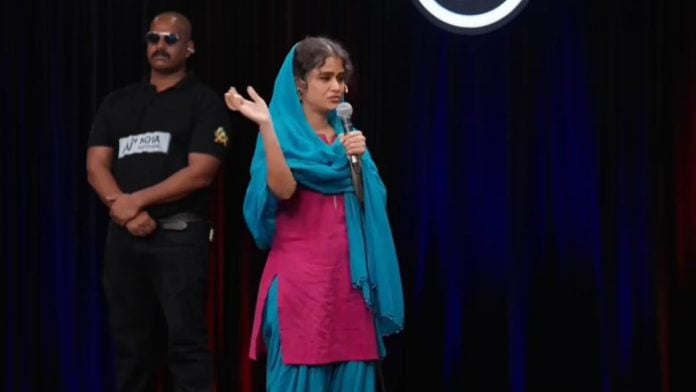
When Bhagyashree Tarke walked onto the India’s Got Latent stage as Salma Deewani, I had a sense of the character I was about to meet. The dupatta over her head, the Dakhni accent, the cheerful assalamualaikum, all of it arrived pre-packaged.
Salma Deewani is a married woman from Hyderabad’s Old City, with two children, a husband working in Dubai, difficult in-laws, and an abiding love for Salman Khan. Her backstory follows the same old, recognisable markers often seen in popular culture about Muslim women.
Tarke, however, did not create Salma for a viral moment on Samay Raina’s show. The actor and theatre-maker first developed the character in 2015, while studying at the National School of Drama (NSD).
Her play, a 15-minute solo performance, was inspired by her observations of Muslim women in Hyderabad’s Old City, where she grew up, and their enthusiasm for Salman Khan films. Tarke has described the play as a satire on the lives of these married women, portraying them as lonely and frustrated with domestic life.
In 2019, she expanded it into a full-length, interactive play. Since then, Salma Deewani has been staged around 45 times, including in Sri Lanka and Dubai. In her theatrical productions, Salma also wears the burqa, which appears to establish the cultural setting.
A ‘harmless’ performance
Now there is nothing inherently wrong with a non-muslim portraying a burqa-clad Muslim woman. Theatre would be a limited space if actors could only inhabit identities they personally share.
But there is a difference between performing an identity and feeding into the assumptions attached to it.
For Tarke, Salma is a character she can inhabit for an hour, take off her costume and leave behind in the green room. For Muslim women, the markers that make Salma recognisable do not necessarily disappear when the performance ends.
The burqa, the suppressed love for a Khan, the family background, all can become grounds for assumptions about their education, freedom, beliefs and choices. They do not get to step out of the role other people have assigned them. Worse, the assumptions follow them into classrooms, workplaces and the public space.
In this climate, the Muslim woman is rarely allowed to be uncomplicated. She is either oppressed or finally taking off her burqa; uneducated or held up as “the exception”; controlled by her family or expected to prove that she isn’t.
Tarke’s character draws on the familiarity of an identity that is already burdened with these stereotypes. The burqa she wears on stage, a costume for her, only adds another layer to the fossilised template.
Now, Salma has moments of wit and agency. Tarke, herself, has described Salma as a “very funny and strong woman” who is trying to find her own freedom beyond the boundaries her family has drawn for her.
Also read: Dear Sooraj Barjatya, step out of your la-la land. Indian families aren’t always happy
Making a stereotype entertaining
When the conversation on Latent turns to women using abusive language, she says that a woman is branded badnaam for swearing, while men can win awards for doing the same. It’s an observation about a double standard that cuts across communities.
But most of the laughter I felt was coming from somewhere else.
In the episode, she talks about having studied only till Class 10 because her father did not see the point of educating a daughter.
“Bachche zyada ho gaye aur paise kam ho gaye. (There were too many children and too little money)”.
She also points to the male members in her family as “nikamme”.
The lines are presented as part of her backstory, but, yet again, it just taps into the default assumption about Muslim families — large households, limited resources, and little regard for girls’ education.
When Salma mentions that a cousin accompanied her, Raina responds, “Cousin, meaning husband?” The joke works because the audience already knows the stereotype linking Muslims with cousin marriage, even though it’s not exclusive to the community.
Tarke has said that Salma represents women across communities and that the play explores their loneliness, desires, and domestic lives.
But her performance gave me no reason to look past the veil and the stereotype stitched to it. It simply made that stereotype more entertaining for an audience already fluent with the script.
Views are personal.
(Edited by Aamaan Alam Khan)