




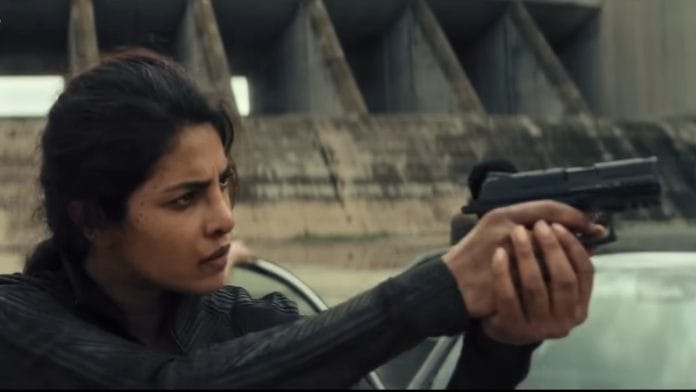

Priyanka Chopra Jonas will star opposite Orlando Bloom in Reset, a Hollywood survival thriller expected to begin production in August. The film follows a woman who wakes up alone in the wilderness with no memory of how she got there, and has to decide whether to trust a stranger if she wants to survive.
For Chopra, Reset is another substantial international role. But it also sharpens a pattern in her Hollywood career. Nearly a decade after she broke through in the West with Quantico, Hollywood has not ignored her, but typecast one of Hindi cinema’s most versatile actors as the global action woman.
This is not the old story of an Indian actor being pushed to the margins in the West. Chopra led Quantico on American network television, played elite spy Nadia Sinh in Amazon’s Citadel, appeared in The Matrix Resurrections (2021), and did action-heavy projects including The Bluff (2026) and Heads of State (2025). She is visible, bankable, and firmly inside the Hollywood machine.
But the machine has mostly known one way to use her.
Agent. Spy. Fighter. Survivor. Woman with a past. Woman under attack. Woman who can take a punch and give one back. It is a better box than the old Hollywood stereotype of Indian women as accents, wives, sidekicks or symbols. But it is still a box, one that Hollywood has decided she will live in.
That is what makes her crossover more complicated than a success story. Priyanka Chopra cracked Hollywood. Hollywood has not cracked Priyanka Chopra.
Chopra’s range
The point is not that action roles are beneath her. They are not. Action travels, pays, and gives scale. For an Indian actor trying to hold space in Hollywood, the action-thriller lane is not a consolation prize. But when that lane becomes the main road, it begins to look less like opportunity and more like typecasting.
This is where her Indian career matters. From Barfi! (2012) to Bajirao Mastani (2015) and beyond, Chopra’s stardom in Hindi cinema was never built on one note. Bollywood had its own limitations. It gave her glamour roles, hero-led films, and commercial packaging. But it also gave her parts that allowed her to be strange, vain, wounded, cruel, funny, foolish, soft, and morally unsafe.
In Barfi!, Jhilmil could have become a set of tics. Chopra made her watchful, hesitant, and trusting. In Bajirao Mastani, Kashibai was neither the warrior nor the forbidden love, but Chopra made her pain feel central to the film. Her strength came from restraint, not combat.
Hollywood inherited that range. But it flattened it.
The flattening is not simply about physical roles. Chopra has done physical parts in India too. Mary Kom (2014) was built around training, combat, and the body. But even there, the fight sat inside marriage, motherhood, ambition, and national expectation. Hollywood has mostly taken the body and stripped away the contradiction.
Also read: Indian aunties are leading the baddie era
A ‘global action woman’
It has also stripped away the risk of dislike. In Fashion (2008), Meghna Mathur was ambitious and ugly about it. She wanted fame, she mishandled it, collapsed under it, and then had to rebuild herself. In Aitraaz (2004), Chopra played Sonia as predatory and glamorous at a time when mainstream heroines were still expected to protect their likability. In 7 Khoon Maaf (2011), she went stranger, but still romantic, violent, lonely, absurd, cruel, and tragic.
These films gave her room to play difficult characters.
There have been exceptions though. Love Again (2023) moved her into romance. Baywatch (2017) cast her as a villain. But exceptions do not define an image. The Priyanka Chopra that Hollywood keeps returning to is glossy, global, and battle-ready.
A spy thriller or survival film travels more easily than a story about marriage, shame, class, vanity, desire or failure. A glamorous, English-speaking Indian star who can stand opposite Richard Madden, John Cena, Idris Elba, Karl Urban or Orlando Bloom is easier to place inside a global franchise than to be written as a fully specific, difficult woman.
Chopra has spoken before about refusing stereotypical roles written for Indian women in the West. She avoided the most obvious trap. Hollywood built her a newer, shinier one. It did not ask her to play the stereotype of the Indian woman. It asked her to play the stereotype of the global action woman.
Tarini Unnikrishnan is an alum of ThePrint School of Journalism, currently interning at ThePrint. Views are personal.
(Edited by Aamaan Alam Khan)
The fact that she got a break in Hollywood is still a mystery of and in itself. Give me a break. Don’t put her on a pedestal that she hasn’t climbed yet. And, don’t look down upon action genre. Those actors have lifetime of fame.
To evolve her image beyond that of a ‘woman of action,’ she and her mother could star in advertisements for cigarettes, cigars, vapes, and marijuana. She could also become the president of female smokers’ associations.