






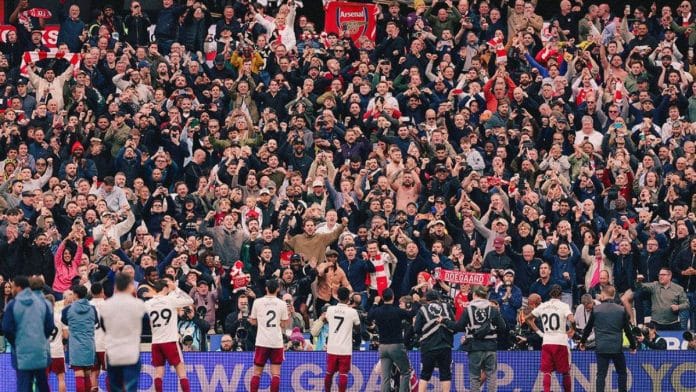


Matchweek 36 has ended in the English Premier League, and football fans cannot keep their calm. Arsenal now seems to be cruising toward lifting the cup after 22 years! And, with this, the Gunners’ coach Mikel Arteta has successfully converted the ‘Trust the Process’ phrase to a legitimate threat.
For Arsenal, the ‘process’ might have been a tad too long, but eventually it has paid off. Last time the Gunners won the Premier League, they were invincible. And after that, every Arsenal defeat turned into a template—screenshots, memes, sarcastic hashtags and fans chanting that the coach should be sacked before the final whistle had even blown.
For 22 years, the Arsenal fans survived in the past to cope with the present. They finished eighth twice, lost games without managing a single shot on target, and to top it all, expensive signings spectacularly failed to ‘keep up their promises’. The dressing room looked fractured, the football looked confused and the Emirates Stadium was not considered to be a fortress anymore. Fans debated whether the club had permanently lost its identity and lustre after the departure of legendary coach Arsène Wenger in 2018.
Younger Arsenal supporters inherited stories of greatness without ever truly experiencing it themselves. Entire generations grew up knowing Arsenal only as a club that almost mattered in August before collapsing into familiar disappointment after the Christmas break.
Also read: Sorry, sprinters! It’s midfield generals who are running the show this Champions League
Arteta’s way
Modern-day football is solely built on panic. A manager gets only six ‘poor’ weeks before questions emerge about “the dressing room” atmosphere. Young footballers are discarded after a handful of bad performances. Clubs spend fortunes attempting to fast-forward emotional development altogether. Nobody wants to rebuild a team anymore; they want instant resurrection and results.
Arsenal chose the opposite path. Arteta too felt the pressure, but this time, the club decided not to panic. This time, the club decided to ‘Trust the Process.’
Arteta joined his former club as a coach in 2019. For almost seven years he failed to bag a significant trophy. There were a few domestic cups, but nothing of note. He was well past his ‘stipulated time’ to build a team. Other ‘successful’ managers hardly get that time. The Gunners board relied on Arteta when many fans wanted him gone. They allowed young players to make mistakes. Most importantly, they tolerated bullying on the internet.
Then, somewhere inside that chaos, something slowly began to change.
The club stopped fearing and resorted to believing. Recruitments weren’t just about big names, but who could fit into Arteta’s system. Young players developed personality and they believed more in open play rather than the same old-fashioned wings. The football gained intensity.
It did not stop at that, the atmosphere inside Emirates too transformed with time—from nervous frustration to genuine belief. Slowly, Arsenal stopped looking like a club desperately trying to recover its past and started looking like one building a future.
Now, with the title suddenly within touching distance, the emotional tone surrounding Arsenal has completely shifted. The jokes are disappearing. And perhaps that is the clearest sign of all.
This very transformation directly reflects what Arteta achieved with the club.
When he first arrived, he was often looked down upon because of his age and experience. “Will he be able to pull off at a team like Arsenal,” fans often questioned his credibility. His tactical ideas were mocked, and his insistence on discipline alienated sections of the fanbase. However, Arteta was stubborn and did not abandon his strategy. He chose to build a team rather than chase short-term survival and glory.
That stubbornness is the reason for Arsenal’s resurrection.
Like Argentine coach Diego Simeone said, “I don’t believe much in luck. I believe more in work, in convincing, in stubbornness and in capacity.”
The phrase “Trust the Process” once symbolised failure wrapped in optimism. Today, it symbolises something far more uncomfortable for the rest of the teams in the English Premier League: The possibility that Arsenal doesn’t need to rebuild anymore, that they might be ready now for the challenge.
Views are personal.
(Edited by Theres Sudeep)