



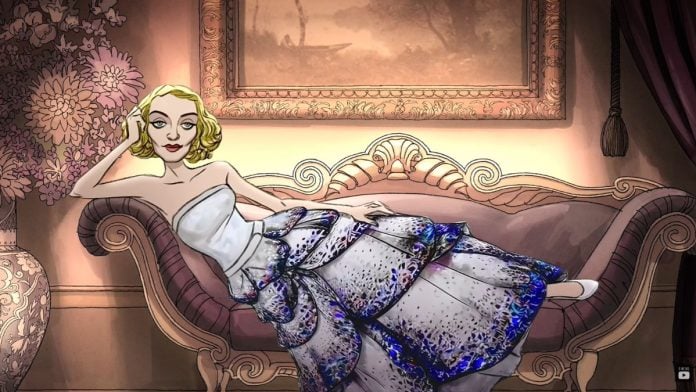
This Christmas, luxury fell in love with the pencil.
In an age when everything can be AI-generated, the human hand becomes a selling point. There is nothing wrong with that as long as brands are honest about what those hands have actually made.
Enter Christian Dior’s Night in Color, a seven-minute fable about Monsieur Dior and Marlene Dietrich directed by Sylvain Chomet and narrated by Robert Pattinson. Creative director Jonathan Anderson told WWD it was “all hand-drawn using techniques that go back to the 1940s”.
The short film is now facing an AI controversy.
Viewers flagged extra fingers, blurry tree stars, a morphing dog collar, and oddly behaving bees. Some pointed to warped lettering and a lazy eye. A Melbourne-based traditional animator flatly said that the film was not hand-animated and that Dior was lying.
Chomet and producer Aton Soumache told Variety that no generative AI was used and that 20 artists drew the film over seven months, with six animators involved in the process. But the producer added that an automated interpolation system was used for a “very small part of the process”.
Prada too brought back hand-drawn animation for its holiday campaign. Directed by former Disney animator John Pomeroy, the campaign features actors Sadie Sink and Maya Hawke in a whimsical winter wonderland. What set Prada apart was that its behind-the-scenes put its animators and their pencils in front of the camera, while Dior’s making-of leaned more on studio shots with no mention of automated interpolation.
AI in animation
Animation has always bent the rules—hands blur, noses wander, bees do as they please—and audiences may accept it as part of the magic. What’s harder to explain is what was promised. A film sold as entirely hand-drawn mentioned automation only after the internet had gone through it frame by frame. Dior itself has still said nothing publicly. In a transparency row, silence doesn’t help.
Animation has always involved some arithmetic behind the art. Somebody has always had to draw the frames in between, and it’s fair to ask whether software can help. Studios such as Disney and Toei are reportedly curious about that, both eyeing AI assistance for in-betweens. If a tool saves an artist from some drudgery, I will not clutch my pearls.
The major problem, then, is not that artists are picking up new tools. Animation has never been frozen in time. From the way Snow White coaxes a small bird on her fingertip to the computer-generated worlds that dominate cinema today, the medium is always evolving.
But there is a reason hand-drawn animation continues to hold a special place in people’s hearts. Think of Studio Ghibli’s Spirited Away (2001) or My Neighbour Totoro (1988). Their charm lies not simply in the colours or fantastical creatures, but in the little gestures, pauses, and details that make their worlds feel alive.
For Loving Vincent (2017), 125 painters created about 65,000 oil-painted frames. The film was first shot with actors, and each frame was then recreated by hand in the style of Vincent van Gogh’s paintings, turning the entire film into a moving canvas. It told you how it was made, because the making was the marvel.
Hayao Miyazaki’s famous 2016 reaction to an AI-generated animation demo, which he called an “insult to life itself”, may have been uncompromising. But it reflects a larger anxiety about what gets lost when the human element is taken out of creative work.
Also read: Samay Raina’s India’s Got Latent gets a Pakistani spin. It’s getting copycat insults
Show the work, Dior
At a time when audiences are bombarded with AI-generated images, hand-drawn animation can be a brand’s biggest USP.
Dior built its whole campaign on a love letter to the human hand, but then went silent about the process. The bigger issue is the lack of transparency rather than the alleged use of AI itself.
AI is here to stay, and there is little point in questioning whether it’s used. Today, what matters more is whether we get told when it is.
If brands want to sell the magic of human craft, they should show what went into it—the technology, the artists, and the compromises in the process. Audiences may forgive a little creative assistance; what they will not is being sold one story and having to discover another by counting fingers.
Views are personal.
(Edited by Prasanna Bachchhav)