








The release and subsequent removal of Satluj, formerly Punjab ’95, from streaming platforms has had an unlikely outcome. It has challenged the political ambiguity surrounding Diljit Dosanjh and elicited a politically charged response from the singer-actor, who generally maintains a safe distance from sensitive issues.
It was more than five years ago that Diljit vocally supported the farmers’ protest, trolled Kangana Ranaut on social media, and criticised the Narendra Modi government for its handling of the issue. Then came a shift. In January last year, he met the Prime Minister and described it as “a fantastic start to 2025.” This not only left his supporters confused about his politics but also invited the fury of some farmer leaders in Punjab.
Diljit’s homeland is as ingrained in his films as it is woven into his persona. He keeps his Punjabiyat close to his heart—whether as the affable “beeba munda” on social media or as a proud ambassador of Punjab when he represents India on the global stage.
His filmography, however, is a more serious, and perhaps more responsible testament to that rootedness. The films he has chosen over the past decade present a carefully curated selfhood centred on Punjab. It’s a far cry from the time he relentlessly chased Kylie Jenner on social media. Through these choices, Diljit reminds everyone of Punjab’s greatness and promise.
Punjabiyat
Diljit’s selection of films is unmistakably an act of self-fashioning. From Udta Punjab to Chamkila, and from Main Vaapas Aaunga to now Satluj, he is emerging as the keeper of Punjab’s memory and wounds—whether those of Partition or the dark years of militancy and human rights violations.
In Udta Punjab (2016), Diljit plays a police officer determined to tackle the state’s drug crisis. It is a story that speaks to the Punjabi notion of betrayed potential. His character, Sartaj, is initially indifferent, even rogue, but comes of age when the crisis hits close to home—a trait Diljit himself seems to have embodied.
In Imtiaz Ali’s 2024 biographical film Chamkila, Diljit plays Amar Singh Chamkila, the Dalit Sikh singer who became enormously popular among Punjab’s working class in the late 1970s for his folk songs. Chamkila’s rise coincided with the rise of militancy in Punjab, when radical Sikh groups began demanding a separate state of Khalistan. He was assassinated by terrorists at the age of 27.
And, of course, there is Satluj, where Diljit plays human rights activist Jaswant Singh Khalra, who investigated the alleged extrajudicial killings during Punjab’s counter-insurgency operations in the late 1980s.
When director Honey Trehan first read him the script, Diljit pressed it to his forehead and said, “Waheguru.” Speaking to ThePrint, Trehan described him as “a pure soul”. That purity is both an imagined and remembered longing for Punjabis. It reflects a collective nostalgia for a land whose greatness was interrupted. From the vast empire of Maharaja Ranjit Singh, Punjab steadily diminished over the next 150 years through the British rule, Partition, the battle for statehood and a gradual decline in political relevance after Independence. This is where the congealed wound, renewed through repeated retellings, comes from.
When Satluj finally released on OTT after a four-year battle with the censor board—which had demanded a title change and 127 cuts—it was withdrawn within 48 hours. That was when Diljit broke his silence, writing on Instagram: “Satluj suffered the same fate as Khalra.”
Over the years, Diljit’s public statements have shifted from vocal defences of his films to passive, cryptic one-liners. They rarely question the authorities directly and, in turn, reveal little about his politics. He has also worked on two films centred on the 1984 anti-Sikh violence—Punjab 1984, released in June 2014 and later honoured with a National Award, and Jogi (2022), which drew controversy after Diljit referred to the anti-Sikh riots as a “genocide”.
Another rare occasion when Diljit criticised “the government’s incompetence and dirty politics” was when fellow singer Sidhu Moosewala was shot dead in Punjab in May 2022. He reportedly acquired US citizenship the same year. More recently, the CJP protest at Jantar Mantar drew his attention, prompting an Instagram story calling on the authorities to listen to the students’ demands.
Also Read: Diljit Dosanjh’s Satluj is Punjab’s biggest controversy. How it got here
Taking Punjab to the world
Incidentally, it was the farmers’ protest that led Diljit to dedicate the song RiRi to global pop icon Rihanna after she tweeted in support of the sit-in. The gesture increased his visibility among the Punjabi diaspora and thrust him into the global news cycle. Though he no longer lives in India, he has emerged as a global voice of Punjab.
On international platforms, Diljit has chosen to be out and out Punjabi. He could have taken the easy route and become culturally neutral, as many Indian artistes who move to the West do. Instead, his strategy has been the opposite: the bigger the platform, the louder his tribute to his homeland.
When he became the first Punjabi artiste to perform at Coachella—one of the world’s biggest music festivals—in 2023, he opened with, “Punjabi aa gaye, oye!”
He followed it up with an appearance on The Tonight Show Starring Jimmy Fallon in 2024, dressed in a traditional Punjabi kurta, tamba and pag (turban). Not once did his broken English get in the way of his authentic charm. Diljit ended the show with the song “Main hun Punjab” from Chamkila. In that moment, he ceased to represent Punjab and instead embodied it. The song itself is a one-line incantation that has since become his signature. When he returned to Fallon’s show this year, he even got the host to perform bhangra.
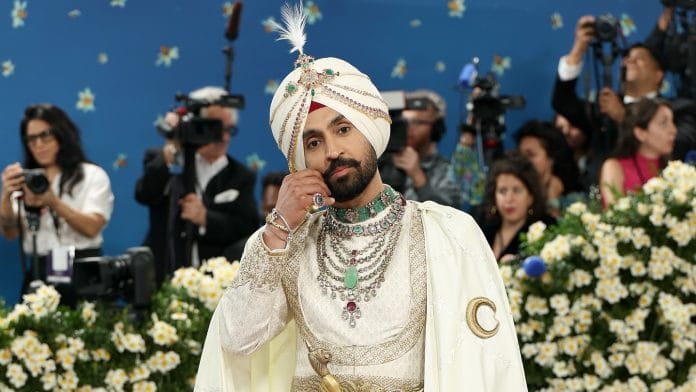
Then came his Met Gala debut in 2025. His ensemble was woven with references to Punjab and Sikh heritage. Inspired by Maharaja Bhupinder Singh of Patiala, he wore a turban, carried a kirpan (ceremonial sword), and draped a cape embroidered in gold with a map of Punjab and the Gurmukhi script. Both his body and his body politic are quintessentially Punjab—not merely Punjabi.
Social media’s ‘Beeba Munda’
On social media, however, Diljit has an altogether different persona. He is the affable “beeba munda”—Punjabi for a well-mannered young man. He presents a goofy, shy, flirtatious and unserious version of himself, one that bears little resemblance to the characters he plays. In his defence, gregariousness is a trait often associated with Punjabis.
In some of his most popular videos, Diljit experiments in the kitchen, whipping up everything from breakfast smoothies to kada—the wheat-flour halwa served in gurdwaras and intrinsic to Sikh tradition. In another, he wanders through Puerto Rico in a floppy hat. Throughout, he provides a running commentary in theth, or unadulterated, Punjabi. He even speaks to Alexa, Amazon’s virtual assistant, in his mother tongue.
Yet while Diljit wears his Punjabiyat on his sleeve, he remains measured when it comes to Punjab’s most contentious issues. His outrage is rare, if not selective. He seldom speaks out when artistes are cancelled or films are banned, nor does he directly confront the censor board or the government.
In doing so, he treads a carefully calibrated line, meant to coddle his career. His films compensate for his silence, and his silence, in turn, sustains his films.
(Edited by Prashant Dixit)
While this article presents a well-written analysis of Diljit Dosanjh’s public persona and filmography, it conveniently overlooks the glaring double standards of the media and the Indian entertainment industry. The author calls his silence a “calculated strategy to coddle his career,” but fails to ask a vital question: Why wouldn’t he protect himself when the media has consistently failed to support him?
When the Federation of Western India Cine Employees (FWICE) threatened to ban Diljit from projects like Border 2 simply for working with a Pakistani artist in Sardaar Ji 3, where was the media’s outrage over artistic freedom [1, 5]? When Punjab ’95 (Satluj) was subjected to a grueling three-year battle with the censor board, slapped with an absurd 127 cuts, and eventually ripped off a streaming platform within 48 hours of its release, the mainstream media largely stood by and watched [2, 3, 5].
The media expects celebrities to be moral compasses and activists, but the moment they speak up, the narrative shifts. The core issue—whether it’s the farmers’ protest or the history of Jaswant Singh Khalra—gets entirely diluted [2, 5]. It just becomes a media circus about the celebrity. Let’s be completely honest: had Diljit launched a massive verbal protest over the Satluj ban, the very same media outlets analyzing his “silence” today would have immediately branded him as “anti-India” or criticized him for stirring up trouble while sitting comfortably in the USA [4, 5]. It is a classic Catch-22—he is criticized for staying quiet, but he would be crucified if he spoke.
Furthermore, why is there a constant, exhausting demand for Diljit to “prove his loyalty”? He is arguably the only contemporary Indian superstar operating at a massive global scale—taking not just Punjabi and Sikh culture, but Indian representation to platforms like Coachella, the Met Gala, and Jimmy Fallon. Yet, despite being a proud, unapologetic global ambassador for his homeland, he is subjected to loyalty tests that culturally neutral artists never have to face. Are celebrities elected officials? Did they ask for this burden?
As the article itself notes, Diljit’s filmography is his activism. Choosing to finance and star in heavy, historically significant, and heavily scrutinized films like Udta Punjab, Chamkila, 1984, and Satluj takes infinitely more courage than posting a fleeting, easily manipulated tweet.
Before we criticize an artist for navigating political ambiguity, we should look at the incredibly hostile environment that forced them into that ambiguity in the first place. Wait for his upcoming Europe tour, and watch how he represents his roots on a global stage. Sometimes, letting the art speak for itself is the most powerful statement of all.
The fact that Amar Singh Chamkila’s assassination by the Sikh Khalistani terrorists was left out of the film told everyone what the film was about and where Imtiaz Ali’s sympathies lie.
That Dosanjh went along with it and brushed the brutal assassination under the carpet in order to shield Khalistani terrorists spoke volumes regarding his actual intentions.