






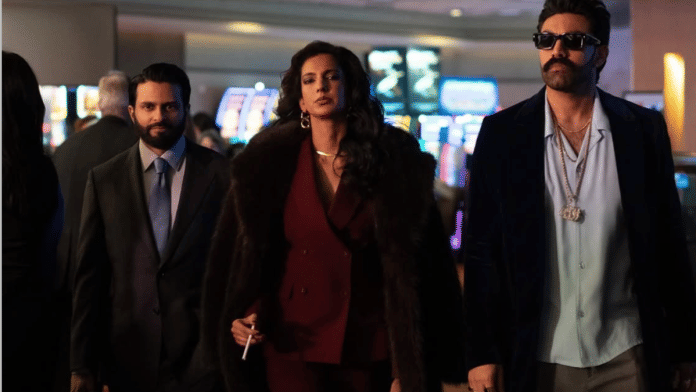


Poorna Jagannathan is not your average desi aunty. As Lucky Aunty in Hulu’s Deli Boys, she is not the woman stationed around the kitchen, issuing warnings, feeding everyone or holding the family together while the younger characters get the plot. She is a fur-coated operator inside a Pakistani-American cocaine business, which is exactly why Lucky works: she takes the authority desi aunties already have and moves it out of the home and into the underworld.
Created by Abdullah Saeed, the series follows two Pakistani-American brothers who discover that their dead father’s deli was, in fact, a front for a cocaine empire. What begins as a family-business crisis quickly becomes a crime comedy about inheritance, dirty money, community networks and men who are nowhere near as smart as they think they are. Season 2 is out today, and Poorna Jagannathan’s Lucky Aunty is not watching the chaos from the side. She is helping run it much like Helen McCrory’s Polly Gray in Peaky Blinders.
The role was originally written for a man. But Saeed saw the vision after attending a talk by actor Geena Davis about turning male characters into women. Much like Lucky, the character, too, literally had to make space for itself in a male-dominated world. Lucky is not a respectable aunty upgraded with naughty one-liners. She is a South Asian crime boss in her 50s. When Vanity Fair called her a “cool auntie,” Jagannathan corrected it: “She’s not a cool auntie. She’s a murderous auntie.”
That is why Deli Boys has more bite than the usual “representation has improved” conversation. The question is no longer whether South Asian women can be seen on American TV. They can. The question is what they are allowed to do once they are visible. Must they always hold the family together? Must they always explain culture? Must they always be the strict mother, the sacrificial wife, the comic neighbour, or the woman at the wedding asking why you are still single?
Aunty ji, not Mummy ji
Jagannathan has already done the more familiar version of a middle-aged South Asian woman role better than most. In Netflix’s Never Have I Ever, her Nalini Vishwakumar was strict, grieving, stylish, loving and often terrifying in the way only Indian mothers can be when they are also scared. Nalini was too tired, too proud and too wounded. But Nalini still belonged to a recognisable screen category: the Indian mother whose life is spent holding the family together.
Whereas, Lucky Aunty’s power does not come from motherhood or sacrifice. It comes from control.
That range matters. In reality, older Indian women have always been far more layered than pop culture allows. They work, date, divorce, remarry, travel, run businesses, manage money, raise children, care for parents, and make their own bad decisions. The woman pop culture keeps trapping in the kitchen has already left the room.
Lucky keeps the substance and throws away the cage.
In Deli Boys, Lucky is not at the edge of the criminal world with a tray and a warning. She is the machinery. The Hollywood Reporter India describes her as a consigliere to a desi Philadelphia criminal empire, and Season 2 gives her a more central presence.
Her romance with Max Sugar, Fred Armisen’s casino king and money launderer, gives Lucky something older desi women on screen are rarely allowed: desire that is not treated as embarrassing, invisible or automatically ridiculous. Jagannathan’s own summary is funnier: “Lucky gets to boink.” The point is not just that Lucky gets a love interest. It is that she has a sexual appetite, risk and bad judgment.
Also Read: Hollywood has reduced Priyanka Chopra to a global action woman. She is more than that
De-gimmicking the South Asian woman
The show does not turn her into a desi gimmick. Nor does Deli Boys strip Lucky of aunty-ness to make her powerful. It lets her be maternal and murderous, romantic and frightening, glamorous and grotesque. She is not liberated by becoming less recognisable. She is liberated by being allowed more than one function.
This is where pop culture often fails older South Asian women. It either makes them symbols of tradition or jokes about tradition. They are the kitchen, the prayer room, the shaadi buffet line, the moral warning, or the neighbour who knows too much. But anyone who has grown up around desi aunties knows that is only half the story. They can be generous, manipulative, lonely, hilarious, controlling, reckless, vain, loyal and terrifying in the same afternoon.
Lucky Aunty feels right because she is so aware of her inherent power. She is not here to prove that South Asian women are dignified, hardworking and family-oriented. That version of representation has done its job. It opened the door. But nobody should have to stand in the doorway forever, smiling politely.
The desi aunty does not have to disappear for South Asian stories to become modern. She just has to be allowed to want something beyond everyone else’s well-being. Deli Boys understands that. It does not make Lucky younger, softer or more palatable. It lets her be real.
The desi aunty has evolved. She is not asking when you will settle down. She is too busy laundering money with her maybe boyfriend.
Tarini Unnikrishnan is an alum of ThePrint School of Journalism, currently interning at ThePrint. Views are personal.
(Edited by Insha Jalil Waziri)