





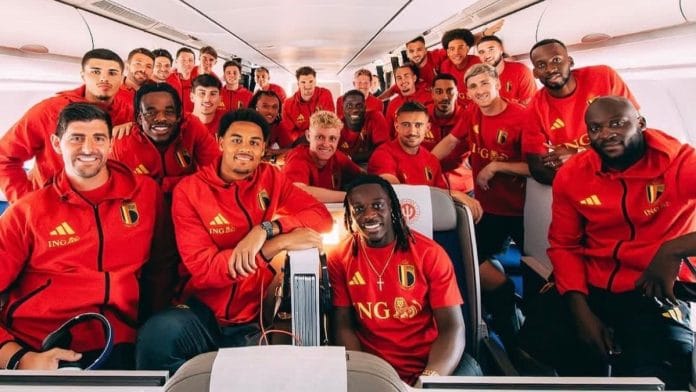


In football, and all of sport in fact, the discovery of a “Golden Generation” is when the country’s sporting culture, architecture and imagination essentially reaches its zenith. For a good decade or so, the country and the sporting world bask in its splendour. “Sport is in safe hands,” it is said. However, the passage of time is cruel even to the glorious “Golden Generations” of world sport. In football, the Belgium Men’s Football Team is the victim of time’s latest unravelling.
At the 2026 FIFA World Cup in North America, the ‘Red Devils’ have failed to win a single game so far. It is worth clarifying a quick misconception, though: they have not actually failed to win a point. The Red Devils have fought to two successive draws in Group G—a 1-1 stalemate against Egypt, followed by a tense, 10-man 0-0 draw against Iran. But for a set of players long touted as the “dark horses” at global events, the narrative does capture the dismal state of affairs for the team, a far cry from what the group once promised.
The underlying sentiment is painfully ringing true: the magic is gone, and the twilight of Belgium’s greatest footballing era is proving to be a slow, agonising fade.
A 20-year game plan
To understand the evolution of this remarkable generation, one would have to go back to the mid-2000s. A systematic overhaul was underway at Belgian football youth development centres. Spearheaded by former Royal Belgian Football Association Technical Director Michel Sablon, one of its key features was that youth teams across the country were mandated to play a 4-3-3 formation, which ensured that when players from different clubs came together for the national team, they already possessed a shared understanding of space and movement. There was also the famous KU Leuven Study.
Commissioned by the Football Association, the study filmed 1,500 youth matches to understand what actually helped young players develop, and what was missing in the others’ training.
By the time the 2014 World Cup in Brazil rolled by, the efforts had begun to show results. A country of 11.8 million had assembled a lineup of world beaters.
An envious lineup of world-class talent had matured simultaneously in the national team. Names like Eden Hazard, Kevin De Bruyne, Romelu Lukaku, Vincent Kompany, and Thibaut Courtois were mainstays for top European clubs and formed the core of a Belgian side that terrified opponents, on their day, capable of tearing any team apart.
Led by Vincent Kompany, the Belgians exhilarated football fans and analysts with a scintillating blend of technical elegance and physical power. And they also had the results to back their style of play. For nearly four years from 2018 to 2022, Belgium sat proudly at the pole position in FIFA’s rankings. The “dark horse” tag was passe. They were the benchmark. All they needed to solidify this as a footballing truth and not just an opinion was some silverware.
At the world stage, they were brilliant in moments. In 2014, after a dream start to the tournament where they cruised through the earlier rounds, they were eliminated 1-0 in the quarter-finals by Argentina.
At the 2018 World Cup finals in Russia, in an unforgettable quarter-final, they tactically dismantled tournament favourites Brazil, showcasing a breathtaking counter-attacking style led by the attacking duo of Hazard and De Bruyne, both of whom had developed into one of the finest players in the world by then, regularly featuring in the Ballon d’Or shortlist.
Unfortunately, though, Belgium’s dream of the elusive trophy ran into a defensive wall in the semi-finals against France, leaving them to settle for a third-place finish. It remains the highest World Cup finish in the nation’s history.
But as history shows now, it was the closest this fine generation of footballers would ever get to a major piece of silverware.
In subsequent years, cracks began to emerge in a side that was now inching past its physical prime. The cracks became impossible to ignore by the next World Cup in 2022 in Qatar, a tournament marked by internal friction and a disastrous group-stage exit. De Bruyne himself openly admitted later that the squad was “too old” for the tournament.
Also read: Colombia’s 1st win in World Cup reopened old wounds for Radamel Falcao
Football is cruel
As the years progressed, iconic figures who headlined the generation, like Kompany and Hazard, hung up their boots. It left a heavy burden on already ageing players.
Today, while emerging stars like Jeremy Doku and Nathan Ngoy have entered the fold, the transition has been clunky to say the least. Belgium appears to be caught awkwardly between rebuilding for the future and clinging to the past.
As a result, this summer, the Red Devils find themselves heavily strained. Rather than dominating Group G, an ineffective offence has failed miserably, a far cry from its heydays when they captured the imagination of the entire footballing world. More often than not, Belgium have ended up ceding the spotlight to their far more resilient opponents in the two games so far—Egypt and Iran.
With a final group-stage match remaining against New Zealand, Belgium’s survival hangs entirely in the balance. The golden era didn’t end with the silverware it was promised. Instead, it is winding down in the gruelling summer heat of North America, leaving fans to wonder what might have been. Football is a cruel sport.
(Edited by Saptak Datta)