






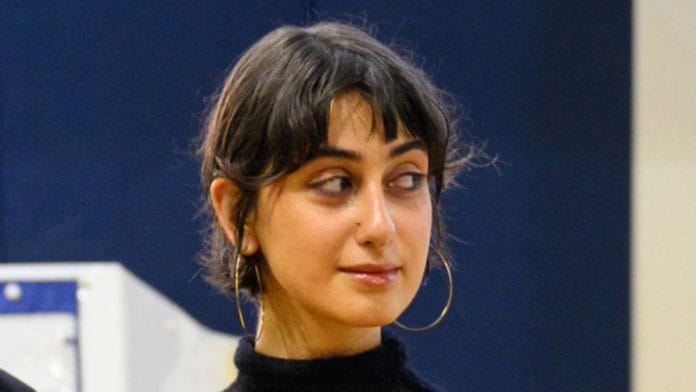


For the better part of a year, Rama Duwaji was cast in roles she never auditioned for. It’s been six months since Zohran Mamdani was elected New York Mayor, but the gaze on his wife Duwaji hasn’t thinned. If anything, the scrutiny has only increased.
But Rama Duwaji’s relationship with the American media, commentariat and the podcast-verse is one of breathless over-analysis with almost no room for nuance. They still don’t quite know what to make of her, how to pin her into a box. She defies easy, reductive categories.
To Vogue, Mamdani’s wife was part of a rare dose of “hetero-optimism” in a bleak dating era — the Syrian illustrator who met New York’s future mayor on Hinge and somehow made political romance fashionable again. Vogue Arabia looked at them and saw John F. Kennedy Jr. and Carolyn Bessette. Cosmopolitan called her the internet’s new “aloof wife”. Vogue India would later come to her defence as “the thinking wife of a famous man”. And to conservatives, the 28-year-old was something else entirely: a political actor hiding in plain sight.
Not bad for someone now being described as a private citizen.
She is the star of several conversations unfolding simultaneously: Palestine, immigration, identity, political branding, feminism, social media, and the changing nature of public life. She has become a vessel into which different corners of American society are pouring their own anxieties.
The artist, the activist, the wife, and the symbol.
As scrutiny of her social media activity, artwork and political associations intensifies alongside the rise of her husband, those competing portraits have collided.
This isn’t the first time the US media hasn’t known what to do with a competent, talented, qualified, self-fashioning wife of a successful male politician. Remember Hillary Clinton?
The debate surrounding Duwaji is ostensibly about whether she is a public figure. But spend enough time following her media coverage, and a stranger question arises: How did American media spend months introducing her to readers only to start arguing about whether she belongs in the public eye at all?
Making of a political It-girl
Long before the controversies, Duwaji occupied a peculiar corner in the American media landscape. She was neither a politician nor a celebrity in the conventional sense. Yet she was frequently covered with the fascination usually reserved for both.
When Mamdani’s political star began rising, media profiles often lingered on her almost as much as they did on him. Their relationship became a story in itself. Vogue turned their courtship into a modern political romance, complete with wedding photographs. Other publications were fascinated by the couple’s aesthetic: young, immigrant, multilingual, politically engaged and seemingly tailor-made for an era when politics increasingly bleeds into culture. Even her haircut was not spared.
Fashion writers analysed it and social media users copied it. Vogue published an explainer on the so-called “Rama” haircut.
Even Duwaji’s illustrations, many of them centred on themes of displacement, identity and Palestine, earned her an audience that existed independently of Mamdani’s political career. Her supporters first see her as an artist whose work has long explored questions of belonging and injustice, not as an extension of her husband’s office.
Some writers went further.
Many framed her as the new template for how political spouses are perceived. Gone, they suggested, was the era of obligatory campaign smiles and carefully managed public appearances. Duwaji appeared distant from electoral theatre, more interested in her work than in performing politics. But media houses were busy finding labels for her.
The internet loved it.
She was glamorous without seeming to seek attention, visible without looking available for public consumption.
Also read: Bob Dylan is a favourite of every generation. The times are always a-changing
Fascination and scrutiny
But critics saw it differently.
As Mamdani moved from insurgent candidate to mayor, attention shifted from the couple’s image to their politics. Critics began combing through old social media activity, public statements and artistic collaborations. Questions that had once been asked admiringly were suddenly asked skeptically.
Conservative outlets led much of that charge. Their argument: if Duwaji’s political views, activism and artwork had been considered relevant enough for profiles and features, why should they become irrelevant now? Why, they asked, was a woman who had appeared in major magazines and political coverage suddenly being described as a private citizen?
Public figures, critics argued, often seem public only when the attention is flattering.
The dispute intensified after Mamdani found himself defending his wife from criticism over her association with Palestinian causes. From Duwaji’s old likes and language on social media, supposedly supporting Hamas’ October 7, 2022 attack on Israel, to even her Spotify playlist — nothing was spared. Mamdani squared up and said his wife was not a public figure.
He also distanced himself from comments made by Palestinian-American writer Susan Abulhawa, while insisting that his wife’s involvement with a project connected to her was limited.
Some accused Mamdani of abandoning a prominent Palestinian voice to shield himself politically, while others argued that he was merely doing what politicians have always done: drawing lines between personal associations and official positions.
Yet even this debate quickly became a debate about Duwaji.
To her critics, the episode reinforced that she occupied a curious space where influence and accountability did not always travel together. To supporters, it demonstrated precisely why politicians’ spouses should be granted greater privacy in the first place.
Curiously, Duwaji has not contributed much to the argument being waged in her name. In interviews, she has mostly spoken about the strange experience of becoming known primarily as “Zohran Mamdani’s wife”.
“This experience has absolutely changed my life. I am still figuring out how it applies to me as an artist and as a person,” Duwaji said in an interview. “It has forced me to confront how much I’ve changed.”
Or she has spoken about how her art reflects the times.
“Everything is political. What we choose to show, what we choose to omit, the stories we highlight, and the ones we leave in the margins,” Duwaji said in an interview after Mamdani’s election.
When her old posts with racial slurs resurfaced, she apologised. Beyond that, she has largely remained silent while others assigned meaning to her.
Maybe that explains why Duwaji has become such a compelling and fascinating figure. She is the Greta Garbo of New York politics. Every new article the American media writes about Duwaji only reveals more and more about the writer and less and less about her.
Views are personal.
(Edited by Ratan Priya)