





At Vatican audiences, gifts are usually the most visible and least consequential part of the encounter. Those presented to Pope Leo XIV on 28 August told a precise story. Published by Crossway in Wheaton, Illinois—within the Chicago metropolitan area—the Catholic edition of the English Standard Version Bible received official approval from India’s Latin bishops in 2019. Beside it was an oak plaque carved by Kerala artist Raphael: Christ surrounded by twelve saints associated with India, from Thomas the Apostle to Mother Teresa and Devasahayam. One gift acknowledged where the pope comes from. The other asked Rome to remember who Indian Catholics are.
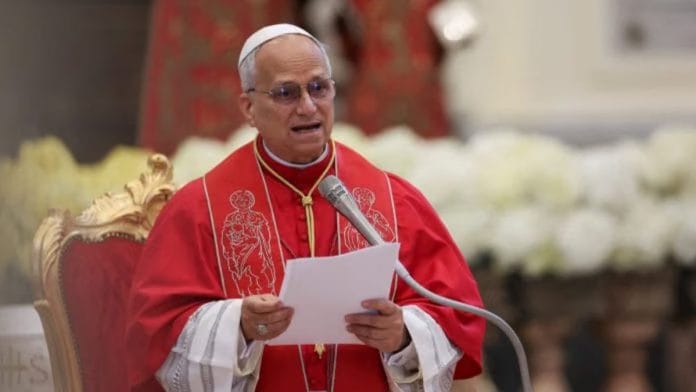
Cardinal Filipe Neri Ferrão, Archbishop of Goa and Daman and president of both the Conference of Catholic Bishops of India (CCBI) and the Federation of Asian Bishops’ Conferences, led the delegation. The delegation’s meeting with Leo XIV lasted more than 45 minutes and covered the life, mission and pastoral concerns of the Latin Church. The bishops also handed him the CCBI’s Mission 2033 pastoral plan and its 2025 Bhubaneswar document.
The significance lies beyond the audience itself. India is one of the few countries Leo XIV does not need to discover through a briefing book. Robert Francis Prevost, now Pope Leo XIV, travelled to Kerala and Tamil Nadu in 2004 and 2006 as prior general of the Augustinians.
“Pope Leo knows the Church in India well,” Ferrão said afterwards. The test is whether memory can become policy.
Why India matters to Rome
Using 2011 census figures, the Ministry of External Affairs counts more than 19.9 million Catholics, the second-largest Catholic population in Asia. The CCBI represents 132 Latin dioceses. The similarly named Catholic Bishops’ Conference of India (CBCI) brings together the Latin, Syro-Malabar and Syro-Malankara traditions: 175 dioceses and about 300 bishops. India also has six cardinals, four of them electors. Numerically a small minority, its Church is continental in history, institutions and diversity.
That diversity matters. The Syro-Malabar and Syro-Malankara Churches retain their own liturgies, canonical traditions and governing structures, rooted in the history of the St Thomas Christians. Rome cannot treat merely India as mission territory or a diplomatic file. It demonstrates that communion need not mean uniformity.
Leo XIV has already invested institutional capital. Between January and July, he appointed the bishops of Udupi, Sindhudurg and Warangal, an auxiliary in Ranchi and a coadjutor in Guwahati. On 27 August, he gave prior assent to the election of Thomas Animoottil as Syro-Malabar auxiliary bishop of Kottayam. Ferrão joined the Dicastery for Communication in April; Archbishop Elias Frank of Calcutta joined the Dicastery for Evangelisation in June. These appointments do not add up to an India policy, but they reveal where a pope places trust.
His most telling Indian decision may have been a withdrawal. The Syro-Malabar Archeparchy of Ernakulam-Angamaly had come close to rupture over a bitter liturgical dispute. After a fragile compromise took effect in July 2025, Leo XIV ended the mandate of pontifical delegate Archbishop Cyril Vasiľ. The conflict persisted, reaching the Kerala High Court again in March 2026.
Only on 30 August was the compromise implemented at St Mary’s Basilica for the first time. Rome did not solve everything. It showed that authority can sometimes work by stepping back when a local settlement becomes possible.
Rome should not listen to India only when Christians are threatened. Mission 2033 offers a positive programme: interreligious dialogue and peacebuilding, inclusion, poverty and integral ecology, accompaniment of children and young people, and a larger role for women and lay people. Reducing the Indian Church to a catalogue of persecution would be another way of refusing to hear it.
The threat is real, however. The CCBI did not disclose which “pastoral concerns” were raised with Leo. But in his Independence Day message, CBCI president Cardinal Anthony Poola — the first cardinal from the Dalit community — condemned “violence, atrocities, intimidation and mob lynching” against Christians and defended every citizen’s right to “live, worship and serve without fear”.
Also read: Orthodox Russia doesn’t take orders from Pope. Vatican can’t convince Putin for a ceasefire
A broader constitutional dispute
In Manipur, an essentially ethnic conflict also follows a religious fault line between the predominantly Hindu Meitei and largely Christian Kuki-Zo communities. Reported death tolls are now around 260; Manipur government records released in April counted 58,821 people displaced by the violence since 2023.
Then there is caste. In February, the CBCI called for the repeal of anti-conversion laws and renewed its demand for equal rights for Dalit Christians. Supporters say such laws target fraud, coercion and material inducement, not faith. The bishops point to their effects: vague definitions and selective enforcement can make religious freedom a right exercised under suspicion.
A Supreme Court ruling on 24 March sharpened the issue. In Chinthada Anand v State of Andhra Pradesh, the top court held that under the Constitution (Scheduled Castes) Order, 1950, a person who professes Christianity after conversion is not legally a member of a Scheduled Caste and cannot invoke the protections of the Scheduled Castes and Scheduled Tribes (Prevention of Atrocities) Act.
The judgment concerned one criminal case; it did not settle the broader constitutional dispute over Dalit Christians, and in July the court dismissed Anand’s review petition rather than revisit it. Yet it leaves an unavoidable question: why should changing one’s faith change one’s legal category?
The Holy See, the Pope and the central institutions through which he governs the Catholic Church and conducts its diplomacy, should answer with neither megaphone diplomacy nor diplomatic euphemism. The bishops’ strongest case is not for confessional privilege but for equal citizenship, freedom of conscience and the rule of law. Diplomatic relations date to 1948. Rome need not tell India what nation to become; it can ask India to honour a constitutional promise already made to its citizens.
Listening must have consequences. Cardinal George Jacob Koovakad already heads the Dicastery for Interreligious Dialogue. Indian and Asian expertise should shape policy, not comment on decisions taken in Rome. The Federation of Asian Bishops’ Conferences (FABC) should be involved before an Asian agenda is drafted, and not after. Dalit Christian rights belong in bilateral discussions as a question of equality before the law.
A papal visit remains unfinished business. Paul VI went to India in 1964; John Paul II in 1986 and 1999, when he promulgated Ecclesia in Asia in New Delhi. Two popes, three visits, then a gap of nearly 27 years. Prime Minister Narendra Modi invited Francis in 2021 and again at the 2024 G7 summit, but the journey never happened. For Leo XIV, India would not be a discovery but a return. A papal visit should crown a relationship, not substitute for one.
That is why the oak plaque matters. It presented Catholicism not as a foreign appendage but as an Indian story: apostolic memory, encounter with Europe, local holiness, lay witness and women who became global figures. Leo XIV knows the country. The real test is whether he lets its Church — plural, ancient and restless — complicate Rome’s view of Asia and help shape the Asian agenda of his pontificate.
Riccardo Benotti is a Rome-based Vatican journalist and senior editor at SIR, the news agency of the Italian Bishops’ Conference. Views are personal.
(Edited by Saptak Datta)
The comparison does not hold. It is true that the Holy See and Vatican City State are explicitly confessional in nature, and that the rules governing the Roman Curia include religious requirements for personnel. But the Vatican does not present itself as a secular state. India does.
The issue of Christian Dalits is also not a Vatican invention. Under the Constitution (Scheduled Castes) Order of 1950, a person professing a religion other than Hinduism, Sikhism or Buddhism cannot be recognised as a member of a Scheduled Caste. This has long been a matter of legal and political debate within India itself, to the point that the Indian government established a specific Commission of Inquiry to examine the possible extension of Scheduled Caste status to converts to other religions.
Calling for that legal framework to be changed does not mean “overriding” the Supreme Court or attacking Indian sovereignty. The Court applies the law as it stands; Parliament can change that law through the procedures provided by the Indian Constitution itself.
One may certainly oppose such a reform. But reducing an internal Indian constitutional debate to “the Vatican versus India” does not address the substance of the issue.
A foreign sovereign lobbying to override Supreme Court rulings and force India to rewrite its constitutional reservation criteria is a direct assault on Indian sovereignty.
The Vatican has absolutely no “inclusivity clauses” for Hindus—or members of any other non-Christian faith—at any level of its governance. In fact, its legal and institutional framework explicitly mandates strict religious discrimination to maintain absolute ideological and doctrinal control.
When Vatican-aligned figures, like this blogger, is, demand that India alter its constitutional secularism, remove anti-conversion statutes, or grant state-funded Scheduled Caste reservation benefits to Christian converts under the banner of “inclusivity and non-discrimination,” they are operating from a multi-tiered double standard.
So, dude, Ricardo, cease and desist. The Vatican operates as an absolute theocracy where non-Catholics can’t even get a job sweeping the floors let alone hold a seat in governance.
A state that legally mandates Catholic baptism certificates for basic administrative employment has zero standing to lecture India on any matter.