






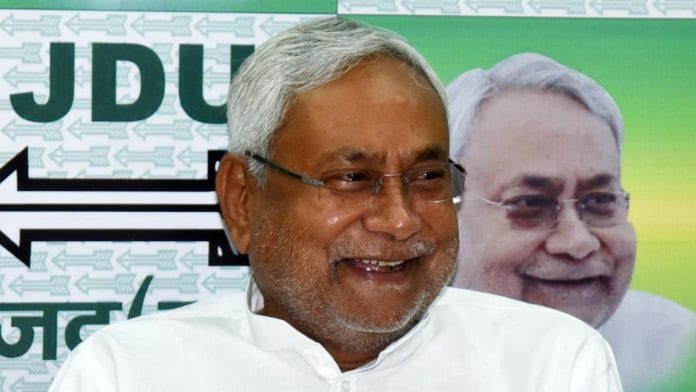



Bihar Chief Minister Nitish Kumar’s exit was a long time coming. It was always a matter of when, not if. Therefore, when the 75-year-old leader filed nomination papers for Rajya Sabha election on Thursday, virtually clearing the decks for a change of guard in Bihar, his decision surprised few in the political circles. What did, however, come as a surprise was the timing of his exit — barely two and a half months after he was sworn in as the CM for the 10th time.
It goes to his credit that his colleagues in the Janata Dal (United) and Bharatiya Janata Party (BJP) leaders were keeping their fingers crossed until he himself announced the decision Thursday morning. After all, how many times in the past had he changed allies to retain the CM’s chair? With only 43 JD(U) MLAs in the 243-member Bihar Assembly after the 2020 election, he remained the CM switching allies twice in the span of five years.
So, with the JD(U) having 85 MLAs as compared to the BJP’s 89, what compelled him to cede ground this time? The fact is that unlike in the past, when his party stood solidly behind him, top JD(U) leaders have been convinced, of late, of his inability to govern. That he often didn’t recognise even his long-time associates in the party and the government is hardly a secret. His gaffes and awkward conduct in public programmes left few in doubt that the age was fast catching up with him.
His close associates have long been controlling access to him, limiting his media exposure to a few random bytes and getting him to read from written texts in public meetings. Kumar’s close party colleagues were “working on him” to step down and put in place a succession plan involving his son Nishant’s entry into politics. How it works out is a matter of speculation as of now. The son’s exact role in the new government and the party is still being worked out even as Bihar is set to have the first BJP CM in coming days.
A govt on auto-pilot
Nitish Kumar finally hanging up his boots as the CM is good for Bihar. Except his tenure from 2005 to 2010, when he did bring a turnaround in Bihar to earn the ‘vikas purush’ moniker, his subsequent terms as the CM have been rather forgettable with primary focus being on saving the chair. It has grown only worse in the past couple of years when his advancing age appeared to have a toll on his memory and cognitive abilities. He held the CM’s chair but the government was on auto-pilot mode, with bureaucrats running the show.
Bihar owes a lot to Nitish Kumar but it now deserves a new CM — someone with long-term vision for Bihar. For someone who was thinking of doing business after losing two Assembly elections and who gave it a last shot in 1985 polls with Rs 20,000 from his wife’s savings and donation, Kumar has had a dream run in politics as he enters the Rajya Sabha before riding off into the sunset.
So, what lies ahead as a new chapter starts in Bihar politics? For one, it’s the beginning of the end of the JD(U) that was formed in 2003. Whatever role Kumar’s son, Nishant, may get — as deputy CM or something else — the likelihood of him stepping into his father’s shoes is a long shot. The JD(U) may still have 12 members in the Lok Sabha and 85 in the state Assembly, but without Nitish Kumar as its face, the party is confronted with a big leadership vacuum. There is no other leader in the JD(U) who has any base beyond his or her constituency. In the absence of a ‘vote-getter’, the JD(U) would be prone to defections and splits in coming months and years. With the BJP already eyeing Kumar’s vote bank, his exit is likely to set off the attrition process sooner than later.
Also read: ‘PM Modi is upset’ narrative is a communication disaster. BJP optics team is slipping
An opportunity for Opposition?
Secondly, the likely installation of a BJP CM fulfills the party’s long-cherished dream. It’s likely to embark on an expansion exercise soon, with Nitish Kumar’s vote bank up for grabs first. The presence of three principal poles in Bihar politics — the BJP, the JD(U), and the Rashtriya Janata Dal — meant that any two of them coming together meant a certain defeat for the third. Trust the BJP to break this dependence. In the run up to the Assembly election last year, when a group of BJP leaders met Amit Shah to discuss the manifesto, the Union Home Minister asked them to be “ambitious” in their promises, as one of those present at the meeting shared with me later. “Jo promise karna hai karo (promise whatever you want to). The Centre will give whatever is required to change the face of Bihar,” Shah reportedly told them. That was an early inkling of the BJP’s ambition in Bihar.
Last but not the least, what does Nitish Kumar’s exit mean to the Opposition? Theoretically, it should have pleased the RJD. It could hope to expand its votebank, currently confined to Muslims and Yadavs, by eating into Nitish Kumar’s support base among women, mahadalits, extremely backward classes, and Kurmis. Tejashwi Yadav hasn’t, however, shown the ability or will power to expand his party’s social base — something Akhilesh Yadav of the Samajwadi Party achieved to some extent in the last Lok Sabha election. This may bring hopes to new players like Jan Suraaj Party’s Prashant Kishor, but it’s a long shot.
DK Singh is Political Editor at ThePrint. He tweets @dksingh73. Views are personal.