







On the second day of the Sabarimala hearing, the Centre asked the Supreme Court to do away with PILs as a concept altogether. The Chief Justice of India, Surya Kant, drawing on his daily experience in Court Room No. 1, pushed back, claiming the court was cautious and admitted only a scant number of applications. Academia and media have, once again, picked sides and chosen to battle out the propriety of PIL jurisprudence.
Ideological battles on either side are unavoidable. What is loudly absent from this debate, however, is data. Do PILs impose a significant work burden on Indian courts? What kind of litigants are forced to use the PIL route? What are they generally asking for? Do they typically succeed or fail? Debates on retaining or abolishing PILs—a long-standing feature of the Indian justice delivery system—are incomplete until these basic questions are answered. For if PILs consume disproportionate judicial time and filter down to rare wins, the system must ask how it can disincentivise frivolous filings. If, on the other hand, PILs constitute a negligible share of the docket but demonstrate unparalleled effectiveness in remedying failures of the State, one needs to make a much stronger case for depriving citizens of this route to enforce their rights.
To demonstrate that a basic data-backed analysis is not out of reach, we look at 3,190 PIL filings before the Bombay High Court over the past half-decade from TheProfesseer’s dataset. We analyse this data to answer precisely the questions we asked above: namely, the impact of PILs on workload, litigant profiles, subject matter of PILs, and success rates. An informed position on the Centre’s call for abolition or the Supreme Court’s defence of caution must be grounded in a nationwide empirical analysis of the kind we demonstrate here.
How are PILs different?
In principle, the unique distinction between a PIL and a general petition before the Supreme Court or High Courts is a ‘diluted locus standi‘. This means that any public-spirited individual, irrespective of whether their rights were affected directly, may approach the court and seek justice. The executive has argued over the years that this loosened standing dilutes judicial processes and encourages extra-constitutional judicial activism. The opposing camp maintains that the PIL is the sole avenue of relief for those reeling under systemic disadvantage and the singular institutional check against executive excesses or failures.
In recent decades, scholarly work has pointed toward PILs as a cause for court docket expansion. Courts have not shied away from reprimanding parties for filing frivolous petitions and wasting their valuable time. Popular narratives about the court’s political leanings are also frequently shaped by how it deals with and disposes of sensitive PILs. We perform three analyses: (a) Workload, (b) Petitioner–subject matter nexus, and (c) Outcome, to demonstrate the potential data holds to bring objectivity to this debate.
Do PILs clog Court Dockets?
The classical way to examine this question is to look at year-on-year trends of PIL filings. Figure 1 below shows an example of such analysis from the Bombay High Court, tracking the share of the court’s total workloads in each year from 2021 to 2025. Together, these numbers tell us whether PILs constitute a burdensome proportion of the court’s workload at all — or if that concern is overstated from the outset.
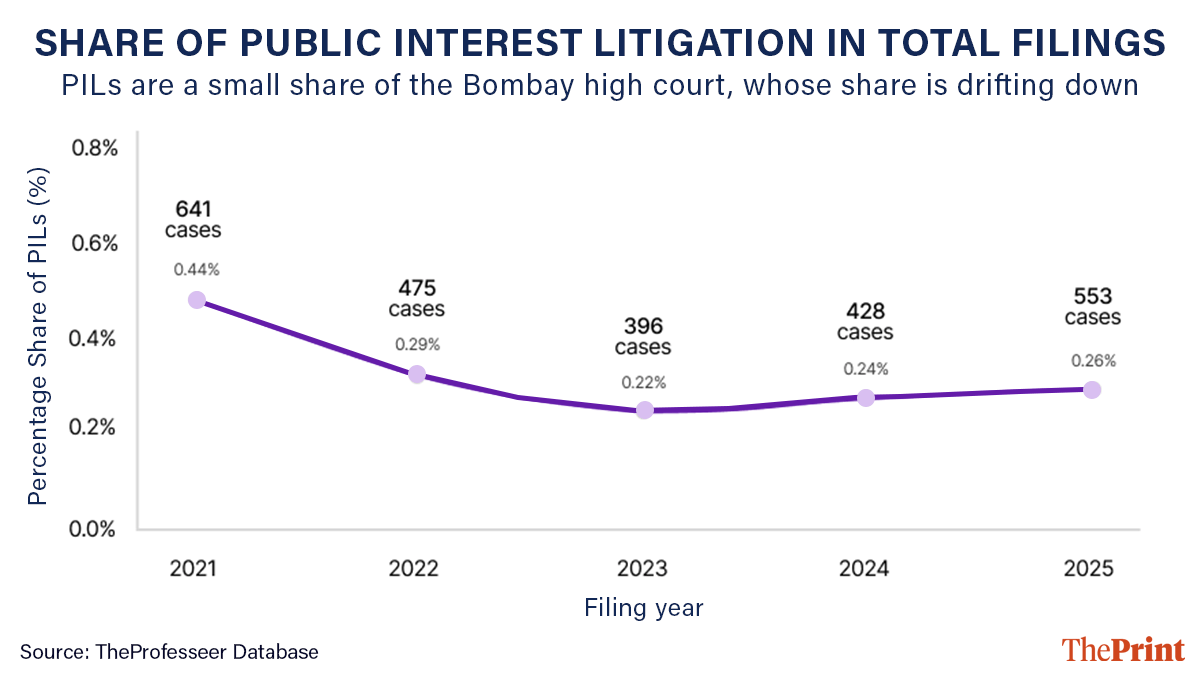
We learn that PILs have never exceeded half a per cent of the High Court’s annual docket in any year observed, and their share has, in fact, compressed. Whatever PILs do at the Bombay HC, numerically overloading the court is not one of them.
Who files PILs and what do they want?
The Centre’s view is premised on the assumption that “access” to the courts is no longer as constrained as it was in the early years of PIL jurisprudence. A closer look at the kinds of petitioners and the matters they bring illuminates a more fundamental question: what compels parties without direct stakes to approach the court at all? Figure 2 below offers a breakdown of litigant types. Most of them are individual petitioners raising concerns of public importance.
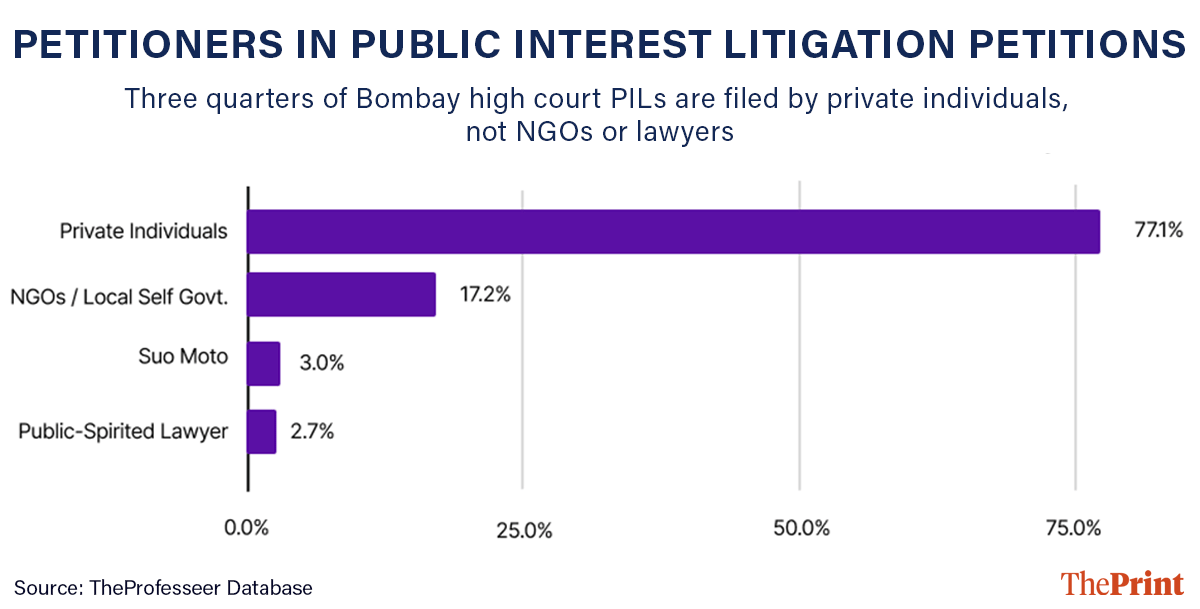
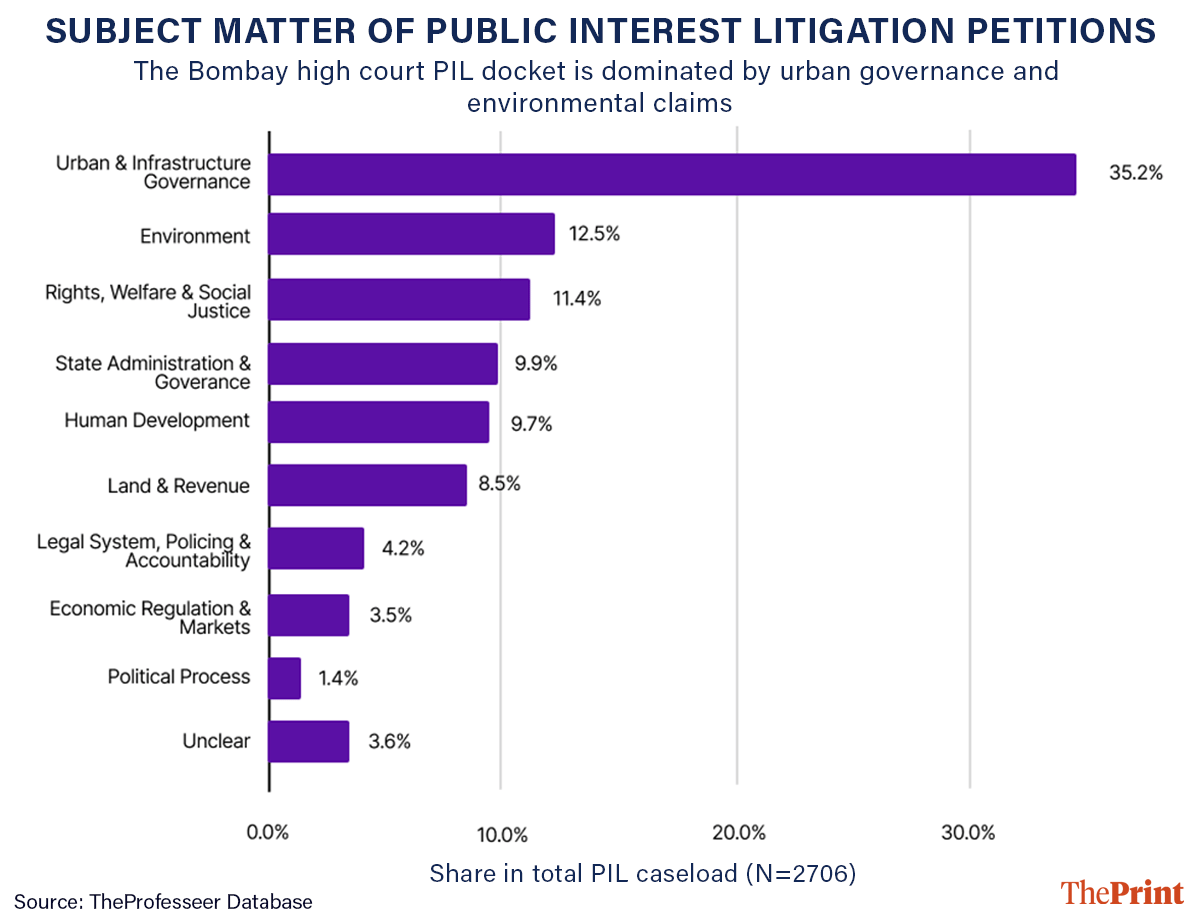
The subject matters of concern range from urban affairs at 35.2 per cent — roads, sanitation, electricity, municipal complaints — at the top, down to political processes and market regulation [See Figure 3]. Notably, 3 per cent of these cases are suo motu instances, where the court has, on its own initiative, registered matters as Public Interest Litigations.
Several of these invocations concern remarkably sensitive issues. Two examples illustrate the court’s expansive appetite. In one instance, the court exercised what it calls its ‘epistolary jurisdiction’—in simpler terms, its power to treat a letter as a petition. Acknowledging a letter seeking urgent intervention to ensure education for children aged 3–14, the court took prompt action. In another such instance, newspaper reports on Mumbai’s deteriorating air quality moved the court to institute proceedings on its own.
At the same time, the court demonstrated remarkable prudence in a number of cases. Relying on its own PIL rules from 2010, the court sometimes required petitioners to deposit an amount upfront as proof of bona fides. In one instance, it went further still—asking a petitioner to complete a week of community service before the matter could proceed.
Within the limits of our data, the population of Bombay High Court PILs bears little resemblance to the stylised claims on either side of the debate: they are neither a flood of elite NGO litigation nor a systematic check on executive overreach. For the most part, they are citizen complaints about poor roads.
A more comprehensive investigation into litigants’ motivations and interests—or the absence thereof—as well as the nexus between petitioners and their chosen subject matters, would require access to the filing forms and pleadings submitted to the court. These documents are not publicly available, but they are accessible to the Supreme Court and the Centre, and would lend themselves well to a thorough empirical inquiry along these lines.
What are the outcomes?
Of the 1,408 Bombay High Court PILs that have concluded, we find that petitioners win 29 per cent of the time. This is not a trivial figure. Even if PILs were nothing more than a pressure valve for civic grievance, the fact that 29 per cent of matters — cases raising substantial questions of justice and fundamental rights that would have otherwise found no institutional home — find relief says something meaningful about the instrument’s utility. Outcomes, in other words, are strong arguments about access.
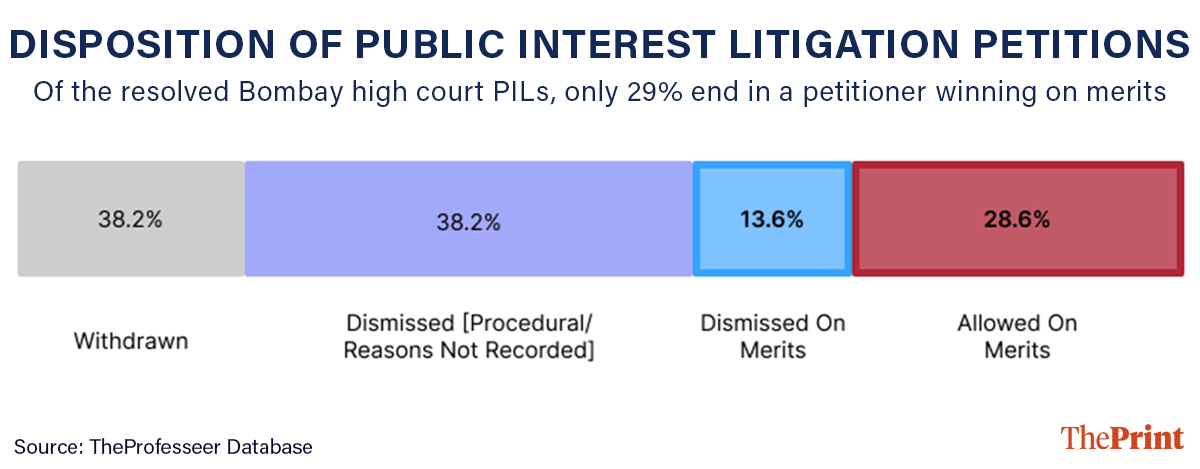
That said, success rates alone are an incomplete lens. This question is also deeply shaped by the court-specific procedural rules and admission structures that govern how each court handles its PILs.
Specific to the Supreme Court, Aparna Chandra, Sital Kalantry, and William Hubbard—in their book Court on Trial—have conducted extensive empirical work on filing data, coding thousands of cases across dozens of parameters. Using stage-wise classification—from admission to final disposal—they arrive at findings that are, at first glance, counterintuitive. A declining win rate for petitioners is not necessarily a symptom of the Court’s eroding pro-litigant disposition. It may, paradoxically, reflect the opposite: a court that has progressively lowered its admission threshold, lending its ears more indiscriminately, and consequently admitting a larger share of weaker cases that are less likely to succeed on the merits. More such analyses—rigorous and data-informed—are what the PIL debate desperately needs.
Given the resources and data at their disposal, it is imprudent for the Centre or the upper judiciary to rely on anecdotal impressions and ideological instinct when deciding the destiny of an instrument so uniquely rooted in the people’s imagination of justice as the PIL.
Also read: Acts of God cases are Acts of State now. The courts are not convinced
Conclusion
Time and again, anecdotal claims are made about the workings of Indian courts without much data. Court vacations, the futility of PILs, and pendency arising from judicial vacancies are some common bugbears. These are important issues, and it is unscientific to keep repeating these claims without data.
Our small exercise in this article revealed some counterintuitive facts about PILs in the Bombay High Court. That they constitute a negligible portion of the court’s workload, over 50 per cent get dismissed, and 20 per cent are withdrawn at some point during the case lifecycle. That said, of those that go through the full case lifecycle, nearly 30 per cent succeed.
More importantly, citizens are using the PIL route to raise what seem like genuine grievances on basic service delivery by the State. While a Bombay HC analysis cannot be extrapolated to any other court, much less the Supreme Court, our rather basic evaluation suggests that a policy or judicial decision to abandon PILs cannot be taken lightly. The oft-overused quip attributed to American composer and economist W. Edwards Deming goes: “In God we trust; all others must bring data.” The government, our courts, and the rest of us all belong to the latter category.
Srikanth is a Developer and Data Scientist at TheProfesseer. He tweets @SonOfRajkumar. Gokul is a Legal Associate at TheProfesseer. He tweets @GokulSunoj. Views are personal.
(Edited by Ratan Priya)