





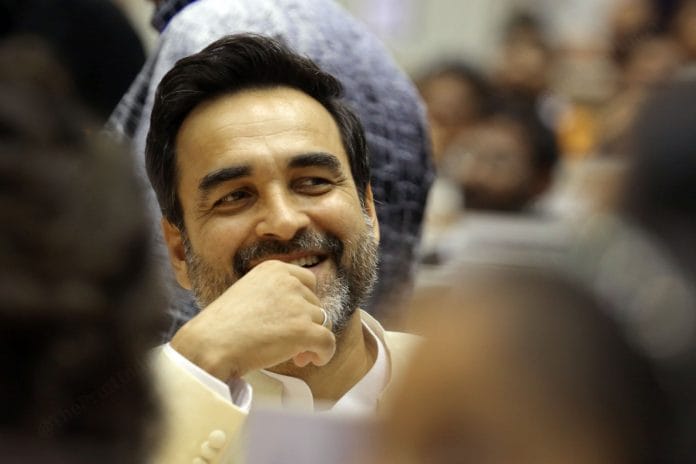

Pankaj Tripathi is like comfort food. He reminds me of a delectable doodh pedha. The mithai made from milk, with or without cardamom. Wholesome. Good for health. Palatable. Bland but not boring. A goody-goody actor, who is almost too ‘good’ to be true. But there he is, an accomplished, seasoned thespian who minds his own business while noiselessly stealing hearts, stealing the show, walking away with awards, headlining successful OTT projects and generally getting around quietly and efficiently in a raucous industry defined by brashness and bad-boy stereotypes. Paradox: The goody-goody excels at playing the baddie.
Tripathi is definitely not hero material; commercial producers remind us. But hello! He is much, much bigger. Tripathi is a one-man acting school. An actor who seamlessly becomes the character audiences immediately react to and adore—regardless of the role. What is this man? Neither fish nor fowl. Not an anti-hero. Not a villain. Not a character actor. Not a supporting star. And yet, the man’s mishti-doi “brand” is shaking up the box office. And exciting offers are pouring in.
This seems just right for a farmer’s son who takes pride in his roots and has scrupulously stuck to his staunch, conservative belief systems. Raised as a strict vegetarian, it’s ironic that Tripathi made his mark playing a butcher. He now says this one role in Anurag Kashyap’s Gangs of Wasseypur challenged him the most as an actor. But look where it took him! Tripathi’s powerful portrayal of Sultan Qureshi swiftly propelled his career forward, which at that point was going nowhere special. It is exactly this quality of quiet menace and unquestioned authority that makes Tripathi one of the most compelling actors on screen.
Jaideep Ahlawat is equally watchable, but his personality prewarns the audience about the brutality that will inevitably follow. Tripathi’s off-screen persona floors fans, by being so annoyingly authentic—it tests one’s patience. Critics wait for a single false note, a careless quote, a misstep—with any luck, a slugfest with a co-actor. Hell no! So far, Tripathi’s report card has been blemish-free and chaka chak—like a class monitor’s—that of a model student who’s the teacher’s favourite and can do no wrong.
Come on, Pankaj! Fake it if you have to, but show us a flaw.
A normal man in an ocean of psychos
Just check out his red carpet appearances – always unapologetically sanskari. Beige tussar kurta—pajamas, the occasional charcoal-toned bundi, perhaps a navy blue shawl and that’s it! Shudh Desi sartorial choices—except for the one time he sent his fans into a tizzy with a wild AI-generated image of him dressed in red harem pants and a black lace see-through shirt. There was a vivid green velvet jacket in the picture as well. It created a big enough stir for Ranveer Singh, Bollywood’s most flamboyant actor, to quip, “Hum sudhar gaye, aur aap bigad gaye.” Personally speaking, I would love for Tripathi to get more “bigadofied”.
There he is blushing away with the missus by his side, as paps ask them for a lovey-dovey pose! No chance! Tripathiji shuns PDA, unlike most of his more demonstrative colleagues, who grab their partners the moment they spot a camera lens. This reticence works big time in his favour. Fans are increasingly turning away from public demos of domestic bliss/ conflict. It’s a refreshing change for audiences to applaud a ‘normal’ bloke with a regular wife, in an ocean of psychos.
Is Tripathi an oddity? A misfit? Take his lifestyle in Mumbai. While successful actors choose to reside in glamorous complexes with names like Galaxy Apartments and Beau Monde, the Tripathis prefer a duplex in Madh Island, called Roop Katha.
It comes with a mud “chulha,” and the interiors are strictly rustic. It is his way of honouring the Belsand village in Bihar where he was born.
His faux gaon ka ghar in Mumbai clearly reminds Tripathi and his wife, Mridula (college sweetheart), of their roots. Today, Tripathi is in a position to call the shots and demand the high level of fees he richly deserves. His unique dialogue delivery style has spawned a meme industry with talented comedians mimicking him mercilessly. That in itself indicates the man’s immense popularity, especially with Gen Z.
Also read: Bollywood has never looked this uncool. Salman calling Sonam Wangchuk ‘bro’ was cringe
Success of Mirzapur
Not yet 50, Tripathi plays ruthless, wily characters who are much older and far nastier than our seedha-saadha, bhola-bhala actor in real life. He is dominating screens this week playing Kaleen Bhaiya in Mirzapur – the Movie. With rave reviews under his belt, the actor (a National School of Drama product) is on a roll, much to the delight of his admirers.
Success and popularity are twin monsters. The essential Tripathi is at that seminal point when the balance can get upturned without prior warning. It has happened to so many grounded and sensible stars in the past. Vikrant Massey, made from a similar mould, temporarily walked away from Bollywood, with all the fame, adulation and money his status guaranteed, to reclaim bits of his family life and make up for lost time spent on sets, away from his loved ones. He did it with aplomb and waltzed right back, career intact. Manoj Bajpayee is another busy actor who knows his priorities. Right now, Pankaj Tripathi is quite the star du jour, as he basks in the success of Mirzapur. Will he or won’t he fall into the celebrity trap?
Gosh. I hope Tripathi stays the way he is, muffler wrapped around his ears during winter, old-fashioned spectacles balancing on his nose, not allowing a smile to crack through the sang-froid. I would hate to see him prancing around in Prada, carrying an oversized Birkin, wearing cool designer shades at night as he slips out of a Maybach and waves to cheering fans. We love your shudh shakahari persona just the way it is. Did we read somewhere that Tripathiji approves of fish?
Thank you for being as essential and unforgettable as a favourite fragrance.
Shobhaa De is an author, columnist, social commentator, and opinion-shaper. She has written 20 books. She tweets @DeShobhaa. Views are personal.
(Edited by Ratan Priya)