




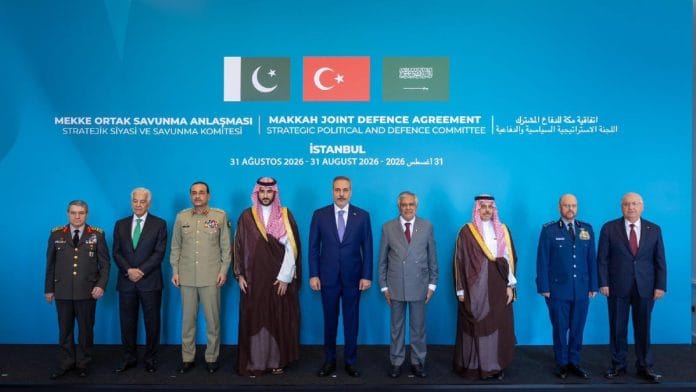

Pakistan has spent years trying to convince the Gulf that it is more than a country looking for economic assistance. Its military ties with Saudi Arabia have long been central to that effort, giving Islamabad strategic influence it has sought to translate into a larger regional role.
The Makkah Pact was meant to do just that, but it comes at a time when Islamabad is already facing mounting security and political pressures at home, even as its commitments to Riyadh could draw it into a wider regional conflict.
Pakistan is stretched across several fronts. In Khyber Pakhtunkhwa, militant violence continues, while relations with the Afghan Taliban have deteriorated over the presence and activities of the Tehreek-e-Taliban Pakistan (TTP). Islamabad once expected the Taliban’s return to power in Kabul to improve its security environment. Instead, it now accuses Kabul of allowing militants to operate from Afghan territory, a charge Kabul rejects, and the dispute has spilled into cross-border military action. In Balochistan, separatist groups keep attacking security personnel and infrastructure, including projects linked to the China-Pakistan Economic Corridor.
The Makkah Pact, signed in August, has since acquired a more immediate purpose as Saudi Arabia faces growing threats from Yemen’s Houthis. On 5 October, Pakistan, Saudi Arabia and Türkiye agreed to move towards the practical implementation of their collective defence commitments, including the rapid deployment of agreed military forces and capabilities in Saudi Arabia. Pakistan was also appointed to provide the alliance’s first secretary-general.
Within days, the risks became more concrete. On 8 October, a double attack on Riyadh’s King Khalid International Airport killed three people. On 10 October, another attack on the airport killed 12 and injured 309. A further strike hit it the following day, killing a Pakistani resident and injuring 11 others. Saudi Arabia’s King Fahd International Airport in Dammam was also targeted. The Houthis renewed warnings to airlines against using Saudi airports and airspace, raising the prospect of further attacks on civilian and economic infrastructure.
Riyadh now faces pressure to respond, and Pakistan’s commitments are being tested in circumstances that could look very different from those envisaged in August. For an army tied down at home, Pakistan has less room to manoeuvre in Saudi Arabia, and in its dealings with Iran, than the pact suggests.
Commitments and Pakistan under pressure
For Islamabad, the difficulty is defining what its commitment to Saudi security means in practice. Does collective defence mean protecting Saudi territory, helping intercept incoming missiles and drones, or supporting military operations against the Houthis inside Yemen? Each level of involvement has implications for Pakistan’s relations with Iran and its ability to act as a diplomatic interlocutor.
There is a precedent. In 2015, when Saudi Arabia sought Pakistan’s participation in its military intervention in Yemen, Pakistan’s parliament declined to commit forces. It nevertheless affirmed that Pakistan would stand by Saudi Arabia if the kingdom’s territorial integrity or the holy sites were threatened. Islamabad sought to preserve its relationship with Riyadh without being drawn into a war whose consequences could extend well beyond Yemen.
The calculation is no easier now. The Houthis have declared the kingdom’s airspace a military zone, with only Mecca and Medina as exceptions. If Saudi Arabia faces repeated attacks on its territory, how far can Islamabad limit its role to defensive assistance? And if Saudi operations against the Houthis intensify, can Pakistan continue to restrict its involvement to the defence of the kingdom?
Conflicting reports cloud what Pakistan is already doing. Reuters reported that between 30,000 and 40,000 Pakistani troops had been deployed to Saudi Arabia, citing a Pakistani official. Pakistan’s Ministry of Information and Broadcasting rejected the figures and operational details on 6 October as speculative, saying such matters were confidential.
Separately, The New York Times reported that Pakistani fighter jets were being used in strikes against the Houthis. Pakistan dismissed the report as ‘fake and fabricated’. Anyone who has followed Pakistan for long enough knows that when Islamabad is this quick to dismiss a report, it is often worth looking a little closer.
There is a political dimension, too. Reuters has reported that Pakistan agreed to deploy additional troops under the defence arrangement without parliamentary approval. In 2015, by contrast, Parliament publicly debated the risks of involvement in Yemen. Today, operational details remain undisclosed while the military, under Field Marshal Asim Munir, plays a central role in shaping Pakistan’s external commitments. The more consequential the commitment, the harder it becomes to separate questions of military capacity from questions of who is making these decisions and how they will be scrutinised.
The domestic pressure increased on 11 October, when President Asif Ali Zardari suspended the Khyber Pakhtunkhwa government led by Imran Khan’s Pakistan Tehreek-e-Insaf (PTI), after the federal government claimed it had failed to contain militancy. PTI condemns the move and is preparing a march on Islamabad. The confrontation risks deepening a political conflict when the state needs a coherent response to militancy.
For the military leadership, the competing demands are clear. The army is expected to contain militancy at home while projecting Pakistan as an indispensable security partner abroad. A larger role in Saudi Arabia could bring Islamabad diplomatic influence and financial benefits. It could also commit the military to a conflict whose duration and costs it cannot control.
Iran and the limits of Pakistan’s balancing act
Pakistan has strong reasons to preserve its relationship with Riyadh. But its relationship with Iran is equally important to its security calculations along the western border. Islamabad has tried to maintain ties with Tehran while positioning itself as a mediator between Iran and Washington. That role is already facing questions.
During a visit to Herat in Afghanistan, Iranian parliamentarian Mohsen Zanganeh took a swipe at Pakistan’s efforts to mediate between Tehran and Washington, alleging that even Prime Minister Shehbaz Sharif’s public message on the peace initiative had been written by the Americans. His remarks followed scrutiny of Sharif’s post on X, which initially carried the word ‘Draft’ before it was edited.
Pressure from Washington could make this balancing act harder still. US Treasury Secretary Scott Bessent says that Washington is working with Pakistan and Türkiye to cut off Iran’s overland trade routes. He also says that the US is likely to seize around $1 billion in Iranian-linked cryptocurrency. The implications for Pakistan go beyond diplomacy. The country shares a long border with Iran, where cross-border commerce, including informal trade and fuel smuggling through Balochistan, is deeply entrenched. Shutting down Iran’s overland trade routes would hit commercial interests and informal networks that Pakistan itself has struggled to control.
There is also the question of public opinion. Mohammed bin Salman is an important strategic partner for Pakistan’s military establishment, but that does not mean Pakistanis will view a confrontation with the Houthis in the same light. Iran retains symbolic appeal among sections of Pakistani society because it is seen as one of the few Muslim states still willing to confront Israel and the United States directly. The Houthis, too, attract support from some who view the conflict through that wider lens. Pakistani opinion is neither uniformly pro-Iranian nor pro-Houthi, but the military cannot assume that the strategic preferences of Riyadh and Rawalpindi will translate into popular consensus at home.
Pakistan’s problem, then, is whether it can define the limits of that commitment without undermining its other interests. A role that begins with defending Saudi territory could become harder to contain if the conflict widens, while any involvement in operations against the Houthis would carry consequences for relations with Tehran and for opinion at home.
The Makkah Pact does not mean Pakistan will have to fight in Yemen. That will depend on what Saudi Arabia asks of Islamabad and how far Pakistan is willing to go. But the promise of rapid deployment raises a larger question about how much room Pakistan has to manoeuvre if its partners expect it to act.
Pakistan’s generals want the country to play a larger regional role. The test will be whether they can turn that ambition into influence, while managing competing military and political demands at home and abroad, without taking on commitments that leave Islamabad with fewer choices rather than more.
Sonam Mahajan is a strategic affairs commentator and columnist specialising in Pakistan, Afghanistan, terrorism and the geopolitics of South Asia. She tweets @AsYouNotWish. Views are personal.
(Edited by Prashant Dixit)