






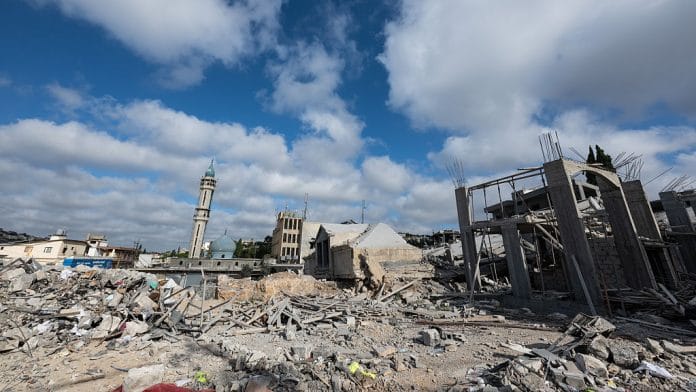


At 1:15 in the morning on 28 February 2026, American and Israeli aircraft opened a campaign against Iran that would run for more than two months. Within the first minute, Iran’s Supreme Leader, Ali Khamenei, and roughly 40 senior officials were dead. Within 24 hours, more than a thousand sites had been hit. The Pentagon called it Operation Epic Fury; Israel called the same campaign Operation Roaring Lion. By the time a ceasefire took hold in early May, the two air forces had flown thousands of sorties, dropped tens of thousands of munitions, wrecked most of Iran’s air defence network, and pushed Israel to mobilise 70,000 reservists for a war that, notably, never needed a single soldier to set foot in Iran.
It was, in almost every particular, a repeat performance. Eight months earlier, in June 2025, Israel had opened a shorter campaign against the same adversary, Operation Rising Lion, killing Iranian commanders and destroying nuclear infrastructure in an opening strike synchronised across 200 aircraft operating nearly 2,000 kilometres from home. Two months before that, India had responded to a terror attack in Pahalgam with Operation Sindoor, striking nine terror camps and 11 Pakistani airbases with cruise and precision-guided missiles, again without a single soldier crossing the Line of Control. And in the background, for four years running, Russia and Ukraine have fought a war increasingly decided in the air, and in the narrow band of altitude just above the trench line, where cheap drones now do work once reserved for artillery.
Something has changed in how states go to war. Air power used to be the instrument of escalation, the thing a state reached for once diplomacy had failed and limited measures had been tried and found wanting. Increasingly, it is the opening move instead. Not the last resort. The first.
A pattern, not a one-off
Sceptics could once dismiss any single case as an outlier. Rising Lion was Israel doing what Israel does. Sindoor was a punitive strike against a familiar adversary, bounded by decades of custom. But Roaring Lion and Epic Fury make it harder to treat 2025 as an anomaly. Here was the same basic script — decapitation strike, no ultimatum publicly exhausted, no ground invasion — run a second time, at greater scale, against the same country, within a single year. Israeli officials say the follow-on campaign destroyed the bulk of what remained of Iran’s air-defence architecture and hunted down its navy in the Caspian Sea and the Gulf. American officials describe the great majority of Iran’s defence-industrial base, including its missile and drone production, as destroyed. Whatever the precise figures, and battlefield claims are always worth treating cautiously, the direction is unmistakable: the second air campaign against Iran in under a year was not smaller or more restrained than the first. It was bigger.
That is the pattern worth studying, not because any one campaign proves a rule, but because four cases in two years, across three different adversarial relationships, now point the same way.
Why now
Three things have converged to make this possible. The first is precision itself, now mature enough that a state can achieve real strategic effect, killing a regime’s leadership, wrecking its missile production, degrading its command structure, without the mass casualties or drawn-out campaigns that once made air power politically costly. Sindoor’s strikes on terror infrastructure specifically avoided Pakistani civilian and economic targets. The opening strike of Roaring Lion is reported to have relied on continuous real-time monitoring to keep the attacking force’s own losses at zero.
The second is the collapse of the kill chain. Modern sensor networks compress what used to take days of planning into hours. The opening salvo of Epic Fury synchronised bombers, fighters, refuelling aircraft and electronic-warfare platforms into a single strike package that reportedly hit hundreds of targets within its first day. In Ukraine, the same compression happens at a smaller, cheaper scale: a first-person-view drone can go from launch to strike in minutes, guided by an operator watching a video feed from a trench a few kilometres away.
The third is cost. Ukraine alone is thought to have set a production target of roughly 4.5 million drones in 2025. A war that once required squadrons of expensive aircraft can increasingly be fought, at least at its margins, with machines that cost a few hundred dollars apiece. That arithmetic does not stay confined to state air forces forever; it eventually reaches militias, insurgents and proxies who have never operated an air force in their lives.
Not yet a settled rule
None of this means air power has permanently replaced escalation as war’s opening chapter. India’s Chief of Defence Staff, General Anil Chauhan, captured the underlying incentive last year: governments increasingly reach for force because political objectives can now be met through short campaigns rather than long ones. But four data points, however striking, are not a settled theory of war. Sindoor was a counter-terror strike. Rising Lion and Roaring Lion were counter-proliferation and regime-degradation campaigns against a state with a crumbling air-defence network. Ukraine is grinding interstate attrition of an entirely different character. The honest reading is that the trend is real and still forming, not a finished doctrine.
Where it goes next probably depends on three things happening at once: campaigns growing shorter and more front-loaded as combatants race to win before defences adapt; a parallel trend toward longer, layered contests, visible in how Russia’s drone-and-missile tactics evolved through 2025 and 2026 from blunt saturation into something more calibrated; and the spread of cheap first-strike capability to actors who have never had to think about escalation control at all.
Applause and worry
Some of this evolution genuinely earns credit. Precision that avoids Pakistani civilian infrastructure while degrading terror camps, or that lets an air force claim zero losses during a strike that killed a country’s top leadership, is more discriminating than the air campaigns of earlier generations. India’s own layered air defence held against more than 600 Pakistani drones launched in a single wave during Sindoor, proof that defence can keep pace with offence when the investment is made early.
What deserves real worry is the economics running the other way. Interceptors cost vastly more than the drones and missiles they shoot down, and that gap widens every year drone production gets cheaper. Israel and the United States burned through finite, expensive stocks defending against Iranian retaliation in both 2025 and 2026; a state without deep pockets cannot sustain that trade for long. There is a psychological risk too—a shared sense of success without resolution that tends to raise, not lower, the odds of a repeat.
The non-kinetic layer
None of these campaigns were won by aircraft alone. Cyber operations and internet blackouts degraded Iranian command coherence before Israeli jets ever crossed the border. Space-based and open-source satellite imagery gave analysts near real-time battle-damage assessment that used to be the preserve of state intelligence agencies. Electronic warfare shaped how air defence performed, with fire-control radars switched on only briefly to defeat direction-finding. Increasingly, these domains do not merely support a strike campaign; they decide whether one can be launched as the first move at all.
Also read: Future of India’s IBGs rests on rollout speed, tech. History rarely rewards armies that wait
Lessons closer to home
For the Indian Air Force, the past two years offer several unglamorous but important lessons. Networked and layered air defence pays off. Patient indigenous integration, however slow, beats dependence on imports. BrahMos took years to mature but became Operation Sindoor’s decisive strike system. Munitions and interceptor stockpiles now need to be treated as a first-order planning question, not a peacetime afterthought. The Iran campaign burned through precision stocks. And a multi-vendor fleet, drawn from Russia, France, Israel and domestic industry, will keep creating integration friction until India builds a clearer architecture for sharing sensor data across platforms never designed to talk to each other.
The broader lesson is that war’s opening move has changed. States that once spent weeks signalling intent before committing aircraft are now doing so within hours of a decision being taken. Whether that makes the world more stable, because conflicts end faster, or more dangerous, because the threshold for starting one has quietly dropped, is the question the next decade will answer.
Air Vice Marshal Prashant Mohan (Retd) was a fighter pilot. He is currently Additional Director General at the Centre of Aerospace Power and Strategic Studies in New Delhi. Views are personal.
(Edited by Ratan Priya)