




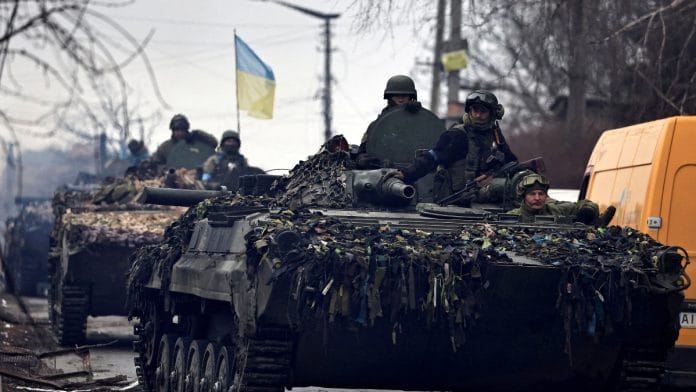

Ukraine’s Operation Vivaldi, currently underway around Lyman, provides a contemporary picture of how an offensive can be conducted on a battlefield saturated with drones, electronic warfare, mines, artillery, and persistent surveillance. It combines familiar elements of offensive warfare with technologies that have changed how those elements are executed.
Information superiority, localised drone superiority, degradation in depth, the close coordination of breach and manoeuvre, and exploitation feature prominently in this scenario. For India, Vivaldi also raises a question at the level above the manoeuvre formation. As the Indian Army develops Integrated Battle Groups (IBGs), does the corps headquarters require a corresponding transformation to command and orchestrate several such formations?
Operation Vivaldi
Based on Ukrainian and Western reports, Operation Vivaldi developed around the Lyman sector after months of Russian pressure and infiltration. Russia’s 20th and 25th Combined Arms Armies had spent around 20 months advancing toward Lyman, an important road and railway junction. Russian forces had established a salient north of the city and had used infiltration tactics to work around Ukrainian defensive positions.
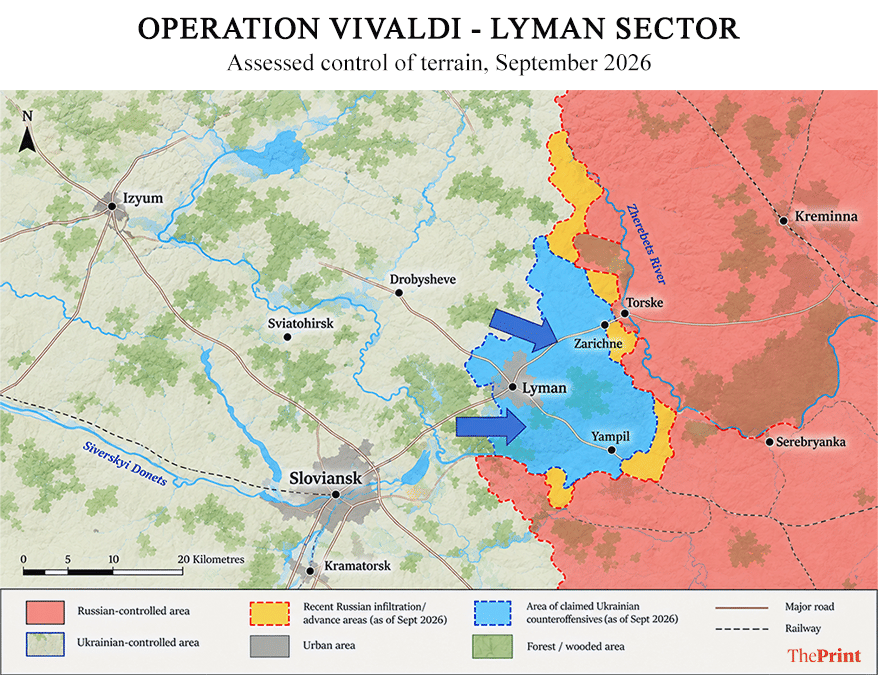
Ukraine’s 3rd Army Corps launched Vivaldi in May 2026. The operation involved several Ukrainian manoeuvre and specialist formations, including the 60th and 66th Mechanised Brigades, the 125th Heavy Mechanised Brigade, a battalion tactical group from the 3rd Assault Brigade, reconnaissance and anti-tank units, special operations forces, and other attached formations. The corps also employed substantial unmanned-systems capabilities.
The preparation of the battlefield extended well beyond the forward defensive line. Ukrainian forces attacked Russian logistics, fuel, ammunition, command posts, communications, electronic warfare systems, and drone infrastructure. The strike campaign initially reached approximately 50 kilometres into the Russian rear and subsequently extended to around 120 kilometres. Ukraine’s broader “middle-strike” concept occupies the 30-to-200-kilometre range between tactical FPV drones and longer-range strategic systems.
The operation also demonstrated an unusual integration of aerial and ground unmanned systems. Ukrainian forces employed heavy bomber drones to carry unmanned ground vehicles and release them deep behind Russian positions. The UGVs then carried out tasks such as attacking logistics and other targets. This combination of aerial delivery and ground robotics extends the reach of relatively small unmanned systems and creates additional ways of placing effects beyond the immediate forward line.
The ground assault fused these activities. Ukrainian formations created localised drone superiority around the areas selected for manoeuvre, while electronic warfare and counter-UAS capabilities reduced Russian battlefield awareness. Deep fires and unmanned systems continued to degrade Russian logistics and command arrangements as ground forces moved through the defensive belt.
Vivaldi therefore provides a contemporary example of an offensive in which information, drones, fires, electronic warfare, and ground manoeuvre operate as parts of one campaign.
Also read: India needs digital neighbourhood policy. Myanmar scam compound, crypto wallets are at border
Information superiority
One of Vivaldi’s most important features was the effort to shape the information environment before and during the ground offensive. Ukrainian commanders placed considerable emphasis on operational security and information discipline. The forces combined concealment and deception with electronic warfare, counter-UAS operations and attacks against Russian reconnaissance and command networks.
The modern battlefield contains a dense network of sensors. Small drones provide persistent observation close to the front, while electronic intelligence, signals intelligence, satellite imagery, and other systems contribute to the wider picture. An attacking force therefore seeks periods when the defender’s understanding of the operation becomes incomplete, delayed, or confused.
Ukraine pursued this condition through several complementary activities. Russian drone operators and launch sites became targets. Electronic warfare interfered with Russian reconnaissance and communications. Ukraine attacked command posts and information nodes, while formations maintained information discipline as they prepared the offensive. The Ukrainian 3rd Corps has also described a “Protective Drone” system involving electronic warfare that it says neutralised around 20,000 Russian drones during the operation. The figure remains a Ukrainian wartime claim.
The relationship between information and manoeuvre is central. A formation moving across an observed battlefield generates information that can feed artillery, drones, electronic warfare, and reserve movements. Reducing the quality and speed of that information creates space for physical movement.
Information superiority therefore becomes an operational condition for manoeuvre. It can also be local and temporary. The attacking force can concentrate reconnaissance, electronic warfare, counter-UAS, and deception around the sector selected for penetration and seek a favourable information environment during the period of movement.
Vivaldi demonstrates this relationship particularly clearly. The offensive required Ukraine to manage the information available to Russia while simultaneously improving its own understanding of Russian positions, movements, and vulnerabilities.
Local drone superiority
The second major feature of Vivaldi is the concentration of unmanned systems around the decisive area of operations. Ukraine employed reconnaissance drones, strike drones, electronic warfare and counter-UAS systems as an integrated part of the ground offensive. The 3rd Corps also received major unmanned-systems capabilities, providing a substantial concentration of unmanned assets.
Ukrainian long-range drones operated deep behind Russian lines and were used against river crossings, logistics and reinforcement routes. Ukrainian forces also targeted Russia’s Rubicon drone organisation, including its logistics, ammunition, launch sites, and experienced operators. The broader campaign sought to weaken the Russian unmanned system as a network consisting of aircraft, operators, communications, logistics, and command arrangements.
This creates the possibility of localised drone superiority. An attacking formation can concentrate reconnaissance, strike drones, counter-UAS mechanisms, and electronic warfare around the point where it intends to breach and manoeuvre. The duration of that advantage may vary from hours to longer periods, depending on the defender’s ability to adapt.
The deeper strike campaign also affected the Russian drone system indirectly. Ukrainian attacks on fuel and logistics reduced the resources available for Russian drone and electronic operations. Electronic warfare systems require substantial power, while drones require batteries, replacement components, communications equipment, and trained operators. The logistics campaign therefore affected the unmanned battle as well as the conventional one.
Drones also bring close air support back into the tactical battle area in a persistent and responsive form, closely integrated with ground manoeuvre. In the Indian context, the importance of CAS has diminished in recent years as threat assessments, platform availability, and doctrinal choices have shifted attention elsewhere. Vivaldi suggests that the function remains relevant, with unmanned systems providing an additional means of delivering it.
The important feature is the relationship between the drone battle and the ground battle. Drone superiority becomes a condition that enables reconnaissance, targeting, suppression, route selection, and manoeuvre at the decisive point.
Also read: Goa’s Porvorim flyover is a Rs 641-crore lesson in how not to build roads in India
Deep fires, breach and exploitation
Vivaldi reinforces the continuing importance of degradation in depth. Ukrainian strikes reached progressively deeper into the Russian rear and targeted logistics, fuel, ammunition, command posts, electronic warfare, drone infrastructure, and reinforcement routes. The objective was to affect the systems supporting the forward defensive position and the reserves available to reinforce it.
The operation also demonstrates close coordination between degradation and ground manoeuvre. Fires, drones, electronic warfare, and ground forces operated in overlapping time windows. This compressed the period available to Russian forces to identify the main effort, move reserves, and establish subsequent defensive positions.
Exploitation then becomes critical. A penetration creates an opportunity whose value depends on how quickly the force moves through it. Russian reserves, artillery, drones and defensive positions can reorganise as the battle develops. The attacker therefore needs a formation prepared to exploit the opening while the effects of the initial disruption remain active.
Vivaldi has produced significant tactical gains around Lyman. Russian forces subsequently redeployed toward the Zherebets River, demonstrating the continuing importance of maintaining momentum after the initial penetration.
Does the corps headquarters need reform?
India’s IBG concept represents a major organisational change. As discussed in my earlier article on IBGs, the traditional corps structure required a corps headquarters to deal with two or three divisional headquarters, each controlling several brigades and supporting arms. The IBG model reduces this intermediate layer and gives the corps a more direct relationship with brigade-sized, relatively self-contained manoeuvre formations.
The Army is now moving toward four IBGs under XVII Corps, with each IBG comprising more than 5,000 personnel and integrating infantry, artillery, engineers, logistics, maintenance, and medical support. A fire support group is also planned directly under the corps headquarters.
Vivaldi presents an interesting comparison. Ukraine’s 3rd Army Corps conducted the operation through several manoeuvre brigades and specialist formations while coordinating reconnaissance, drones, electronic warfare, fires, logistics and deep operations. The corps also integrated attached formations and unmanned systems into the operation.
This places substantial demands on the corps headquarters. It must develop the operational picture, identify where to concentrate effort, coordinate deep fires and unmanned systems, manage electronic warfare, synchronise several brigades, control reserves, and sustain the operation as the situation changes.
The question for India therefore moves one level above the IBG. The Army has redesigned the manoeuvre formation. Does the corps headquarters require a corresponding organisational and functional redesign to command several IBGs in an information-intensive offensive?
The issue covers headquarters organisation, intelligence fusion, targeting, fires, UAS and EW control, communications, logistics, reserve management, and decision-making authority. Reducing headquarters between the corps and manoeuvre formation increases the importance of the remaining headquarters.
Vivaldi consequently provides India with a useful case for examining the next stage of the IBG concept. The IBG provides the manoeuvre formation. The corps headquarters has to create the operational conditions in which several such formations can function as a coherent offensive system.
Brigadier Anil Raman (retd) is a Research Fellow at The Takshashila Institution. Views are personal.
(Edited by Prasanna Bachchhav)