


Want to experience the brilliance of the Ajanta and Ellora caves? You have no option but to travel to Aurangabad. Similarly, if the Pyramids of Giza are on your list, you must reach Cairo. Plan B doesn’t exist — it is impossible to see these wonders anywhere else.
It works similarly for birds. Some species are found exclusively in a particular geographical region. These are called endemics. They have evolved this way over centuries of isolation, through mutations and adaptation to their surroundings.
They inhabit a single geographical area — an island, like Australia, Madagascar or the Philippines; a mountainous region; or a particular part of a country, as in Brazil, China or Colombia. Such species cannot be found in the wild anywhere outside their natural range.
Endemism, however, is about where a species is found, not how rare it is. Some endemic birds are relatively easy to spot within their limited territories. The Andaman Teal, for instance, can be seen in the wetlands of the Andaman Islands, but nowhere else in the wild.
Conversely, a bird may be rare without being endemic. The Nicobar Pigeon is hard to spot on Great Nicobar Island, but that is not its only home — you might also spot it in other parts of Southeast Asia.
Migratory birds, meanwhile, travel between regions, so they can be found in more than one place. Hence, they are not endemic. Sea birds also lack membership of this club for the same reason.
Endemic birds are like the Ajanta caves: natural jewels found nowhere else in the world.
India’s hotspots for endemic birds
After a few years of birding locally and in nearby hotspots, several birders start saving up to travel to a new ecological region in search of its endemic species. In India, there are several options.
The Western Ghats, including the Sahyadri mountain range, run from Goa to Tamil Nadu along India’s western coast. This region is home to around 30 of India’s 80 endemic birds — the most of any region in the country.
A birder visiting the region can hope to spot the bright-red Malabar Trogon, which is also known to follow birders, perhaps in an attempt to chase them away. Or they might look for the loquacious Malabar Parakeet or the shy Ashambu Laughing Thrush.
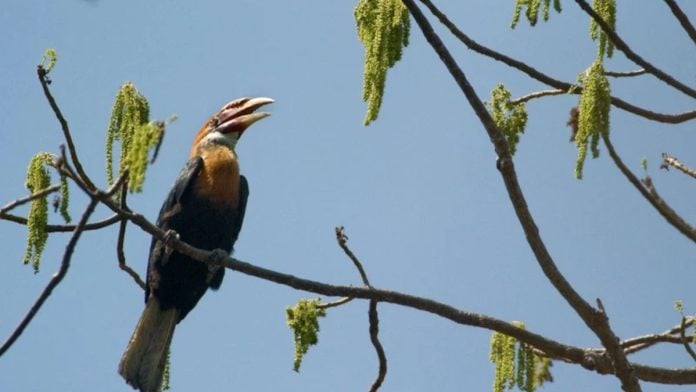
Further southeast, the Andaman and Nicobar Islands are home to about 25 endemic bird species. The Nicobar Bulbul is found on Kamorta Island in the Nicobar group — and nowhere else. The Narcondam Hornbill is found only on Narcondam Island, in the Andaman Sea, beyond the turbulent 10th Degree Channel. Landing on the island requires permission.
The Northeast, which often offers India new bird discoveries, is home to the much sought-after Bugun Liocichla, found in Arunachal Pradesh. It was described as a new species only as recently as 2006 and named after the local Bugun tribe. Perhaps several more endemic species remain hidden in India’s wilderness. We have yet to find them.
Also read: From Manipur to Somalia in 6 days — The extraordinary migration of Amur falcons
Endemics have nowhere else to go
Endemics are particularly vulnerable because they have nowhere else to turn when their habitats are threatened. The news these days tells us about raging forest fires, devastating floods, landslides and extreme weather events.
Urbanisation, too, has historically eaten into wilderness areas and open landscapes such as farmland. Now, we have both climate change and a new kind of urbanisation that prioritises immediate, tangible profits from land. Both mean we lose what makes a place uniquely special — much like losing an entire language.
The late Dr Madhav Gadgil faced widespread protests when he suggested keeping the entire Western Ghats intact as a survival mechanism.
Today, parts of the region have been nibbled away, while others have been severely fragmented. How can an endemic species continue to thrive when its limited habitat is broken up? As the richness of an ecosystem is steadily eroded, populations of endemic birds may no longer remain viable. Disease could threaten them, too.
It is also unclear how endemic species will cope with climate change, though some may be more vulnerable than others. Consider the Nicobar Megapode, an elusive, nervous bird that lives in the muddy coastal stretches between the ocean and sandy inland areas, and is found only on Great Nicobar Island.
Climate change will cause sea levels to rise here. It may only be a matter of time before the sea swallows up the bird’s habitat. Rising temperatures and heat stress could make survival even harder for the species. What next?
Several bird habitats are no longer suitable for the species they once supported. Scientists tell us of birds moving to higher altitudes in the warming Northeast. Where can an endemic species, bound to a territory, escape?
Protecting what makes a place unique
If the pyramids began dissolving, or the Trevi Fountain broke, it would make global headlines. Very few endemic birds can attract the same international attention.
Our conservation efforts have the skills to ensure that these birds never reach the brink of extinction — by proactively protecting the landscapes they depend on.
It is not about one bird, or even 80. It is a matter of our collective Indian moral compass and our age-old respect for sentient life.
Bharati Chaturvedi is an avid birder. She is the founder of the environmental non-profit organisation, Chintan India. She tweets at @Bharati09. Views are personal.
(Edited by Maryam Hassan)