


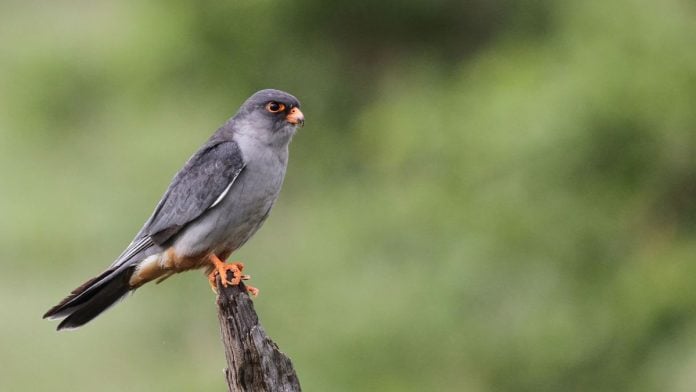
Manipur: When you read about Manipur, you’ll come across the conflict and maybe the fashion trends, but what you will likely miss is the best news from that state — a miracle of nature, the return of the Amur falcon.
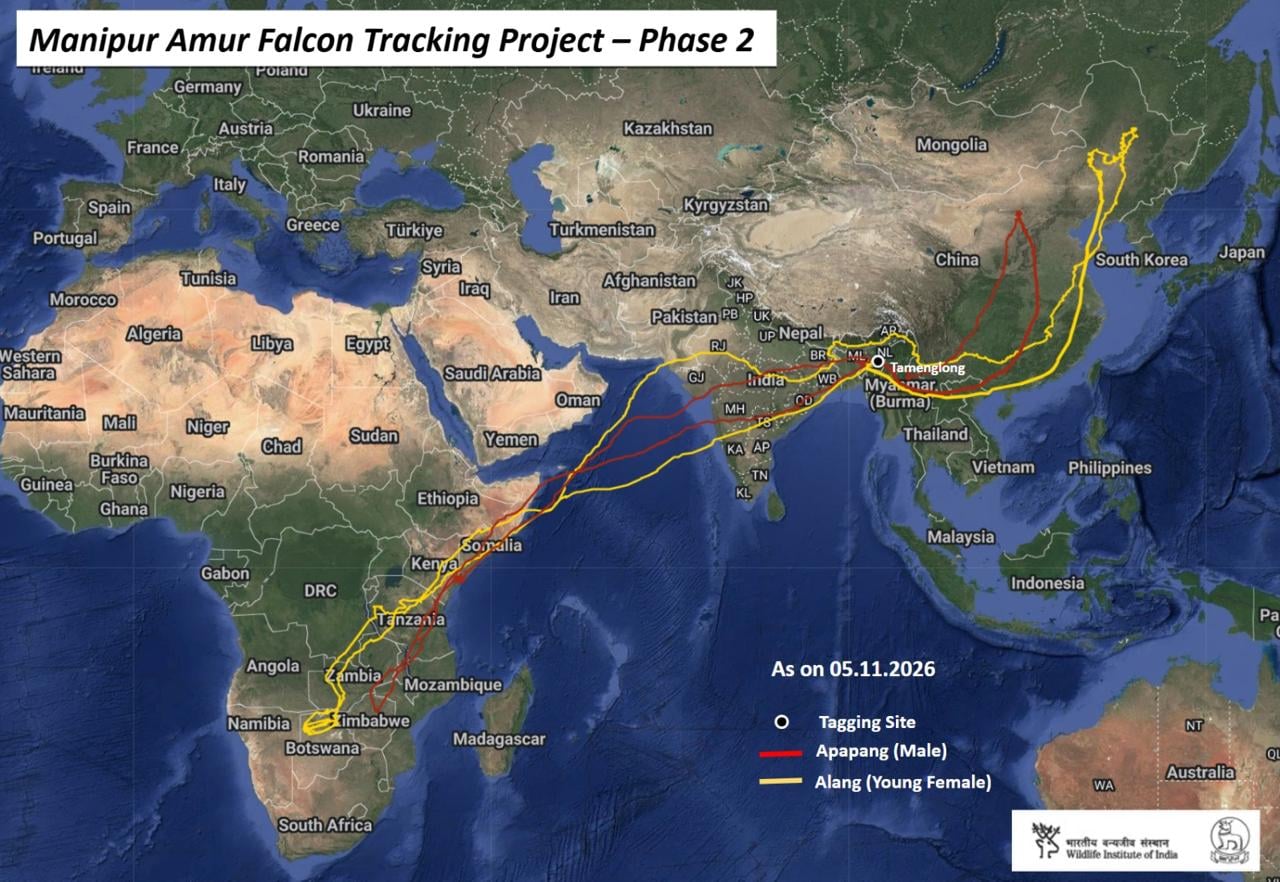
Last year, Dr Suresh Kumar, a senior scientist at the Wildlife Institute of India’s Department of Endangered Species Management, fixed transmitters on three Amur Falcons (Falco amurensis) in one of Manipur’s villages. Of the three, one ceased to function. The other two brought good news — the falcons, Apapang and Alang, have completed their annual migration safely, and returned to the very village in Manipur where Kumar and his team had tracked them last year.
“So what?” You might ask. “What’s the big deal?”
Here’s why their return is a miracle.
Amur Falcons are relatively small birds compared to other falcons, but they take the longest migration route of any bird of prey or raptor — at least 20,000 kilometers annually. Every year, starting with Mongolia, Eastern Siberia and North and East China, almost a million birds fly into India’s Northeastern states, Nagaland and Manipur, from mid-October till the first ten days of November.
During that period, in specific villages, everywhere you look, these small falcons, with their bright orange beaks, legs and talons, and grey bodies, look like fluffy fixtures, almost weighing down the branches of every tree around.
The birds have only one purpose — to get the protein they need to complete the rest of their mind-bogglingly arduous migration journey. They feast on a seasonal delicacy, winged termites that are abundantly found exactly during this season. Kumar’s research suggests it is this specific food that draws the birds to these villages, year after year. This is why the presence of Apapang and Alang in Manipur is a miracle.
A miraculous journey
They’ve completed a round trip of over 20,000 kilometres. From Manipur they would have travelled across India, shooting off the West coast, across the vast 3,000 kilometre surface of the Arabian Ocean. A break is impossible during this leg of the journey, for there is no place to land. Kumar explains that they took only 6 days to fly from Northeast India to Somalia. Think of a bird between 100 and 180 grams — the female is bigger — making this journey, year after year. And surviving to tell the tale.
Not all their ancestors managed this feat. Many were eaten up as they took their annual protein break in the Northeast. In October 2012, a mass Amur falcon massacre was uncovered in Nagaland. Locals were trapping over a lakh birds during their 2-weeks nutrition break. The trapped birds were then sold for their meat.
What ended the practice was a global outcry, governments that took notice, and citizens’ action — making this case probably one of the most extraordinary cases of mass behaviour change. Prominent local actors, NGOs and the state, all collaborated to speak to poachers and local citizens.
Banu Haralo, a well-known journalist and a member of the Nagaland Wildlife and Biodiversity Conservation Trust is one of the best-known voices that brought the issue to the centre stage and highlighted the importance of conserving the falcons. Along with her, the late Ramki Sreenivasan, co-founder of Conservation India, created a landmark film that grabbed global attention. He also compelled Indian birders to take heed of this tragedy with photographs and posts.
Scientist Shashank Dalvi, who has spent a significant amount of time studying bird life in the Northeast, documented how they were trapped. Kumar brought in scientific expertise. These and several others were able to collaborate with the state to transform the falcon’s story. From being easy food, the bird became a symbol of local pride, a welcome visitor. If you search YouTube, you will be delighted by the songs from Naga school children, welcoming the falcons. The Amur falcon meat market has now ceased to exist. To my mind, such a turnaround is hardly short of a small miracle.
Also read: Want Lakshmi’s blessings this Diwali? Don’t kill her ride, the owl
A harsh life
The life of an Amur Falcon is harsh — it rarely rests. Breeding in Mongolia, China and Russia is hard work. What happens to other birds who migrate and enter our land every season? Not every bird ends up in the meat market, but some find it hard to survive. The loss of habitat and a robust food base upends their entire universe in India. Urbanization, poorly imagined, is one of the more obvious culprits.
Wetlands are filled up for reclamation, so more condominiums can be built. The surface of the earth is concretized, leaving no space for insects to complete their life cycle. Urban vegetation is often landscaped with ecologically sterile botanicals.
Indians often explain their warm hospitality in three succinct words — Atithi Devo Bhava, the guest is god. That we can see an Amur Falcon today is because this welcome was extended to a bird by an entire community. As a country that shares its ecosystems with over 1,380 birds, we should extend such a welcome to all avian visitors. As an international power, destination, and a voice that is heard at the global high table, India must ensure that the birds flying in from other lands do not meet their end on our turf. Not an easy task, but our country has pulled off impossible projects — and we must pull off this one rapidly.
Bharati Chaturvedi is an avid birder. She is the founder of the environmental non-profit organisation, Chintan India. She tweets at @Bharati09. Views are personal.
(Edited by Janaki Pande)