







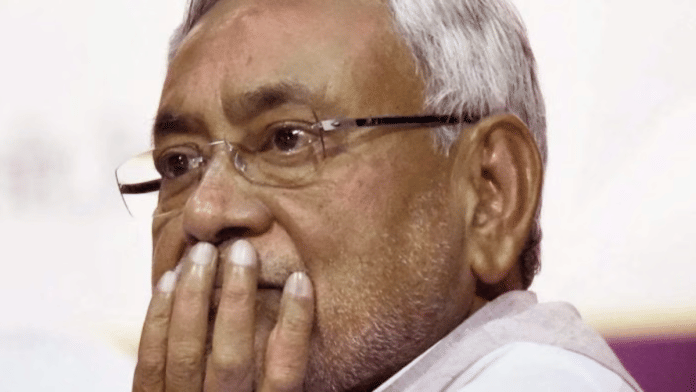



Nitish Kumar resigned from the Legislative Assembly after his Rajya Sabha confirmation, putting what appears to be a very early end to his latest tenure as the Chief Minister of Bihar. Among the many questions that this move raises, none is perhaps more consequential than the fate of the Mukhyamantri Mahila Rojgar Yojana (popularly known as the Dus Hazari scheme), which was rolled out in the run-up to the 2025 state Assembly elections.
The scheme promised, “along with initial transfer of Rs. 10,000 each, scope of additional financial support of up to Rs. 2 lakh subsequently.” Women voters’ turnout in the November elections hit a record high of 71.6 per cent. Recent estimates indicate that around 1.62 crore women received Rs. 10,000 through the scheme before they reached the polling booth. The National Democratic Alliance (NDA) was re-elected with 202 out of 243 seats.
The Janata Dal (United) (JDU) has been quick to point out that the BJP’s tactic of springing surprise appointments—seen in the selections of Chief Minister of UP Yogi Adityanath, Chief Minister of Madhya Pradesh Mohan Yadav, Chief Minister of Rajasthan Bhajanlal Sharma—will not work in Bihar. However, this observation only muddies the waters. The transfer had been delivered. The guarantor of the promise has left. What happens next?
Politics of succession
The coalition arithmetic that produced this outcome adds to our understanding of what’s to come. JD(U) went from 43 seats in 2020 to 85 in 2025. This is a recovery that appears, at first glance, to signal organisational consolidation, or even renewed voter confidence. But that collapse in 2020 was partly Lok Janshakti Party (Ram Vilas)’s (LsJP(RV)) Chirag Paswan’s doing. His campaign ran on “Modi se bair nahi, Nitish teri khair nahi,” and it did so with precision, fielding 143 candidates almost exclusively against JD(U).
The party won one seat, but it did bleed JD(U). By 2025, however, the terrain had shifted. With LJP(RV) contesting on the same side for the first time – and winning 19 of 29 seats – JD(U)’s recovery was built, quite substantially, on the removal of the very threat that had previously gutted it. This is the coalition Nitish Kumar is now leaving behind.
It is by no means an organic alliance, but a managed thaw between parties with a documented history of mutual damage, held in place by the BJP acting as the senior broker, sometimes mediator, sometimes enforcer. Chirag Paswan now holds 19 seats and, more importantly, a credible claim on the SC/ST constituencies where Dus Hazari had its highest measurable impact, with 47 per cent of SC/ST women citing it as the most impactful local scheme. The new CM, then, inherits a coalition whose internal incentives might not align around delivering the second instalment of Dus Hazari.
What Kumar leaves behind is not merely a political vacuum. It is a welfare architecture built on something more fragile – the fusion of one man’s credibility with an institution’s reach. That fusion is difficult to replicate once broken.
It is important to note here that the Dus Hazari scheme is being routed through the JEEViKA programme, which was launched in 2006 and expanded across all 534 blocks of Bihar’s 38 districts, reaching 1.23 crore families through over 10 lakh self-help groups (SHGs). JEEViKA acted as the funnel through which Rs 10,000 was distributed and through which the Rs 2 lakh must be verified and disbursed. The SHG network will assess how productively the first instalment of Dus Hazari was used, and upon a successful assessment, the Rs 2 lakh will be conferred upon the individual.
JEEViKA, however, is not a bureaucratic inheritance in the ordinary, transferable sense of the term. Its community pyramid runs from SHGs upward through Village Organisations (VOs) to Cluster Level Federations (CLFs), and it does so while being interlocked, at every level, with a parallel project pyramid of block, district, and state offices. The connective tissue here is relational, and therefore contingent.
The Area Coordinators and Community Coordinators operating at the block level derive their effectiveness from legitimacy with the JEEViKA didis. This legitimacy sedimented over the years under a specific political dispensation. This matters, perhaps more than anything else in the present moment, because the Rs 2 lakh disbursement sits precisely at the most vulnerable point in this entire architecture.
Enterprise assessment happens at the SHG level; verification moves upward through the VO; the CLF aggregates and filters; and the Bihar Rural Livelihoods Promotion Society (BRLPS) administers the final disbursement. Every layer requires field functionaries to exercise judgement about who qualifies, whose application is prioritised, who is deferred, and who is quietly excluded. That judgement isn’t a politically neutral one, and it’s now being exercised under a CM the network did not cultivate.
But Kumar’s move to Rajya Sabha, followed by talks of the BJP candidate inheriting the post, indicates that BJP might feel confident in cutting across the caste arithmetic and installing a leader who can evoke a similar response from the citizens of Bihar.
That said, Kumar’s portended exit also opens up space for the political opposition in Bihar to ensure that the post-Nitish Kumar dispensation delivers the second instalment of Dus Hazari. Indeed, it is this approach that defines Prashant Kishor’s post-defeat strategy. His Jan Suraaj party lost deposits in 235 of 238 seats, polling 3.4 per cent of the vote. The voters emphatically rejected his premise of governance-focused politics.
In his first significant public pronouncement after the defeat, Kishor stated that his party would collect signatures from one crore people across 40,000 villages and deliver them to the Governor and the Chief Minister if the government failed to disclose the steps taken to deliver the Rs 2 lakh scheme within a month. His recent, albeit failed, intervention in the Supreme Court, challenging the bona fides of the scheme, ostensibly delivered in violation of Model Code of Conduct regulations, can also be interpreted in this light.
Also read: MS Swaminathan’s unfinished dream for women farmers may finally see the light of day
Accountability after Nitish
From food-for-work programmes to rights-based entitlements to DBTs, Bihar has long been a laboratory for welfare innovation that gains a foothold nationally. Nitish Kumar’s model of turning welfare into a system of last-mile entitlements, as development economist Dipa Sinha puts it, became a template that other states have since imitated. What it may now presage is an accountability problem: what happens when there’s a promise made by an alliance, credit is associated with one individual, and delivery depends on an infrastructure whose architect has switched floors?
Nitish Kumar’s move to the Rajya Sabha does more than create a political vacuum – it severs a specific accountability relationship that the election was supposed to cement. Vertical accountability can be understood as the mechanism by which voters hold politicians responsible through the ballot. This was exercised as designed in Bihar. Women voted, the NDA won, and Kumar was the face of that mandate. But the Rajya Sabha is Kumar’s way of stepping outside the circuit through which Bihar’s women could have held him to the Rs 2 lakh promise.
The JEEViKA network, through which enterprise assessment, verification, and disbursement must flow, requires a sense of discretionary, relational judgement that Yamini Aiyar and Michael Walton call thick accountability.
Thin accountability, on the other hand, can survive a change in leadership as it concerns itself with specific, verifiable outcomes such as pension payments. Thick accountability, which turns on field-level trust, institutional legitimacy, and the alignment between political commitment and bureaucratic incentive, is far more fragile.
Bihar’s women, however, are cognisant of the difference between a transfer received and a promise made. One recipient of the first instalment asked, “Rs. 10,000 is nothing. What will you do with Rs. 10,000?” And now, with the likes of Prashant Kishor keeping the spotlight on the government’s Rs 2 lakh promise, they will certainly be paying close attention to whether their bets on Nitish Kumar paid off.
Subhasish Ray is Professor and Associate Dean of Research at the Jindal School of Government & Public Policy, O.P. Jindal Global University, Haryana; and an editor for the Journal of Genocide Research. He tweets @subhasish_ray75. Kalyani R. Janakiraman is pursuing a MA in Diplomacy, Business, and Law at the Jindal School of International Affairs, O.P. Jindal Global University, Haryana; and an editorial intern for the Journal of Genocide Research. Views are personal.
(Edited by Ratan Priya)
After twenty years in office, CM Nitish Kumar leaves Bihar with a per capita income of less than $ 900. Seriously never PM material.