


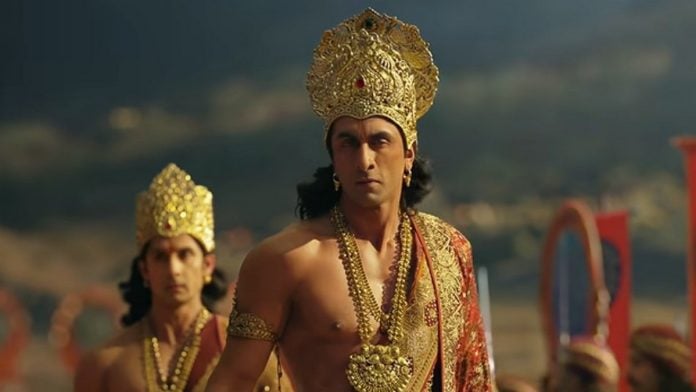
Nitesh Tiwari’s magnum opus Ramayana: Part 1 is the ultimate love story. I watched it in a packed theatre on Day 3, smiling and weeping simultaneously. It was that sweet and romantic. The response to the movie at the end of three long hours was significant: silence.
Throughout the screening, nobody clapped and cheered. No taalis. No seetis. No gaalis. Just a thoughtful, respectful response from an audience that was clearly moved. And perhaps, a little confused, too.
Like I was. This was not a dhoom dhadaka ‘‘mytho’’ cashing in on melodrama and spectacle. Instead, the route taken by Tiwari was introspective… and disruptive. So many tired preconceived ideas about a well-loved, timeless saga were gently cast aside, by a director who dared to go well beyond a familiar narrative, known through generations. He opted for an iconoclastic approach to a subject we think we understand “by heart’’. This needs guts and high intelligence. Every moviemaker is ambitious. That’s a given. But when ambition translates into an interpretation that challenges conventional wisdom… oh yes, it’s time to sit up and say, “Wah bhai, Wah!’’
Tiwari wisely chose to focus on love. Love as Dharma. Dharma as love. Everything else follows. Tiwari’s Ramayana is not a tale about revenge, exile, rivalry, and redemption. It is about the complexity of human nature. Ram himself is conflicted in this version. Lord Ram — the “Maryada Purushottam (Idealised Man)”, with all his nobility, sense of duty and honour — still comes across as ‘everyman’, striving to do the correct thing, make the right decisions, be loyal and faithful to his vows…but also, remain true to his feelings.
Nothing over the top
Sensibly, the dialogues are sparse and spoken conversationally. There is no ‘dialoguebaazi’. Ram and Sita express their love through tiny gestures and glances, with a tenderness that leaves the audience with moist eyes. There are no big declarations of eternal bliss. Instead, the transition from being strangers in a grand palace to a banished couple wandering through dense forests is shown without exaggerated flourish — Rama bringing hand-picked flowers to adorn his wife’s hair, or Sita unselfconsciously expressing jealousy when she senses temptress Suparankha’s attraction to her husband.
Ramayana is good cinema. Given the sweep of Valmiki’s epic, Tiwari’s main job was to chisel away and arrive at the core. He succeeds brilliantly. It’s foolish to compare Tiwari’s version to the multiple explorations of Ramayana over the years. This is 2026. Gen Z has no idea about Doordarshan or Ramanand Sagar — zero! If at all they decide to watch Tiwari’s movie, it will be with untrained, unfiltered uninformed fresh eyes. What will their takeaway be? I think they will approve of this Ram — a man in tune with his decisions and destiny. Not a wimp. Not a victim. Not weak. But someone with extraordinary empathy and intuition, who accepts the power of fate and chooses not to fight it.
Tiwari’s Ram is philosophical, calm, and sure. As is Sita, a wife who chooses to abandon the luxuries of a royal life to stay by her husband’s side and face the consequences. Tiwari’s Sita is a strong, self-willed woman, a warrior, not a martyr or a self-suffering ‘bichari’. Together, they form a formidable team, with a tempestuous, fiercely devoted Laxman by their side.
Also read: From Dadasaheb Phalke to Nitesh Tiwari–How the Ramayana has been retold on screen
A break from convention
Tiwari’s Ravana is a tour de force. It is such an inspired take on a character frequently misrepresented as a brutal ten–headed monster in popular culture. Tiwari audaciously chooses to open the film with Ravana, not Ram. Again, what an unconventional cinematic choice — bravo! His Ravana is a cerebral, cultured, strategist looking for victory. Proud of his lineage and his people. His faith and knowledge of the scriptures, gives him an unlikely edge over his adversaries. As a fearless warrior, Ravana has no equal. Tiwari’s biggest and most daring gamble is in projecting Ravana as the epic’s parallel hero — worthy of admiration — not a despised villain. This is huge. And exceptionally courageous. Ram and Ravana are placed on a level-playing field — equally great, equally inspiring, equally heroic. What a delicious break from convention. And Sita? In Tiwari’s version of the abduction Sita is converted into a bargaining chip in a fierce territorial battle between two kings.
This is what makes the current Ramayana so compelling. Mythology encourages debate. There is no single version of the Ramayana… it belongs to all of us. Tiwari urges audiences to identify their own ‘Laxman Rekha’ — what are the boundaries we set for ourselves when the test comes — as it inevitably does. Can subterfuge and deception be excused if both are employed to serve a larger good? What about the ‘shakti vs bhakti’’ conversation? Haven’t we all dealt with it in our lives? When does the moral compass shift and lead to compromise? How is divinity defined and by whom? Sages here on Earth or Gods in heaven? What happens when we fail to acknowledge the divine residing within us? Tiwari provides no answers. But he does raise questions — obliquely, not obviously.
Ramayana: Part I is mesmerising. I plan to watch it again to rediscover my favourite moments and stumble upon a few surprise nuggets I missed. Tiwari’s movie is not a perfect film. Which is its biggest strength. It isn’t a masterpiece, either. There are countless jarring elements which jump out and make you groan. But that’s also a big part of the film’s success. It encourages you to rethink your version of the epic. Forget religion. Forget Hindutva. Forget propaganda. Forget politics. Watch it as a pure cinematic experience mounted on a magnificent scale. Then come away singing the Hanuman Chalisa, composed by AR Rahman and melodiously sung by Diljit Dosanjh, along with four others. It’s still playing in my head.
Shobhaa De is an author, columnist, social commentator, and opinion-shaper. She has written 20 books. She tweets @DeShobhaa. Views are personal.
(Edited by Aamaan Alam Khan)