


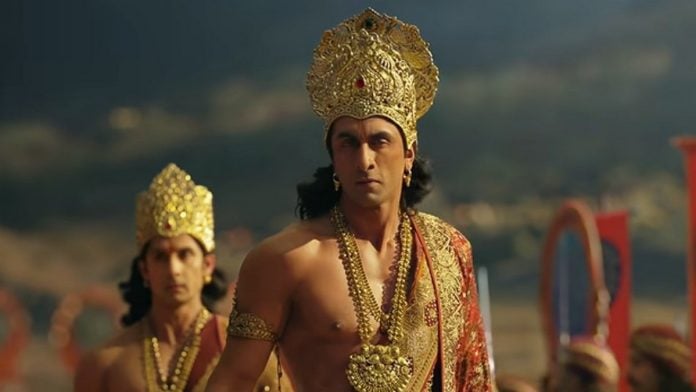
New Delhi: The Ramayana has been staged, televised, animated, reimagined and even retold through artificial intelligence. Across centuries, the epic has travelled through languages including Sanskrit, Awadhi and Tamil, as well as Thai, Indonesian, Japanese and Tibetan. Now, with Namit Malhotra’s Ramayana: Rise of a Legend, the epic is getting its biggest VFX-driven cinematic treatment yet.
Namit Malhotra’s Ramayana brings together stars from different film industries, with Ranbir Kapoor as Ram, Sai Pallavi as Sita and Yash as Ravana. With a reported budget of nearly Rs 4,000 crore for its two parts, it is the most expensive adaptation of the epic yet. The film also has global ambitions, with Sony Pictures associated with its worldwide release, and has reportedly crossed Rs 115 crore in worldwide collections on its opening day.
Yet, the appeal of the Ramayana goes beyond how many times it has been retold or how its narrative has evolved across formats and generations. Indian audiences continue to return to the epic, even when they know its story and every major turn in it. Its appeal goes beyond cinema and theatre; the story of Ram and Sita has travelled through generations, passed down orally long before it found its way onto screens and stages.
From silent cinema to modern-day blockbusters
Ramayana’s cinematic journey began nearly a century ago, in the black-and-white era, with Dadasaheb Phalke’s Lanka Dahan (1917), his second feature film. At a time when women were not allowed to work in cinema, both Ram and Sita were played by Anna Salunke.
This was followed by Seeta (1934), starring Prithviraj Kapoor as Ram, and Vijay Bhatt’s Ram Rajya, which became a box-office hit. It is also said to be the only film Mahatma Gandhi watched in a theatre. He was reportedly supposed to watch 40 minutes but stayed for 90. More adaptations followed, including Babubhai Mistry’s Sampoorna Ramayan, which used special effects to depict the powers of the gods.
The next major cinematic reinterpretation came much later. Mani Ratnam offered another reinterpretation of the Ramayana with Raavan (2010), placing Ravana at the centre of the narrative. The film drew from the Ashok Vatika episode, reimagining the abduction of Sita through a story in which an antagonist kidnaps a hero’s wife, prompting her morally upright husband to embark on a journey to rescue her. Starring Abhishek Bachchan, Aishwarya Rai Bachchan and Vikram, the film collected nearly Rs 50 crore at the box office.
A more direct cinematic adaptation followed with Adipurush. The film failed both critically and commercially, despite its ambition to bring different cultures and religions together through its casting and interpretation. It featured Prabhas as Ram and Saif Ali Khan as Ravana. Its extensive use of VFX and creative choices, however, became points of criticism.
Now comes Namit Malhotra’s Ramayana. More than just another retelling, it is being presented as a spectacle, with greater emphasis on action, VFX and the task of bringing the creatures and larger-than-life elements of the ancient epic to the screen. It also marks a shift in the casting of Ram. Ranbir Kapoor brings the profile of a mainstream Bollywood superstar to the role, unlike earlier television adaptations in which actors became closely identified with their portrayal of the character. The film also has pan-Indian and global ambitions, taking the Ramayana beyond the boundaries of Indian cinema.
Television made Ramayana a household experience
While cinematic adaptations of the Ramayana have often faced controversies and debates, its television adaptations have enjoyed a different relationship with audiences. It all began with Ramanand Sagar’s Ramayan in 1987, a 79-episode series, with each episode running for nearly 45 minutes on Doordarshan, giving the epic almost 60 hours of screen time, far more than a three-hour feature film could offer.
Sagar cast Arun Govil as Ram, Deepika Chikhalia as Sita and Sunil Lahri as Lakshman. None of them were established A-list Bollywood stars, but their association with these characters became so strong that audiences continued to identify them with Ram, Sita and Lakshman for decades.
Interestingly, Govil is now playing Dashrath in the new Ramayana.
The series covered the epic from Ram’s early life in Ayodhya, his marriage to Sita, the 14-year exile, the abduction of Sita and the battle against Ravana. Despite its limited production technology, it used computer graphics to bring divine powers and battles to the screen. Some effects, such as the familiar neon-like graphics when two arrows collided, were repeated across several battle sequences. Yet, the series became a cultural phenomenon, changing how Indians watched and experienced the epic. Its popularity was evident again when it was retelecast during the Covid lockdown in 2020. On 16 April, it drew 77 million viewers, becoming the most-watched entertainment programme globally at the time.
In 2008, another television adaptation arrived, produced by Sagar Arts and often seen as a reboot of Ramanand Sagar’s version, on NDTV Imagine. Starring Gurmeet Choudhary as Ram and Debina Bonnerjee as Sita, it brought improved graphics, cameras, sets and production values. Unlike the original, which had become a cultural event through its simplicity and devotional appeal, the newer version leaned towards a more polished television presentation, with greater emphasis on drama and visual effects. However, despite its technical improvements, it could not recreate the cultural impact or the emotional connection that Ramanand Sagar’s Ramayan had established.
In the same year, another retelling of the epic arrived in the form of the 105-episode series Raavan on Zee TV, which shifted the focus from Ram to Ravana. Played by Narendra Jha, the series presented a humanised version of the Asura, tracing his journey from birth and exploring his personal relationships, ambitions and conflicts to show how he eventually became the antagonist.
Animation, AI and the epic beyond the screen
Another notable adaptation was the Japanese-Indian collaboration Ramayana: The Legend of Prince Rama, directed and produced by Yugo Sako. The North American English version featured Breaking Bad actor Bryan Cranston voicing Ram. Unlike many live-action adaptations, the animated film stayed close to the original story, presenting Ram as a prince whose journey was defined not just by his archery skills but also by his humanity, kindness and wisdom. Its visuals retained an Indian and ancient aesthetic, while its action never overshadowed Ram’s identity as Maryada Purushottam. The film eventually became a source of nostalgia for generations of viewers and remains one of the most widely cherished animated interpretations of the epic.
With evolving technology, the epic has now entered the AI era, with projects such as Ramayana: Path of Dharma and Rama: The Path to Dharma offering AI-generated retellings. These films have not received theatrical or OTT releases and are instead available through their production houses’ websites and social media pages.
The epic has also lived beyond cinema and television through Ramlila, a folk-theatre tradition that recreates episodes from the epic, particularly during the Dussehra period. Performances were staged by ordinary villagers and local folk artists, supported by small community organisations known as Ramlila Samitis. Over time, the tradition has evolved, with trained performers and established actors also taking to the stage. Bhojpuri actors such as Ravi Kishan and Manoj Tiwari have played Ram in these productions.
Contemporary theatre has also moved beyond conventional retellings. In Gaurav Bhardwaj’s Humare Ram, Ashutosh Rana plays Ravana, portraying him not merely as an evil figure but as a learned scholar of the Shastras and a devoted follower of Lord Shiva.
(Edited By Raunaq Lekhi)