








Who is a farmer? The person in whose name land is registered in revenue records, or the one who actually engages in agricultural production?
This was precisely the question raised by India’s most well-known agricultural scientist, Dr MS Swaminathan, in 2011 when he introduced the Women Farmers’ Entitlement Bill in the Rajya Sabha. The Bill proposed a comprehensive, gender-neutral definition of ‘farmer’ that included landless workers, sharecroppers, tenant farmers, fisherfolk, livestock rearers, and pastoralists, shifting the axis from ‘those who hold the land’ to those who ‘engage in agricultural livelihoods’. The Bill, however, was allowed to lapse.
Fortuitously, sixteen years later, as the UN and FAO have declared 2026 the International Year of the Woman Farmer, a Bill on similar lines has been introduced in the Rajya Sabha.
The National Commission for the Entitlements and Welfare of Women Farmers Bill, 2026, tabled on 13 March, seeks to establish a national commission to secure the rights and entitlements of women farmers.
Also Read: MSP under Shastri began as a crisis response. Now India must ask what role it should play today
Green Revolution’s blind spot
Dr Swaminathan went on to receive the Bharat Ratna in 2024, and last year his comprehensive biography, The Man who Fed India, by his niece Priyambada Jayakumar, renewed attention on his life and work as the progenitor of the Green Revolution in India.
Two quotes from this book help set the context of the times and relate, even if tangentially, to his later concern about the exclusion of women farmers.
The first tells us about his foray into plant genetics.
“He was a product of his times; he was a product of history. He was preparing to be a doctor, but it was history that forced him to change and jump in to become an agricultural scientist because of the Bengal famine after finishing two years of medical studies. That was history part one. He had gotten a job under the then Federal Public Service Commission because his family felt that agriculture was going nowhere in India. So, they wanted him to have something more respectable. He sits for the exam, gets selected as an Indian Police Service officer and is asked to report to Mount Abu immediately. Around the same time, he gets a UNESCO fellowship to study plant genetics at the Wageningen Agricultural University in Holland.”
The second quote is about the political economy of the Green Revolution (GR)when it was starting out in the mid-sixties.
“On 9 June 1964, C Subramaniam received a call at 10 pm from Lal Bahadur Shastri who had just taken over as Prime Minister. Shastri wanted Subramaniam to take over the decidedly less-glamorous Agriculture and Food ministries! This move clearly flummoxed Subramaniam because he considered himself a highly successful Steel Minister! Shastri had found absolutely no takers for the Ministries of Agriculture and Food and was heavily banking on the eminently qualified Subramaniam to bail him out of a tight corner. Shastri’s faith in Subramaniam as Minister of Agriculture and Food was not misplaced as history would prove. Both Shastri and Subramaniam were firm believers in the Nehruvian tradition of the future belonging to science. Subramaniam crucially recruited B. Sivaraman, a brilliant civil servant who had vast field experience in agriculture and irrigation in Orissa, as his agriculture secretary in May 1965 (much against Biju Patnaik’s wishes who wasn’t willing to let him go!).”
It was this trio of the Ss—MS Swaminathan the scientist, C Subramaniam the politician and Minister of Agriculture, and B Sivaraman the civil servant (incidentally all from Tamil Nadu)—who put together a plan that would turn India’s fate from that of a begging bowl to a bread basket and from abject scarcity to one of abundance.
However, the point to note about his life is that he did not rest content with the acclaim and the abundant laurels he received. Within the first decade of the Green Revolution itself, he saw its limitations and was concerned with the negative externalities—the rising salinity, the declining water table, and, most importantly, the marginalisation of women in agriculture.
He saw men moving out of agriculture to supplement family incomes as farming lost ground to manufacturing and services, both in terms of trade and share in GDP. He wanted to address these issues in the Women Farmers’ Entitlement Bill. However, that was not to be, and the Bill was allowed to lapse.
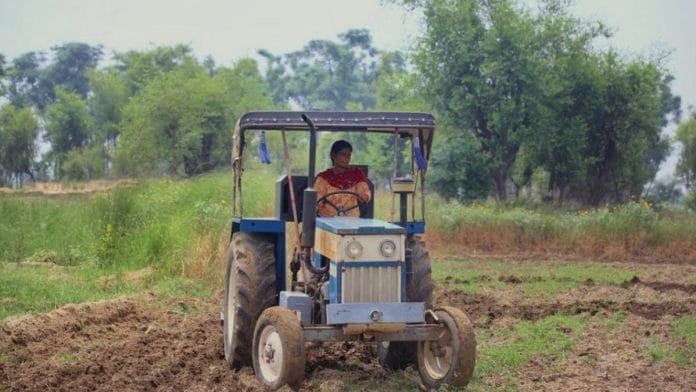
Nine years later, in 2020, an ICAR study reported the increasing salience of women in agriculture: 75 per cent in crop production, 79 per cent in horticulture, 51 per cent in post-harvest operations, and 95 per cent in animal husbandry and fisheries.
Women performed the largest share of agricultural work but were not recognised as farmers in law because their names did not figure in land ownership, restricting their access to institutional resources—Kisan Credit Cards to membership of co-operatives and food producer organisations. The report showed that only 13.9% of agricultural land was in women’s names due to patrilineal inheritance, social norms, limited legal awareness, and administrative hurdles.
Also Read: The real White Revolution—Shastri’s NDDB built a farmers-first economy that still works
What the new Bill does
These issues are now being addressed by the new Bill, which will also help India achieve three SDG goals — zero poverty, zero hunger, and gender equality. Drafting this new legislation was relatively easy, for the template was ready.
Some of the important provisions in the National Commission for the Entitlements and Welfare of Women Farmers Bill 2026 include the delinking of land ownership from the definition of a farmer.
Now, a certificate issued by the Gram Panchayat will be sufficient to access the benefits to which a farmer will be entitled. A “farmer” shall include not only agricultural operational holders, but also landless cultivators, agricultural labourers, plantation labourers, pastoralists, sharecroppers, and tenants. In case of a landless farmer migrating or moving from one state to another, the farmer may be registered in the state of his karmabhoomi.
This also opens up a new vista for migrant women farm workers. The Bill clarifies that the term “woman farmer” is not bound by marital status or ownership of land. Instead, it means “any woman who undertakes cultivation in her own land or land owned by her husband or a family member or land owned by any other person on a sharing basis or on lease.”
The Commission will also be tasked with the annual identification and survey of women farmers, including different types of crops and landholdings. This will help in documenting the number of women farmers in each state, currently “without legal rights and entitlements on agricultural land”, and ensure that “every woman shall have equal ownership and inheritance rights over her spouse’s self-acquired agricultural land, or his share of family property”.
Most significantly, the Commission shall ensure that every woman farmer who has a certificate from the appropriate authority shall be entitled to a Kisan Credit Card. This is certainly likely to increase the number of beneficiaries under the PM Kisan Samman Nidhi, but the current asymmetry in numbers of men and women farmers will be addressed. As of now, of the 9.35 crore eligible farmers, only 2.15 crore are women. It will certainly add to the outlay for the scheme, but will address the issue of equity, dignity, and financial security of women farmers. The Commission will also monitor women farmers’ access to credit, insurance, technology, and markets, and inquire into violations of their rights and entitlements.
Meanwhile, it may also be mentioned that on 11 March, Maharashtra Deputy Chief Minister Sunetra Ajit Pawar announced that a Special Bill for women farmers will be introduced in the next Assembly session to secure their rights and dignity. The Bill aims to resolve land record issues by tracking gender-disaggregated data, alongside initiatives such as drone pilot training and the use of AI in farming. The government plans to replicate Pune’s successful 75 per cent subsidy model for women’s drone purchases across the state, with 30 per cent of all agricultural scheme benefits now reserved for women.
Thus, it appears that finally, in the International Year of the Woman Farmer, Swaminathan’s vision may see the light of day.
Sanjeev Chopra is a former IAS officer and Festival Director of Valley of Words. Until recently, he was director, Lal Bahadur Shastri National Academy of Administration. He tweets @ChopraSanjeev. Views are personal.
(Edited by Asavari Singh)