






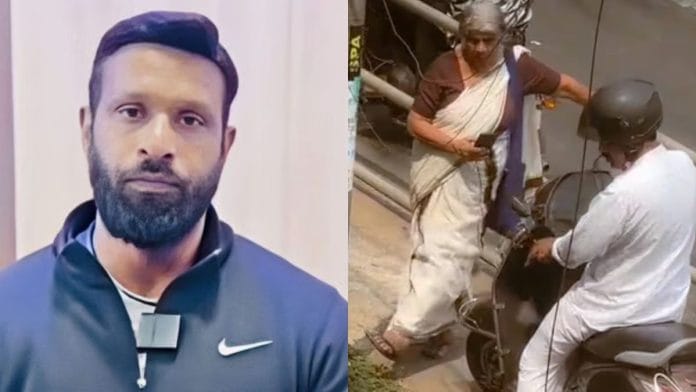



When Deepak ‘Akki’ Kumar sprang to the defence of an old shopkeeper in Kotdwar, Uttarakhand, he didn’t know he had taken a hammer to a pane of glass. It took five words—“Mera naam Mohammad Deepak Hai”— from the 42-year-old gym owner, in one of the most communally charged states in India, for a hairline fracture to slowly spread across the surface. That surface is the seasoned understanding that individual courage has no place in our society.
Two and a half weeks later, 2,500 kilometres south of Uttarakhand in Kozhikode, Kerala, Prabhavathi Amma dealt another hammer blow. She planted her feet on a footpath at the busy Eranjipaalam signal and refused to give way to a scooter rider trying to bypass traffic.
To understand why ‘Mohammad’ Deepak has captured our imagination, we have to understand what his courage cost. His fitness centre, Hulk Gym, is close to Vakeel Ahmed’s “Baba School Dress”, a shop that the 70-year-old Muslim man has operated for 30 years. On 26 January, a mob of 30-40 men claiming to be from Bajrang Dal descended at the shop, demanding that Ahmed change its name. “Baba”, they argued, was a Hindu religious term and it was presumably inimical for a Muslim man to use it.
Deepak intervened and told the aggressive crowd that everyone had a right to be treated equally in India. When they asked for his name, he anticipated the turn the confrontation was taking, and painted himself into posterity by announcing his name was Mohammed Deepak. In the process, however, he assumed the target which was painted on the Muslim shopkeeper’s back.
As has now become routine with such incidents, an FIR was lodged against Kumar. Cases have also been filed against “unidentified” men from the mob. Within days, a violent group showed up outside Kumar’s gym too and attempted to vandalise it. Thanks to the violence, the gym’s membership dwindled from 150 to 12. Female members, already nervous about the police barricades and the shouting protesters camping outside, disappeared entirely.
Death threats have come in from the Hindu Raksha Dal who called Kumar a “secular keeda” or secular insect, the kindest label among other unmentionable things. Meanwhile Bihar Police has arrested Utkarsh Singh, a man who had announced a Rs 2 lakh bounty for his murder on social media. It’s clear that these bodies wish to make an example of him—but the example he has already set is something else entirely.
Despite these expected reactions, Kumar broke something in the algorithm. It started with an outpouring of social media support for the man. John Brittas, Rajya Sabha MP from CPI(M) flew to Kotdwar and bought an annual gym membership—because Kumar refused donations and charity. Fifteen Supreme Court lawyers followed suit and bought memberships for local youth who couldn’t afford them. Several of them have also promised pro bono legal aid. It all led Rahul Gandhi to say: “We need more Deepaks, who won’t bow down, be afraid, and defend the Constitution… You’re a babbar sher.”
Prabhavathi Amma’s story has had a different trajectory, but is no less heartwarming. In the past, the 73-year-old had filed multiple complaints about riders using the Eranjipaalam footpath to dodge traffic. When the authorities did nothing, she became the enforcer. Her face-off with the scooter, captured by a social media influencer, finally caught the attention of Kerala’s Motor Vehicles Department. The body honoured her at her home with a ponnada, a shawl, and stripped the rider of his license. In the process, they validated the lesson Amma was trying to teach in the first place: The footpath belongs to pedestrians—someone just had to insist on it.
Also read: The idea of India rests on ‘traitors’ like Uttarakhand’s Mohammed Deepak
A refusal to accept status quo
Kumar and Amma remain the exceptions, which is exactly why they matter. In a country where collective complacency has calcified into a survival strategy, watching someone say “no” feels radical. They’ve inverted the “bystander effect”, while the rest of us have gawked on. As onlookers, we’re captivated because we’ve forgotten this was even possible.
Years of competitive displays of bigotry, parochialism, and lack of civic sense have congealed into an acceptance of the status quo. We’ve been lulled into believing that a concave point of view is safest: Turning inward, staying defensive, and not making a fuss.
The national discourse has trained us to obsess over enemies at the gates, while violations within our borders go unchallenged. Hating on Pakistan takes less courage than reclaiming a footpath. Filing an FIR against “unidentified men” is easier than naming the mob at your door. Our helplessness and desire for psychological safety has been weaponised against us. So we wear our cynicism as a badge of realism.
But every once in a while, a 73-year-old woman will rail against haplessness and kick up a fuss. A gym owner and his friend will stand up to rowdies. And if we are lucky, their courage will have a witness. That will make all the difference between what fades away and what causes a rupture. In watching someone’s stubbornness broadcast to us, we will be forced to reckon with our own capitulation.
The pattern appears in fragments elsewhere. The delivery worker who risked his life and dove into a water-filled construction pit to save a young software engineer, when no one else would. A band of local people who rallied to vouch for a poor Muslim food vendor, harassed by clout-chasing, ghoulish YouTubers. A spirited bunch that chased away a gang of Bajrang Dal members, armed with sticks, determined to harass couples celebrating Valentine’s Day. Small acts of big bravery—briefly viral, then forgotten—that share the same stubborn DNA: A refusal to accept that this is just how things are.
But a little bit of foolhardiness, it turns out, is essential for living. One person’s pig-headedness can turn into a contagion of possibility. In an uneasy country, radical hope is the last seditious act.
Karanjeet Kaur is a journalist, former editor of Arré, and a partner at TWO Design. She tweets @Kaju_Katri. Views are personal.
(Edited by Theres Sudeep)
What a bullshit opinion
Madam Karanjeet Kaur, Thank you for such articles covering the stories of our present day heroes. Please keep going with such encouraging articles.